Wednesday, 26 June 2019

How to Become a Better Writer: 14 Tips to Up Your Writing Game in 2019

If you search Google for tips on how to become a better writer, you’ll find a lot of big promises.

Here’s the truth:

There’s no tip, trick, strategy, or hack capable of turning a bad writer into a good one.

But if you’re looking to improve your writing skills by 5%, if you want to go from average to good or even good to great, a valuable tip can help make it happen.

Here are fourteen such tips:

1. Find Your Unique Voice

Serious question:

If we all listen to the same experts and we all follow the same advice, how is it possible for anyone to stand out from the crowd?

The trap many of us fall into is we believe if we mimic a popular blogger or writer, we’ll be popular too.

Imitation is indeed the sincerest form of flattery, but it’s a no-win proposition. Even if you succeed, you’ll be indistinguishable from all the other parrots out there.

There’s only one you. You have unique DNA. Your hopes, thoughts, and dreams are unique. Even the face you make when you accidentally walk into a spider web is unique.

Want to stand out?

When you sit down to write, tap into what makes you… well, you.

Learn More: In my guest appearance on the Biz Mavens’ podcast, I discuss the importance of finding your unique voice and offer three exercises to help you find it.

2. Edit Like Crazy

7 Editing Tips That’ll Make You a Better Writer (with Examples!)Many first drafts are clumsy, sloppy, and difficult to read. This is true for most writers — even experienced, well-known ones.

So what separates our writing heroes from the masses?

Editing.

The hard part isn’t over once your first draft is complete; on the contrary, it’s only beginning.

To take your work to the next level, you need to spend just as much time editing your words as you do creating them.

It’s ruthless work. It’s kind of boring. But it’s vital.

Learn More: 7 Editing Tips That’ll Make You a Better Writer (with Examples!) will show you the editing secrets popular bloggers and writers don’t want you to know.

3. Supercharge Your Subheads

Weak WritingMost readers stick around for fewer than 15 seconds.

Heck, most will stick around for fewer than 5 seconds.

Why? Because readers are experts at scanning. They’ll click your headline, quickly scan your content, and — in only a few seconds — decide whether to stay or go.

Writing a great introduction is one way to convince readers to stick.

Another?

Write masterful subheads that create curiosity, hook your readers, and keep them on the page long enough to realize your content is worth reading.

Learn More: In The Ultimate Guide to Writing Irresistible Subheads, Gary Korisko shares the four ingredients of a killer subhead.

4. Write Like Superman (Or That Guy You Know Who Types Really Fast)

WP Super Cache Made Easy: A Step-By-Step Guide to Speeding Up Your SiteMost of us are limited in the amount of time we have available to write.

So, if you want more time to write every day, you only have three options:

  1. Say goodbye to your family and lock yourself in your office;
  2. Invent a time machine;
  3. Learn how to write faster.

Your spouse and children won’t like the first option, and the second option requires plutonium.

But the third option? That’s doable.

Learn More: Want some actionable tactics to boost your writing speed? Check out Linda Formichelli’s How to Write Faster: 10 Crafty Ways to Hit 1,000 Words Per Hour.

5. Craft Irresistible Headlines

10 Ways to Exploit Human Nature and Write Amazingly Appealing HeadlinesSmart Blogger’s CEO, Jon Morrow, recommends spending at least 20% of your time on the headline for your content.

That isn’t a typo.

If you spend 10 to 20 hours writing an article, 2 to 4 of those hours should be spent on the headline.

Why so many?

Because if your headline sucks, no one is going to give your content a chance.

In short:

Headlines are important. Get good at writing them.

Learn More: In How to Write a Blog Post in 2019: The Ultimate Guide, Liz Longacre goes over the 8 rules for crafting amazing headlines. And in 10 Ways to Exploit Human Nature and Write Amazingly Appealing Headlines Robert van Tongeren shares tips for writing irresistibly-clickable headlines.

6. Avoid Weak Words

25 Writing Exercises That’ll Give Your Content More Punch and PowerToo many writers dilute their writing with weak, empty words that bring nothing to the table.

Worse?

They silently erode your reader’s attention — one flabby word at a time.

Spot these words and eliminate them from your writing.

Learn More: In 297 Flabby Words and Phrases That Rob Your Writing of All Its Power, Shane Authur shows you how to tone and trim your prose.

7. Write with Rhythm

31+ Writing Podcasts You've GOT to Hear (Best of the Best)You know short paragraphs and white space are your friends.

But that doesn’t mean every paragraph you write should be short.

Too many short paragraphs in a row and your writing will bore your readers. Too many long paragraphs in a row and you’ll overwhelm them.

So, mix things up.

Let the rhythm of your words dictate when each paragraph begins, and you’ll strike up the perfect balance between short paragraphs and long.

Learn More: In How to Write a Paragraph in 2019 (Yes, the Rules Have Changed), Mike Blankenship looks at why variation is important and offers a few rules of thumb to follow.

8. Kick Writer’s Block in the Buttocks

When you’ve been staring at a blank page for what feels like hours, writer’s block can seem insurmountable.

It’s not.

Savvy writers have a collection of tried-and-true techniques to bust out whenever writer’s block starts to rear its ugly head — techniques ranging from brisk walks to asking Alexa to play “I’m Gonna Be (500 Miles)” by The Proclaimers.

If you want to be a better writer, find a writer’s block technique or two that works for you.

Learn More: Henneke Duistermaat has 27 refreshingly-original writer’s block techniques you can try. Pick a few favorites, and don’t be afraid to break glass in case of emergency.

9. Make Your Words Burst to Life in Readers’ Minds

600+ Power Words That’ll Pack Your Writing with EmotionIf you aren’t using power words or sensory language in your writing, you’re missing out.

Smart writers and copywriters use power words to give their content extra punch, personality, and pizzazz. And great writers from Shakespeare to Stephen King use sensory words evoking sight, sound, touch, taste, and smell to paint strong scenes in the minds of their readers.

Both types of words are effective and super simple to use.

If you’re tired of lifeless words sitting on a page, try sprinkling power and sensory words throughout your content.

Learn More: Check out 600+ Power Words That’ll Pack Your Writing with Emotion and 581 Sensory Words to Take Your Writing from Bland to Brilliant. Besides being the definitive guides on their topics, they each offer huge, bookmarkable lists you can reference again and again.

10. Be Funny

Some writers won’t like this, but…

Your content can’t simply teach — it needs to entertain too.

Or, to put it bluntly:

If you don’t entertain while you inform, your audience will find a writer who can.

how to become a better writer be funny

Thankfully, there are numerous ways you can make your content more interesting and entertaining.

The easiest way (and my favorite)? Sprinkle in a little humor.

Learn More: Marc Ensign’s How to Captivate Your Audience with Humor (Even If You Don’t Think You’re Funny) will show you how to be funny (without looking like you’re trying to be funny).

11. Write with Clarity

It doesn’t matter how amazing, profound, or revolutionary your ideas are, if you can’t express them in a clear, coherent way, you might as well have written them in an ancient language no one understands.

Ask yourself this question:

Could I explain my content to someone in one sentence?

If the answer is no, your work is probably too complex. It’s time to simplify.

Learn More: In 20 Rules for Writing So Crystal Clear Even Your Dumbest Relative Will Understand, Smart Blogger’s COO, Glen Long, shares his best tips for writing with clarity.

12. Master Transitional Words and Phrases

How to Use Transitional Words and Phrases to Make Your Writing FlowDo you want to keep your readers glued to your content?

Want your posts to be so effortless to read people can’t help but absorb every word?

Experienced writers are meticulous about making each sentence flow seamlessly into the next, and they use transitional phrases to help make it happen.

If you want people to read your writing, from beginning to end, you need to do the same.

Learn More: Smart Blogger’s How to Use Transitional Words and Phrases to Make Your Writing Flow (with Examples) breaks down transitional phrases and how to use them to give audiences a smooth reading experience.

13. Learn SEO (Like a Boss)

How to Make Money Blogging: The $5.3 Million Case StudyWhether you write for yourself or as a hired hand, being able to create content that ranks on Google is a valuable skill.

(In fact, if you’re a freelance writer, companies and agencies will happily pay you extra for this skill.)

Consistently ranking on Google doesn’t happen by accident. It happens when you understand the basics of SEO — keyword research, user intent, UX signals, etc. — and purposefully create content with SEO in mind.

If you already know the basics of SEO, you have a leg up on the competition.

And if you don’t know the basics, you need to learn them.

The sooner, the better.

Learn More: Brian Dean of Backlinko has a thorough SEO guide and resource list you should read. And if you want to learn what not to do, check out Jon’s 6 SEO Mistakes That’ll Make Google Hate You Forever.

14. Sleep With Your Readers

10 Things You’ll Only Understand If You’re a Domain Name JunkieRemember when I said subheads should create curiosity? This is a good example.

What keeps your audience awake at night? What has them tossing and turning at 2 o’clock in the morning?

Answer this question and then write about it.

Follow this one tip and you could (almost) ignore the rest.

Learn More: “Sleeping with readers” is a metaphor Jon used in his epic article, Copyblogger Editor Admits to Sleeping with Readers and Recommends You Do the Same. For more insight into why knowing what’s keeping your readers up at night is so important, give it a read.

You Now Know How to Become a Better Writer (but Knowing’s Just Half the Battle)

Most who read this post will smile, nod their head in agreement, and implement precisely zero of these tips.

But not you.

You know knowledge that’s not put into practice is wasted. That’s why you’ve already picked out a few favorites, and it’s why you can’t wait to start writing.

On their own, none of these writing tips will catapult you to superstardom. But each of them, little by little, will help you hone your craft.

So, are you ready to be a better writer? Are you ready to get 5%, 10%, or 15% better? Ready to go from a good writer to a great one?

Then it’s time to get to work.

Let’s do this thing.

About the Author: When he’s not busy telling waitresses, baristas, and anyone else who crosses his path that Jon Morrow once said he was in the top 1% of bloggers, Kevin J. Duncan is the Blog Editor for Smart Blogger.

The post How to Become a Better Writer: 14 Tips to Up Your Writing Game in 2019 appeared first on Smart Blogger.


from Smart Blogger https://ift.tt/2RBtrcc

Decommissioning Jet: Two charts proving Walmart planned to ground Jet all along

Walmart made headlines last week by announcing that it would fold Jet.com into its Walmart ecommerce operations, less than three years after the $3.3 billion acquisition.

But, in fact, a closer look at the performance of both sites’ leads reveals:

  1. This shouldn’t be a surprise, because this has been Walmart’s plan all along, and
  2. Despite what the headlines say, this is primarily a win for Walmart despite the large acquisition price.

We’ll tell this story with two simple charts. Apologies in advance for over-doing the aviation metaphors. I couldn’t help myself. As the kids say, “Sorry. Not sorry.”

1. Jet’s transactions are way down

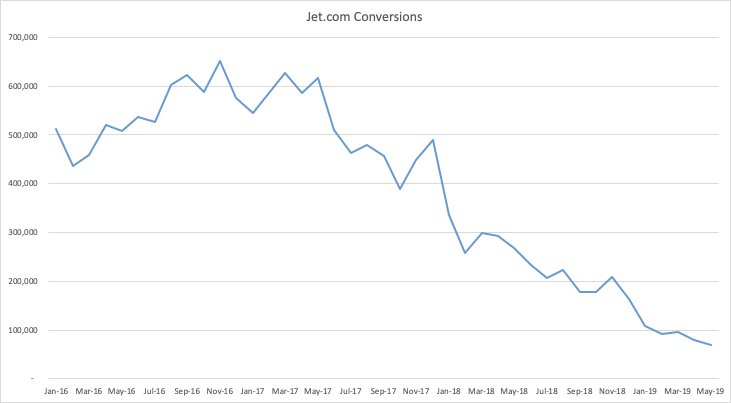
The number of transactions on Jet.com rose to more than 600,000 a month in early 2017 but has been on a precipitous decline since then, shrinking to less than 100,000 a month. They don’t even exhibit the holiday-shopping spikes nearly every other retailer exhibits.

A drop like this doesn’t happen by accident, not in a world where Walmart reports that its ecommerce sales were up 37 percent in Q1. Or, after the ecommerce marketplace as a whole has grown steadily since, well, the start of ecommerce. Or, where spending power among affluent urbanites (Jet.com’s supposed strength) continues to rise as economic bifurcation enters its fourth decade. There is a long list of contextual reasons why a rising tide (tailwinds?) should be lifting Jet.com. Because of this, its loss of altitude is even more surprising and stark.

Jet.com's transaction YoY graph

Source: Jumpshot

2. Jet.com’s ecommerce fuel, paid search, is also way down

Jet.com is one a handful of ecommerce sites, along with Chewy.com and Wayfair.com, to have successfully bought their growth. Largely this means paying for placement on Google’s search engine results pages, and it’s an increasingly effective strategy. Paid click-through rates on Google are up, particularly for companies willing to spend on expensive awareness-building campaigns across media channels. Consumers simply feel more comfortable clicking on those paid links when they recognize the brand.

Paid search kept Jet.com’s internet traffic aloft. And it has tumbled almost in lockstep with Jet.com’s sales. You could argue that Jet.com’s sales may have fallen for any number of reasons. But there’s only one reason why their paid search traffic went from eight million visitors a month to less than one million: Walmart was reallocating its budget elsewhere. Growing sales on Jet.com simply wasn’t a priority for the retail giant.

Jet.com's graph of paid search spends

Source: Jumpshot

The Jet brand and the Jet/Walmart fit remain indistinct

Walmart has pulled back on making Jet a public-facing brand in part because of an ill-defined fit between the two brands. Jet was initially created to reach consumers who cared more about value than convenience. It was designed to be sort of an online Costco, offering very low prices to those willing to pay a membership fee. This would seemingly be a good fit for Walmart, whose growth has come via an unwavering commitment to its brand promise (everyday low prices) and core target (value-oriented non-urban consumers). But over time, Jet morphed into a brand with a reputation of reaching younger, more affluent urbanites – not an existing fit with Walmart, but a potentially complementary one that could help Walmart grow beyond its core.

While either strategy can be reasonable, the Walmart/Jet fit seemed to vacillate between the two, and never really settled on either. Jet has upscale ambitions, but its appeal to affluent consumers may be overstated. In Q1 2019, the top three keyword searches on Jet.com were decidedly mainstream “toilet paper”, “paper towels”, and “Frito-Lay”. It’s not until the fourth keyword search term, “mid-century modern furniture”, that the searches take a more upscale vibe.

Walmart has been toning down its positioning of Jet.com as an urban growth engine, and its discussion of Jet’s role has become increasingly circumscribed. As Walmart put it,

“Last year, we repositioned the Jet site itself. Across most of the country, we saw we could get a much higher return on our marketing investments with Walmart.com, so we’ve dialed up our marketing spend there… However, in specific large cities where Walmart has few or no stores, Jet has become hyper-focused on those urban customers…. The focus has largely been on New York so far, and we’re looking at other cities.”

Walmart’s real motivation in buying Jet.com 

The fact is that this acquisition was never about adding new customers or reaching complementary markets. Instead, it was part tech-buy, part acqui-hire. Walmart wanted technology innovations like Jet.com’s real-time pricing algorithm, which helps increase revenue per customer. And while Walmart announced that Simon Belsham, Jet.com’s current president, will leave later this summer, it still has the person they really wanted: Jet.com’s founder Marc Lore, who will continue to run Walmart’s ecommerce business. Lore is widely considered to have led Walmart’s recent overall ecommerce growth, including improvements in operations, infrastructure, and supply chain.

The Jet.com acquisition remains a win for Walmart

Ultimately it’s hard to argue with results. Walmart’s ecommerce sales are up significantly. Its extensive network of stores bodes well in the omnichannel future. Amazon has extended beyond its affluent base to build extensive middle-class appeal but hasn’t penetrated strongly into Walmart’s base. And while Walmart is a distant second to Amazon online, Walmart is far ahead of the other retailers behind it.

Many headlines will try to position Jet.com’s incorporation into the Walmart mothership as a failure. But a deeper analysis reveals that the acquisition continues to go as Walmart planned, and is largely a win for the Arkansas-based retailer.

Stephen Kraus is the head of digital insights for Jumpshot. Kraus is an expert in consumer insights and digital trends, the author of three books and holds a Ph.D. from Harvard University.

The post Decommissioning Jet: Two charts proving Walmart planned to ground Jet all along appeared first on Search Engine Watch.


from Search Engine Watch https://ift.tt/2LlzKQ8

How to Build a Facebook Ad Funnel

If you’re ready to break into the world of PPC campaigns to build brand awareness, attract leads and drive sales, Facebook Ads is one of the best platforms to start with.

Facebook, after all, is the world’s third-most-visited site with a monthly active user count of 2.38 billion. Their ad system has exceptional targeting, letting you get incredibly specific; if you want to target a young parent who loves anime and works as a software engineer, you can do that.

This is important, because the biggest benefit of this ad platform is that it allows you to show ads to users even if they’ve never heard of you, thus generating interest and demand where there was none before.

The demand generation, however, can be a little tricky. Since you’re introducing your brand, product and/or service to users who have never heard of you, they’re typically not going to be ready to purchase right away. That’s where ad funnels come in.

In this post, we’re going to take a look at how you can set up ad funnels for optimal success – and we'll go over a few templates for what this might look like, too.

<b>Click here to download it for free right now!</b>

What Is a Facebook Ad Funnel?

Facebook Ad funnels are a system of ad campaigns designed to work together to take users from point A to point Z in the buyer’s journey. This starting point can be discover and it can end in a purchase, but that doesn’t necessarily have to be the case.

Marketing Funnel

Most ad funnels start with a general audience and use retargeting campaigns to deliver increasingly segmented ad campaigns to increasingly warm audiences. The idea is to give users the information they need depending on their stage in the buyer’s journey to help them get closer to taking your desired action, whether that’s to sign up for a free webinar, attend an event, make a purchase or just get in touch for a consultation.

Dive Deeper: How to Create a Marketing Funnel that Generates Sales (Templates Included)

Why Facebook Ad Funnels Are Essential for all Advertisers

Ad funnels sound complicated, and since a single Facebook Ad can start to add up in terms of cost, it’s no surprise that plenty of advertisers strongly dislike the idea of needing multiple ads to get a single result.

But think about it from a user’s perspective. You see an ad from a laundry detergent company that you’ve never heard of that promises to be effective. Big deal, right? You already have a detergent that works just fine, even though your workout clothes do get a little funky sometimes. You just need baking soda washes, right?

So you don’t convert. When you see a series of ads, however, that are designed to capture and then keep your interest while delivering more relevant information and overcoming more objections and finally hitting you with a discount code, it’s a different story.

Dive Deeper: 7 Easy Ways to Optimize Your Facebook Ads

So What Does This Look Like?

Let’s look at the following ad funnel as an example from Rockin’ Green Laundry Soap.

This is the first ad in the mix. It starts strong by reminding users that athleisure-wear is expensive and needs to be cared for properly, and that includes getting it truly clean while being gentle. They use a video campaign to show how gross our workout clothes really are and how effective their detergent is at getting it clean. It catches your interest and something that alarming is hard to forget.

The first time I saw this ad, I actually grabbed all my workout clothes – clean or otherwise – and stuck them on a soak and wash cycle:

Screen Shot 2019 06 17 at 1.17.11 PM

Next, you see an ad like this. Simple and likely retargeted based off of views of the first video. They use a comparison video here to really demonstrate value again:

Screen Shot 2019 06 17 at 1.17.38 PM

Then comes the more salesly offer, which was likely retargeted from the second video campaign. In order to entice purchases from warm audiences, they offer a discount code and finish with a clear CTA:

Screen Shot 2019 06 17 at 1.17.14 PM

I converted after seeing an ad similar to this, taking advantage of that coupon code. About two months later, I saw an ad similar to the one below. The campaign didn’t end after the first purchase; they retargeted users who had already purchased with a new campaign several months later reminding them to purchase again:

Screen Shot 2019 06 17 at 1.17.49 PM

This funnel was designed to take cold-as-ice audiences, get them toasty warm, and not only urge them to convert once, but on a continual basis moving forward. This is a smart strategy; retaining clients is much cheaper than constantly acquiring new ones.

These campaigns that go a step further to re-engage after the purchase are also typically really profitable, especially considering that you have about a 60-70% likelihood of selling to an existing customer but only a 5-20% chance of selling to a new one:

Customer Acquisition Vs.Retention Costs

Dive Deeper: Retargeting 101: Why It’s Essential for Any Marketing Funnel

<b>Click here to download it for free right now!</b>

Why You Need Segmentation

Before we start looking at different structures for ad funnels that you can use, it’s important to talk about audience segmentation.

Segmented campaigns are typically the key to success on Facebook Ads. The more relevant your ad campaigns are to a specific audience, the more likely they are to take interest and (hopefully) convert.

On the night of the Game of Thrones premiere, I must have seen three different ads from three different food delivery companies with puns like “Winter is coming…and so is delivery!” These ads will obviously resonate more with Game of Thrones fans, and probably wouldn’t be as effective to anyone outside of that audience.

Most ad funnels start with some segmented audiences and go from there. The Rockin' Green campaign I saw, for example, was clearly targeting women who are interested in active activities; it’s why they mention “leggings” and “sports bras” instead of just “workout clothes.”

Screen Shot 2019 06 17 at 2.04.42 PM

You can segment your audience by interest, demographic, behavior or their current relationship with your brand. You can also use lookalike audiences based off of high-value custom audiences. I’ve even seen marketers use “interested in” targeting to show ads to people who follow key influencers, and then mention the influencer in the ad to get attention and build trust.

Screen Shot 2019 06 17 at 2.07.08 PM

You can get creative with this and really use the audience segments you’re optimizing for to guide your Facebook Ad copy. This will increase relevance for audiences who see the first ad in the funnel, giving you more people to work with for the rest of the campaign.

Dive Deeper: Segmentation 101: A Strategist’s Complete Guide to Marketing Segmentation

2 Examples of Facebook Ad Funnels You Can Use

The structure and strategy behind an ad funnel on Facebook will obviously be important and, as you can tell from the post, there are so many different options for how to build a funnel and what you want it to accomplish.

The sky is the limit here, but to get you started, let’s take a look at the following two different ad funnel templates that you can customize for your business.

Note that each of these are simply meant to be templates to show you what these funnels would look like and how to implement them. You can adjust the strategies and layout entirely as needed – that’s what makes them templates!

The Advanced Video Funnel

Video funnels are a personal favorite. They work by showing a general appeal ad campaign to a cold audience. Then you create a new campaign based off an audience who watched a certain amount of the video, either in time or percentage. I like to target users who watched at least 50% of the initial video. You can then do the same thing with a second video, like Rockin' Green did, or follow it up with other high-engaging options like carousel ads.

Screen Shot 2019 06 17 at 2.49.42 PM

Here’s an example of how this would play out:

  • Use a video focusing on brand storytelling to explain why your company was founded and what makes it different.
  • Retarget users who watched at least 50% of the first video, and show them a second video of the product in use and how versatile/valuable it is.
  • Retarget users who watched at least 75% of the previous video and show them a carousel ad either featuring different products or highlighting different benefits of the same product. Run multiple ad campaigns at this level to show users different versions of these ads.
  • Run a retargeting campaign based on site activity, showing people the products they’re interested in and offering a 10% discount, free shipping and/or free returns.

Dive Deeper: How to Get 1,000 True Fans with Facebook Video Retargeting

The Landing Page Lead-to-Sales B2B Funnel

Some businesses offer several distinct products or services, and audiences for each one may not necessarily overlap much. My own business is a good example; the person who wants me to ghostwrite a book isn’t someone who wants me to write their PPC campaigns.

When this is the case, driving generic cold traffic to your site and then immediately following up with segmented retargeting based on what they express interest in is the way to go. Using lead ads is a good choice to slowly nudge users towards conversion and allow you to work with them one-on-one.

Screen Shot 2019 06 17 at 2.50.41 PM

This is an ad funnel that I’ve used for my B2B writing business, but that (again) can easily be adapted depending on what you need. Keep in mind that high-value services typically require more nurturing to get to conversion:

  • Start with an ad campaign appealing to cold audiences using lookalike audiences based on current high-value customers. Keep the audience similarity as high as possible while maintaining high numbers. Show them a carousel ad featuring different products or services, and use the main ad copy to explain your business’s USP.
  • Retarget users based on the individual landing pages they end up on. For example, I have a separate page for content marketing, a separate page for PPC services, and so on. Show them a campaign explaining the value of this service with a lead ad that’s designed to gather their information. Ideally, consider offering a lead magnet like an e-book or free consultation.
  • Retarget based on users who filled out that lead form, showing them the benefits of working with you. Use CTAs to get in touch or for them to send you a message with any questions they might have.
  • Run a third campaign with another lead magnet or offer to those who opened the form but didn’t convert. This can help you increase people moving through the funnel. Once they do, send them to ad three.

Dive Deeper: 

Facebook Ad Funnel Best Practices

Facebook Ads are so versatile that it’s hard to put a finger on definitive, universal best practices that would apply to each one. That being said, the following almost always hold true:

  • Start with a niche, but don’t get too niche. If your starting audience is too small, you’ll have a hard time getting enough users to move all the way through the funnel to be worth it. Funnels are a little like dating, and it’s definitely a numbers game, so just niche down enough to keep it relevant but no smaller than that.
  • A/B test it. Split testing is everything in the PPC world, and that goes for ad funnels. Make sure you’re keeping an eye on which funnels are working and potential drop-off points in the funnel. This can help clue you in about where things are going awry and how to adjust accordingly.
  • Include multiple ad campaigns at every touch point. Use different copy, different images and even different strategies at every stage of the digital sales funnel. This will not only help you see what’s effective, but appeal to as many members in the ad funnel as possible. Not everyone will have the same pain point or respond to the same appeal, after all, so casting a wide net will benefit you immensely.
<b>Click here to download it for free right now!</b>

Conclusion

When someone sees your ad campaign on a Google search ad, if they see what they like then there’s a decent chance they’ll convert quickly. It’s sometimes hard for advertisers who are new to Facebook to adapt to the fact that this just isn’t true on Facebook. Because users aren’t searching for products or services like yours at the time, it will take some convincing to get them to decide they need to purchase.

Funnels are a necessary solution, and they’re the most effective way to take a cold audience all the way from point A to point Z. In many cases, it will be best to have multiple funnels established so that you can appeal to different segments of your audience and hit them with campaigns that will resonate with them at any given point.

The post How to Build a Facebook Ad Funnel appeared first on Single Grain.


from Single Grain https://ift.tt/2Xx0fbQ

How to craft the perfect blog post: a step by step guide

Reading List: Jenna Erickson of Codal

For this installment, we corresponded with Jenna Erickson. She is marketing manager at Codal, a UX design and application development agency.

The post Reading List: Jenna Erickson of Codal appeared first on Practical Ecommerce.


from Practical Ecommerce https://ift.tt/2X4bDr2

How to run a successful competitor-focused paid campaign

One of the biggest advantages of running a paid search campaign is the ability to bid on keywords that would be difficult (if not impossible) for your website to rank for organically.

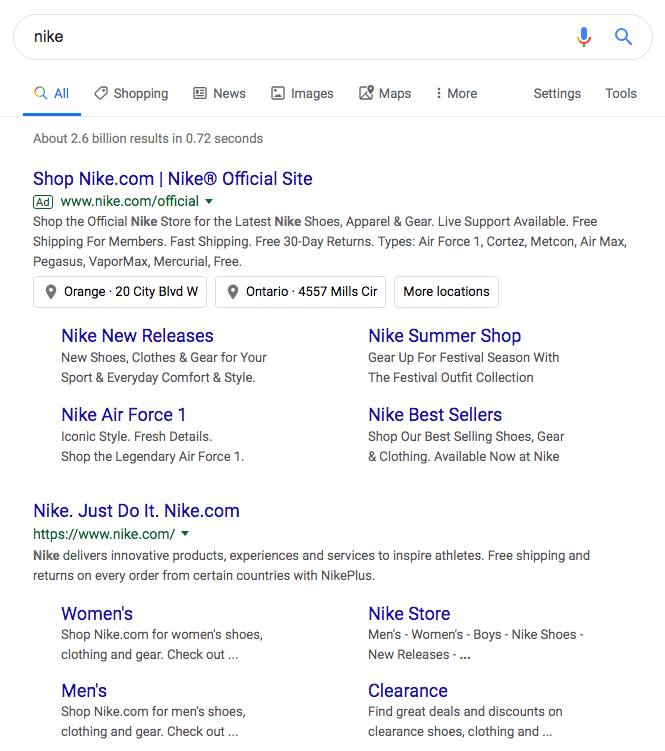
The best example of this is bidding on competitors’ brand or product names. For example, if you’re in the athletic shoe/apparel industry, you’d probably want to bid on Nike or UnderArmour branded terms. So, if you’re not running any competitor focused campaigns right now, you are definitely missing out.

screenshot of SERP listings and ads for Nike


But it doesn’t have to be that way. Here are five steps to set up and run a successful competitor-focused SEM campaign.

Step one: Do your research

First things first, you’ll want to go through a current list of competitors and perform preliminary keyword research on each of them, one-by-one.

Preliminary research should cover average monthly search volume, the number of relevant keyword variations, estimated keyword bids, and any potential conflicts or double-meanings – a classic example would be “Apple” the company or “apple” the fruit) within the keyword phrases you are considering targeting. This should include not only the competitors’ brand names but also all product name(s) that your company competes with directly. You’ll want to repeat this step for every competitor on the list.

Step two: Choose your competitors wisely

After going through the research portion mentioned in step one you’ll want to narrow down your list and focus on just your top three competitors. Why only three? To ensure your messaging is tightly focused around each competitor and that your key differentiators against each specific product can be clearly communicated in both the ad copy and on a custom landing page (more on landing pages in a minute). So how do you determine which three competitors to focus on?


After completing step one you should have the quantitative data needed to determine if it’s worth targeting certain keywords related to a specific competitor or product. But don’t just go off of the numbers alone. You’ll also want to account for strategic business reasons that could outweigh factors such as monthly search volume or estimated bid numbers. For example, your company is planning to launch a new product in the coming months and wants to hit the ground running.

If everything still looks good at this point then you can continue with your standard keyword research/selection process. But be sure to keep the following in mind:

  • Use exact match if a brand or product name has an abnormally high average monthly search volume.
  • Include all relevant brand/product name variations as well as common misspellings.
  • Pay close attention to the following queries – “alternative to [your competitor]”, “[your company name] competitors”, or “[your competitor #1] vs [your competitor #2]”. You’ll likely want to include these phrases in your campaign.

Step three: Landing pages (the bread and butter)

Let’s face it, landing pages are your workhorse. They can make or break your campaign. Because of this, I always recommend creating a unique landing page for each competitor. You may be thinking, that’s going to take a lot more time, is it really worth it?

The answer is yes and the reasons are simple, relevance and context. Relevance is important because you’re going to be bidding on keywords with the intention of “stealing” traffic away from your competitors. And context is critical because if the prospect’s intention was to find out more about one of your competitors, you are steering them off their original course. This is fine but you need to make it clear how you’re adding value to their research efforts.

With this in mind, let’s go over a few specific recommendations when it comes to creating engaging competitor-focused landing pages.

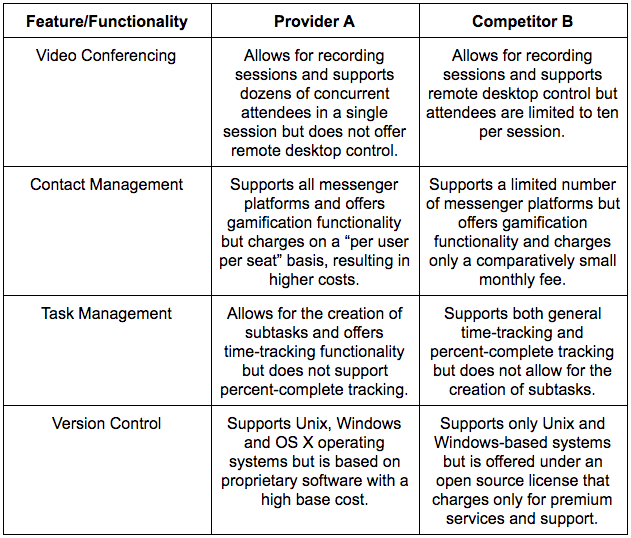
First, it’s important to immediately convey that the content is all about “You vs. Specific Competitor X”. Since people are going to be actively searching for information on Competitor X, you’ll not only want to show them the info they’re most likely looking for but also how your company stacks up against said info. So, for example, by creating a basic three column table with the first column listing out the features/functions, the second showing how your company performs against that feature/function and the third how your competitor stacks up. It’s an easy, visual way to convey the focus of the page and provide the visitor with the information they were probably searching for in the first place.

Example chart of how to run a competitor audit


Ideally, you want to make sure the content is designed to give the visitor a fair comparison of you and your specific target competitor. This is particularly true for certain queries such as, “alternative to [your competitor]”.

Step four: A/B testing from the get-go

Marketers are constantly told that they need to be doing more A/B testing. But is this overkill? Yes and no. You definitely want to be following the ABT (Always Be Testing) rule when it comes to running any digital campaign. But too much testing can eat up time and resources that could be spent on other campaigns or initiatives.

So, to help mitigate, you’ll want to take steps to streamline testing right off the bat. For example, don’t use your competitor’s name directly in the ad copy itself. Depending on your industry and level of competition this might not be an issue (local “mom & pop shops” probably haven’t trademarked their business name). However, for any decent size company, you’ll have to assume their name will be trademarked, which means your ad will get rejected for using a trademarked term. To save time it’s best to avoid using brand names in your copy.

The testing in your ad copy should focus on testing different key differentiators in relation to a specific competitor. The reason for this is simple, you won’t be able to include every single differentiator in your copy due to character count restrictions. So instead you have to focus on the most compelling ones.

Note: These differentiators should be included on the corresponding landing page as well.

Lastly, when running this kind of A/B test you’ll want to make sure to change only one element at a time. If you’re changing more than one element at a time it can be difficult to determine the true cause of any fluctuation in performance. For example, if you change headline one in an ad, you’ll want to keep description one and the CTA consistent.

Step five: Quality over quantity

Last but definitely not least, let’s talk about leads, you know, the reason we’re all running these campaigns in the first place.

Too many companies focus on the wrong thing when it comes to leads – Raw numbers. What companies really need to focus on is quality. Revolutionary, I know. But how can you assess quality?

First, start by looking at the following information – Was a work email provided? Did the prospect provide their title? If so, does it fall in line with your target audience? Does their company match your target company revenue/size/industry targets?

The answers to these questions will tell you if your campaign is on the right track, or if adjustments need to be made. They will also provide valuable context, something the raw number of new prospects generated won’t be able to.

With that said, there is still value in continuing to track and report on both, the total number of new prospects (which is quantity) as well as the number of designated “ideal fit” prospects (which is quality). Taken together, these metrics will help you to determine how successful your campaign has been.

Running a successful competitor focused paid search campaign can be tough. From the setup to the ongoing optimization and the reporting, it’s non-stop data gathering, analysis, copywriting, and A/B testing. But if you follow these five steps, it should help to streamline the process and make it easier to manage.

The post How to run a successful competitor-focused paid campaign appeared first on Search Engine Watch.


from Search Engine Watch https://ift.tt/2LkPaUO

Ecommerce Briefs: FedEx, Amazon Spark, Jet.com, Toys “R” Us

In “Ecommerce Briefs,” I address news and developments that impact online merchants. In this installment, I’ll report on FedEx severing its air-services relationship with Amazon and rolling out seven-day delivery,

The post Ecommerce Briefs: FedEx, Amazon Spark, Jet.com, Toys “R” Us appeared first on Practical Ecommerce.


from Practical Ecommerce https://ift.tt/2REWThl