Showing posts with label Search Engine Watch. Show all posts

Friday, 13 November 2020

Four digital marketing strategies to prepare for a wild holiday season

30-second summary:

  • Ecommerce has become an increasingly important element of any business, but it is more important than ever going into the 2020 holiday season.
  • With the plethora of brands vying for ad space online, companies must make the most of their marketing budgets by adjusting their digital strategies.
  • Socium Media CEO Owen Loft offers four tips for breaking through the noise to get in front of your customers and boost sales this holiday season.

Retailers already set up for online sales had an immediate advantage, but others quickly fell behind. Instead of reaping profits from consumers who have chosen to shop from home, retailers without online infrastructures have missed out on booming sales opportunities. Online shopping was already trending upward before the pandemic, but the pandemic pushed the shift from physical to ecommerce ahead by five years.

Businesses cannot afford to overlook digital. But one question remains: How can they bolster their online presence and get in front of their target customers in the current landscape?

Holiday season 2020: A perfect storm of competition

Reaching customers who have flocked online has become more challenging (not to mention costly) as large retailers take control of valuable advertising space. And big-box stores aren’t the only ones driving up the cost of digital advertising — political candidates have sunk more than three billion dollars into campaign advertising this year.

Major retailers such as Best Buy and Walmart are taking more online-centric approaches to holiday shopping this year. Many have already announced that they will keep their physical stores closed on Thanksgiving. Some will even remain closed on Black Friday or offer limited shopping hours, pushing customers to stay home and shop online.

With the coronavirus pandemic stretching into the fourth quarter of 2020, major elections, and the holiday season, marketers have major competition for valuable online ad space.

Revamp your digital marketing strategy to reach customers at home

To break through the noise and make the most of your marketing budget in the current environment, you must adjust your digital marketing strategies. Here’s how:

1. Prepare for the early rush

In years past, Black Friday signaled the start of holiday shopping. This year, however, Amazon’s annual Prime Day — typically held in the summer — was rescheduled to early October due to the pandemic. Some experts predict this will be the starting point for holiday shopping in 2020, which amounts to roughly an extra month and a half of holiday-related advertising and deals.

Another reason for the early start? Getting ahead of anticipated shipping delays. Some businesses already have felt the coronavirus-related strain on deliveries; pair that with additional demand, and customers will probably start shopping early to make sure their gifts arrive on time for the holidays. It will be more important than ever to start your holiday marketing efforts early. You’ll also want to communicate shipping cut-off dates clearly on your website so customers can plan their purchases accordingly.

2. Leverage your email lists

With major events converging at once — COVID-19, the 2020 election, and the holidays — consumers will be bombarded with ads across the internet. Considering this perfect storm, it might be easier to reach your target customers in their inboxes. And if they subscribe to your business’s emails, it means they’ve had positive experiences and trust your brand. They’ll be more likely to order from you, a known quantity, rather than the thousands of other retailers jockeying for their attention.

3. Highlight gift-able items in your ads

Some items in your business’s inventory simply won’t wrap well, while others are practically made to be gifted. Analyze your inventory and determine which products would fit in a gift guide for your business.

To do this, harness the data you already have. Which products are popular with your customers? What were your top sellers during the 2019 holiday season? You should also research consumer trends to see what up-and-coming products will be popular this year, which will allow you to highlight them in your marketing.

Once you’re armed with that knowledge, make sure you have adequate inventory of those products — even if those items aren’t your typical bestsellers — and plan your marketing strategy around them. With high-quality images and video and updated ad copy ready to go, those products are sure to fly off the shelves.

4. Be flexible

While online shopping is by no means new, ecommerce in the time of COVID-19 is unprecedented. Retailers — even major ones — can’t predict how consumers will behave this year. With a slew of retailers staying closed during the traditional holiday shopping times, some consumers may shift to ecommerce for everything. Others may decide to play the waiting game in hopes that physical stores reopen before the holiday season kicks into gear.

Because it’s impossible to know precisely what consumers will do, your tried-and-true marketing methods may not work. If you don’t already, prepare some contingency marketing plans in case you need to pivot quickly and try a new strategy to reach your customers.

Ecommerce has steadily become an important part of business, but this year it is absolutely critical. With a veritable trifecta of competition due to the pandemic, election, and holiday season, marketers must reassess their digital marketing strategies to ensure they can reach customers and boost sales.

Owen Loft is Co-founder of Socium Media, a performance-focused digital marketing agency specializing in paid search, paid social, and SEO. He can be found on LinkedIn.

The post Four digital marketing strategies to prepare for a wild holiday season appeared first on Search Engine Watch.


from Search Engine Watch https://ift.tt/3kvowpQ

The rise of vertical search engines

30-second summary:

  • Google’s rise as the dominant search engine has left the industry undisrupted for 20 years.
  • The number of use cases for search are infinite meaning Google’s information lacks depth in some cases.
  • Vertical search engines support unique workflows and provide domain expertise.
  • Specialized search for consumers is well established but B2B search is rapidly growing due to a “digital exhaust” effect.
  • B2B search helps fuel SMB’s and the mid-market because more businesses get found.

On October 20, 2020, the Justice Department sued Google, an Alphabet subsidiary, claiming the company’s internet search platform is an illegal monopoly that is harmful to both competition and consumers. The case aims to prove that Google’s position as a dominant search provider limits consumer choice and partnerships with companies like Apple suppresses competition. Taking on Big Tech has been a mainstay in the national conversation ever since the 2016 Presidential election, but this is the first antitrust action taken against Google. While we might not reach the end of this story for years, the DOJ’s suit signals a larger shift in the search industry, which hasn’t been disrupted in over 20 years. The unintended consequence of Google’s conquest to broaden search is limited depth for some. Businesses tend to be affected more than consumers because of how results are ranked. Therefore, in the wake of Google’s antitrust suit, a new market for specialized information has emerged.

Shifting dynamics

In 1998 Google processed 10,000 search queries per day – roughly 3.65 million annually. The official Google Zeitgeist reported 1.2 trillion searches in 2012, the year it was published. That trend would eventually stabilize to an estimated 2.3 trillion searches per year in 2020.

Despite its size and tremendous growth, web search dynamics have begun to shift. Google has taken a super-aggregator and partnership approach to many growing verticals. Google Maps, for example, aggregate Booking.com, TripAdvisor, and Yelp. Google Shopping and Google Finance are aggregators for ecommerce and financial information, respectively. Vertical search has always been at odds with aggregators, wanting to be found but also wanting direct traffic. Vertical search engines have built their own mobile apps to lure users away from the Google search bar.

Defining a vertical search engine

A vertical search engine is a search engine that focuses on a specific domain, or vertical. Think of LinkedIn for people search, Zillow for housing search, or Kayak for travel search. The benefits of using a vertical search engine are:

  1. More precise information due to narrowed scope
  2. Calibrated systems for providing users with vertical expertise
  3. Purposefully designed to facilitate a specific task or workflow

The third point is particularly noteworthy, especially when comparing vertical search engines to Google. It’s unlikely that you’re searching for car prices and inventory for fun. The price tells you if you can afford it; location information tells you where the nearest dealership is. Search is part of a workflow. Google, in most cases, acts as a middle man, guiding users from point A to point B.

Like web search, vertical search also supports various workflows. Where they differ is providing users with both the pathway and tools to complete an intended action. Here’s an example: Zillow users start by searching for homes, weighing data on home prices and taxes against other factors like school districts and proximity to work. The user’s workflow ends with an appointment for an open house with the listing agent. Workflows differ greatly depending on someone’s need, which is why the market for vertical search engines is so vast.

In recent years Google has attempted to compete with certain consumer search workflows. Google Flights, a Kayak competitor, brings users closer to booking travel all within one platform. Interestingly enough, Google’s purchase of ITA Travel in 2011 (which became Google Flights) was reviewed and cleared with the DOJ. If history is any lesson, Google is surely capable of competing with certain vertical search engines and capturing market share for consumer-based search. Business to business search, however, is a different ballgame.

The need for B2B search tools

There is a gap in the B2B search market. The gap exists, in part, by the design of Google’s search algorithm, which ranks websites based on five key factors. You’ll find the most popular business websites, but not every business website. More importantly, results might not provide the right business.

B2B search is beginning to transform, however. The amount of digital exhaust has increased drastically over the last few years. The emergence of Shopify, Squarespace, and others have decreased the barrier to entry for businesses on the internet. In 2014 the internet surpassed one billion websites and two billion is within reach. Having a website is one thing, but getting found is another. Companies must invest in website tools and resources and consistently optimize website content. Not to mention, it takes time to accumulate domain authority. If you’re a small business in a constrained economy, this looks like a tall order.

Google’s ranking algorithms, limited workflows, and surface-level information create an opportunity for B2B search engines across multiple functions. For example, ThomasNet (www.thomasnet.com) is an industrial sourcing platform connecting procurement professionals and industrial manufacturers. Drugdu (www.drugdu.com) operates medical device databases citing access to over 1,000,000 products.

With so much focus on small businesses this year due to COVID-19, it should be noted that B2B search products are good for SMBs, thus good for the economy. Tools like ThomasNet and Drugdu even the playing field, allowing small businesses to be found. Information also tends to be more trustworthy because of the general absence of advertising and crowdsourced information reduces reliance on individual company databases.

The big picture

The last antitrust case presented against a large technology company was in 1998 when Microsoft was, ultimately, found guilty of abusing monopoly power. Over the last two decades, Google has emerged as the clear leader in consumer search, but they’ve failed to extend their reach into vertical search engines. That void has since been filled with dozens of specialized search engines, platforms that mostly benefit small to mid-sized businesses. The advantages for users are clear: focusing on a limited set of data accelerates workflows and supplies better information. As the Google saga unfolds, vertical search engines are well-positioned to grow by facilitating business-to-business commerce.

Andrew Bocskocsky is a software expert, CEO, and Co-Founder of B2B search engine Grata.

The post The rise of vertical search engines appeared first on Search Engine Watch.


from Search Engine Watch https://ift.tt/3nifbUn

Thursday, 12 November 2020

Internal communication plan: How SMB marketing teams can achieve growth

30-second summary:

  • With remote work and the peak season coming in, creating an internal communication plan has become a massive priority for upper management to facilitate great teamwork.
  • How can companies create internal communication plans that not only work in the short term but can also be utilized for years to come to achieve steady team growth?
  • Eight great steps to improve your SMB digital marketing team’s internal communication plan and optimize successful outcomes.

Creating an internal communication plan has become a massive priority this year. 

With more companies working remotely, documenting processes and making them accessible to teams has taken precedence over many other tasks.

Since team members cannot walk over to each other’s desks for a quick chat, it has become key for upper management to determine how best to facilitate teamwork.

Overcoming communication barriers in such an environment will take planning—especially as this remote working situation is set to continue for some time.

How can companies create internal communication plans that not only work in the short term but can also be utilized for years to come to achieve steady team growth?

We share a step by step guide that will help marketing teams communicate better in the long run.

1. Audit established internal communication plans

Before you go steaming ahead to create a new internal communication plan, you need to look at what you already have—or whether you have something at all.

Analyze your documentation to see whether you have the most up-to-date information. Examine your process flow to determine whether obstacles are being overlooked.

Study how effective your former communication plans had been—did you reach the goals set out for it? If not, what areas require improvement?

It’s also worth creating a company-wide survey to get a better understanding of where your employees think the company is.

Are they comfortable with the way communication is handled? Would they prefer changes in a particular area?

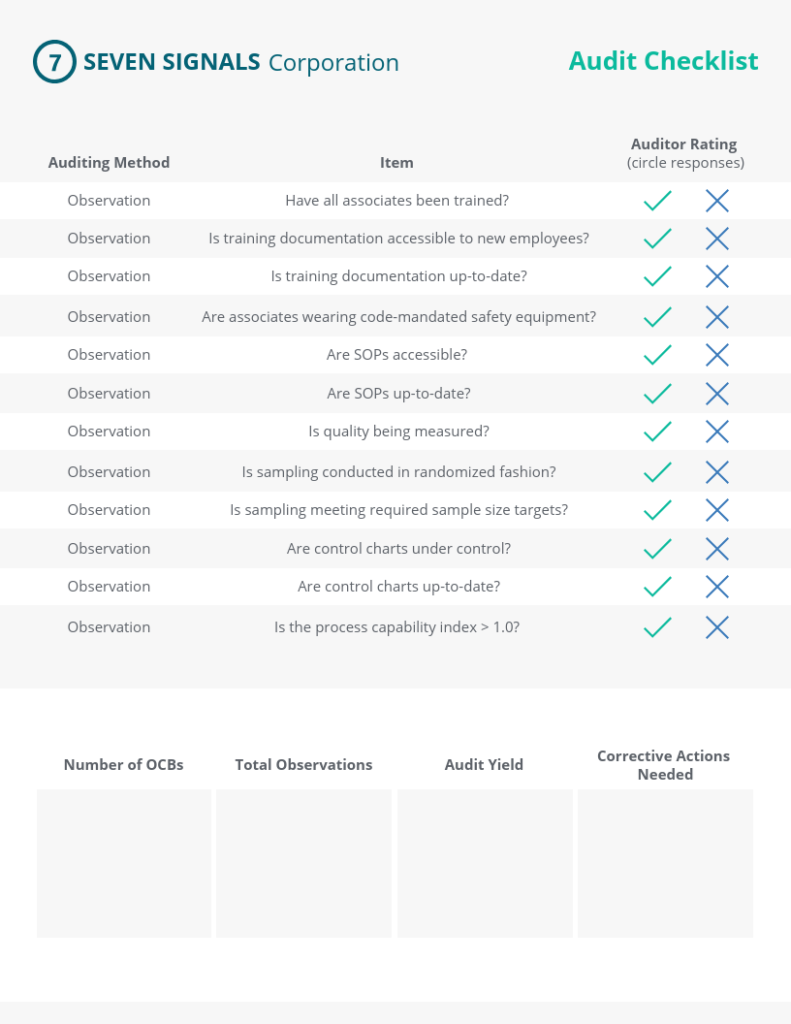
A thorough audit, like in the example below, will make it much easier to start creating an internal communication plan that helps your company grow.

internal communication plan - audit

Source: Venngage

2. Internal communication plan metrics

Now that you’ve determined what worked and didn’t in your previous internal communication plans—or that you do need one—you need to determine metrics for it.

Some metrics to aim for include:

  • Employee reach
  • Employee engagement rates
  • Employee retention rates
  • Message open rates
  • Message click rates
  • Level of productivity
  • Employee net promoter score
  • Revenue increase

Your SMB may not be focused on all of these metrics—but you should aim for at least a few of these in your initial plans.

You don’t want to have a narrow focus such as increasing productivity rates that don’t improve engagement or revenue.

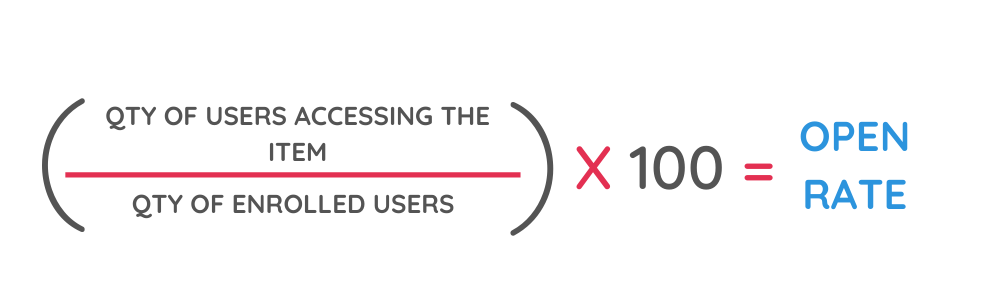
Instead, choose a set of metrics that you can calculate, and that won’t be unattainable, like the open rate below used by Contact Monkey.

openrate

Source

3. Setting goals for internal communication plans

Miscommunication can cost SMBs an average of $420K in losses, found SHRM. Which is why internal communication plans are so necessary.

When you determine your metrics, you also need to set goals for your company and how the internal communication plan will tie into those goals.

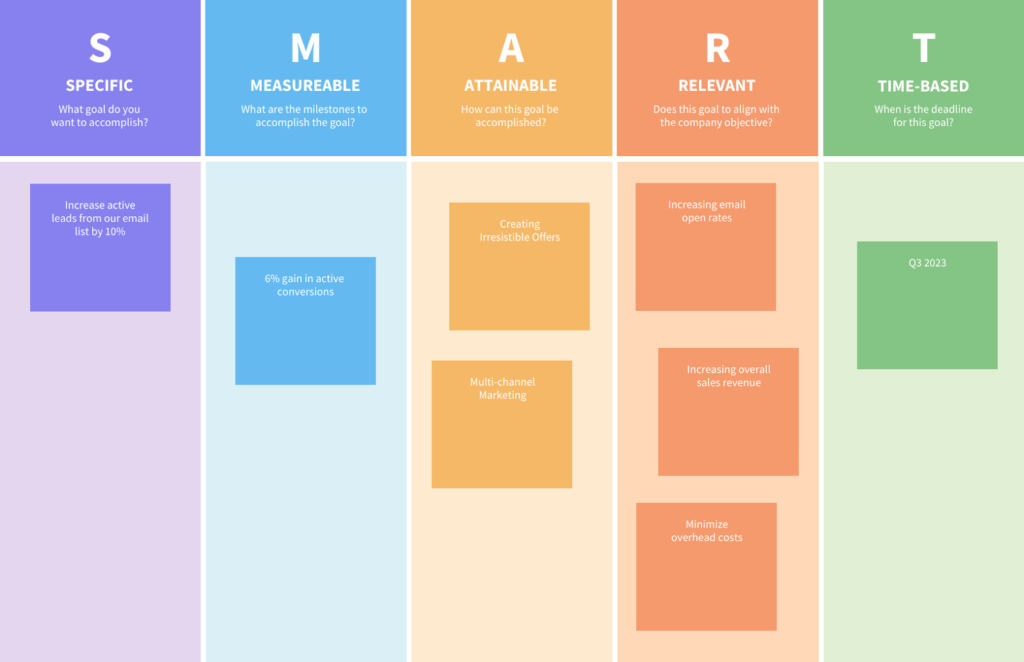
How do you choose a goal for your plan that will help your marketing team grow? By using the SMART goal-setting method:

  • Be specific about what you want to accomplish, and use simple language to convey it
  • Choose a measurable goal that you can analyze
  • Make the goal attainable so your communications don’t aim for something you can’t get
  • Your goal should be relevant to the team and your overarching company goal
  • The goal should also be time-based so that your plan doesn’t miss deadlines

Here’s a visual overview of SMART goals that your team can refer to in the future.

SMART Goals Team Brainstorming - internal communication plan

Source: Venngage

4. Identify internal communication plan stakeholders

No matter the size of your company or marketing team, your internal communication plan needs to be targeted towards specific stakeholders.

This is because not all messages are relevant to every member of the team. 

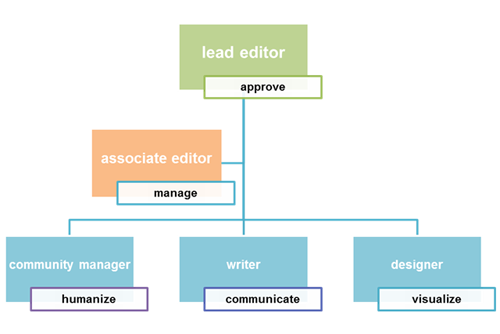
The way a website design team functions will differ from the PR team, or social media team, like in this example.

internal communication plan - identify stakeholders

Source

You also don’t want to bombard other teams with marketing information that won’t be important to them.

Creating a one-size-fits-all plan for your company will only cause more misunderstandings—that is why you need to outline your target audience before creating a plan.

Use behavioral targeting methods to understand how, when, and why your team members need to be reached. This will make communication more effective.

5. Brand your internal communication plan

Branding is an essential part of external communications, but it should also be acknowledged for internal communication plans.

While brand symbols like logos, colors, and fonts are meant to evoke a connection between companies and consumers, it’s also necessary to maintain consistency within the company.

Branding ensures that your team is seeing the same message design internally and on your external channels.

So, make sure your internal newsletters and your business letter template, like this example, are updated regularly to reflect your branding styles.

Business-Employee-Recommendation-Letter-Venngage

Source: Venngage

But remember that branding isn’t just about the visual appearance of your company—your tone and messaging should also be consistent in your communications.

Don’t adopt a serious tone internally, only to be jovial with customers—your team is in many ways a customer, as well. 

Your messaging should also be consistent—don’t tell external parties something that your marketing team doesn’t already know.

6. Design the internal communication process

One of the key aspects of an internal communication plan is workflow—your team should know whom they need to send content and strategies for approvals.

You should include a flow chart in your plan—these demystify approval processes so team members send their material to the right people in the right order.

7. Channels to implement internal communication

There are numerous channels where you can implement your internal communication plan:

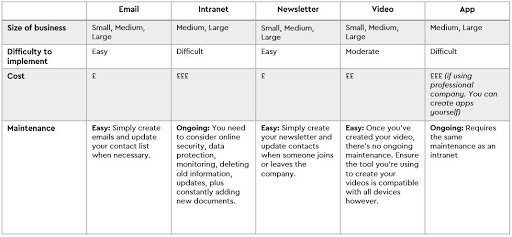
Most of these channels are completely free to create and maintain but some of them can be time-consuming, as you can see from this chart.

internal communication plan - platforms for it

Source

Emails aren’t as instantaneous as they used to be and many people have found themselves using them solely for external purposes.

On the other hand, instant messaging tools have allowed remote workers to keep in touch with each other and respond immediately.

Your SMB may not have the ability to institute an intranet, but you may be able to design newsletters to send to your team.

Include which channels you will be using in your plan and for what kind of communication so that team members are aligned and know where to reach out for responses.

8. Regularly evaluate your internal communication plan

If you think your job is done because you’ve created your internal communication plan, I’m afraid that isn’t the end of it.

Your plan will need to change to reflect your marketing team’s structure, your company’s new goals, and even the external environment.

Be prepared to assess the following on an annual basis:

  • Email open rates
  • Click-through rates
  • Channels used
  • Feedback from your team
  • Common barriers
  • Areas for improvement

Once you determine how these areas have performed you can redesign your communication plan.

Conclusion: Create an internal communication plan that keeps your team aligned

Creating an internal communication plan that works takes time and energy. You will also need to A/B test your tools and processes to define the ones that work best for your company.

To recap, here’s how you can create an internal communication plan that works:

  • Audit your current plans
  • Choose your metrics
  • Set plan goals
  • Identify stakeholders
  • Brand your documents
  • Design the process
  • Choose your channels
  • Evaluate your plan

By following these steps, you can create an internal communication plan that will help your marketing team become aligned with your company.

Ronita Mohan is a content marketer at Venngage, the online infographic maker and design platform. Ronita regularly writes about marketing, sales, and small businesses.

The post Internal communication plan: How SMB marketing teams can achieve growth appeared first on Search Engine Watch.


from Search Engine Watch https://ift.tt/38Bim5e

Tuesday, 10 November 2020

Holiday marketing: Get the data that puts you ahead of the competition

What you will read in this post:

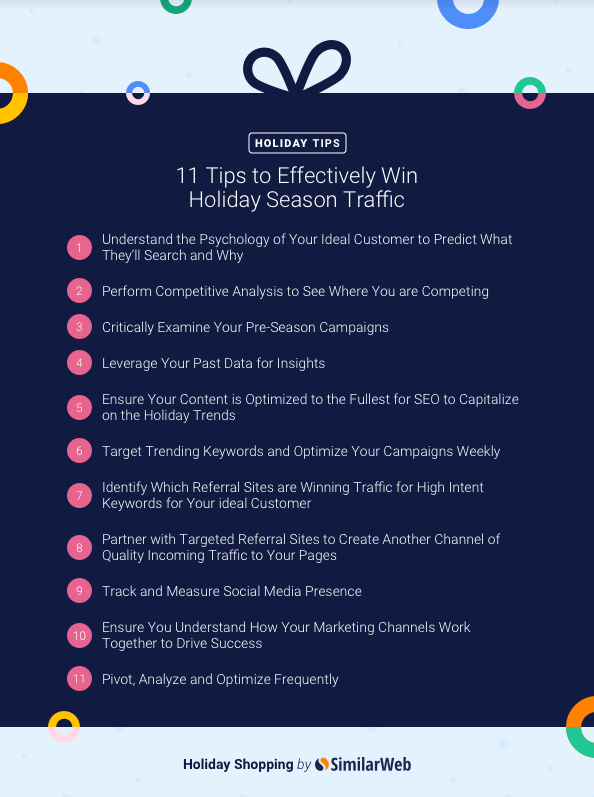
  • Understand holiday season traffic trends
  • Optimize for strong SEO and PPC keywords
  • Analyzing keyword-driven traffic for seasonal marketing
  • Which sites won the most keyword traffic?
  • Black Friday marketing: November 2019
  • Christmas marketing strategy: December 2019
  • Build strong display and referral partnerships
  • Analyze historic conversion data
  • The biggest display and referral sites (and the brands winning traffic)
  • Black Friday marketing strategy: November 2019
  • Christmas marketing: December 2019

Already imagining the taste of the delicious holiday meals and the laughter of your kids when the entire family comes together? Sorry, we know you’re a marketer; you don’t have time for that. You’re busy worrying whether you have everything you need so your marketing strategy can ensure the biggest possible chunk of holiday traffic and generate maximum sales.

This post investigates seasonal marketing statistics of the past few years and provides some eye-opening insights from SimilarWeb’s Digital Marketing Intelligence that helps plan your seasonal marketing.

But first, let’s quickly look at how the COVID-19 pandemic changed consumer preferences and spending this year. Keep these in the back of your mind when you set goals for this year’s holiday marketing strategy.

According to a recent report published by McKinsey & Company, consumer behavior has shifted in five main areas:

  • Increased online buying
  • Increased interest in household goods
  • Higher focus on essentials (health, hygiene, security, and sustainability) 
  • More mindful buying (consumers are researching more, looking for cheaper alternatives and value)
  • More readiness to break loyalty to a brand

Pay attention to the last point. Consumer loyalty has suffered during the time of crisis. This can be meaningful for your retention marketing and also serve as an opportunity for your acquisition marketing and content SEO strategyOne thing is for sure: Competition is going to be more fierce than ever during November-December.
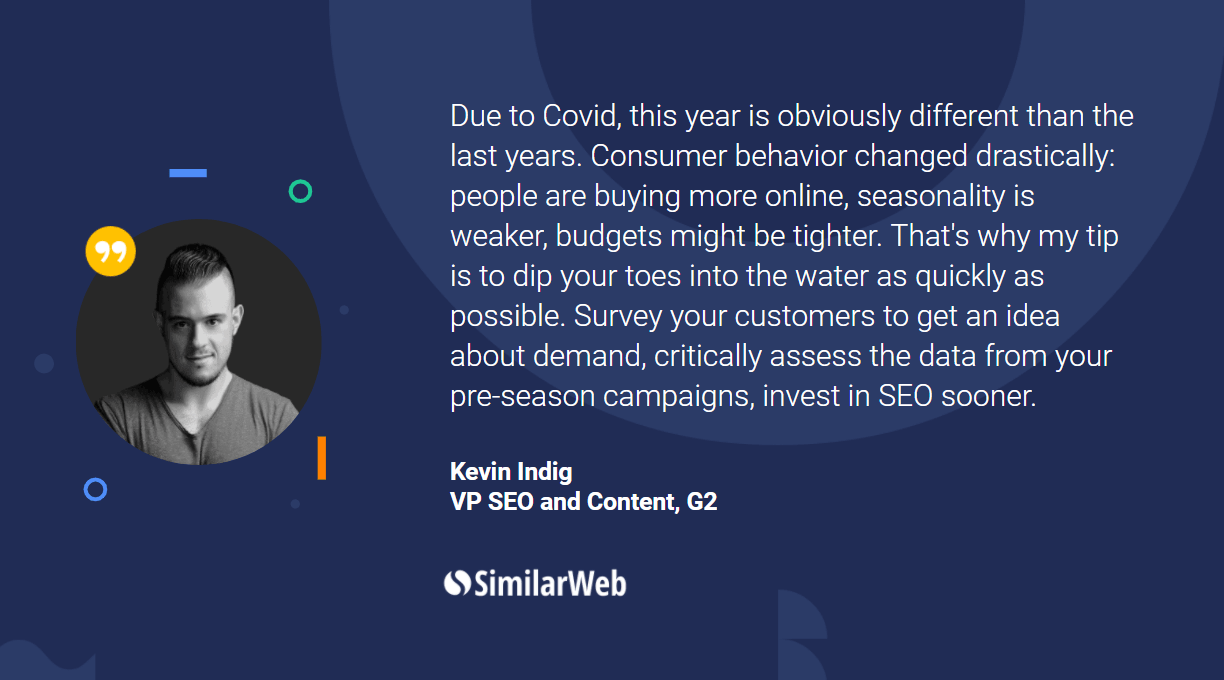
Content created in partnership with SmilarWeb.

Holiday Marketing 2020

It’s now more crucial than ever to know how to leverage your digital marketing channels and optimize campaigns in real-time to reach relevant consumers and stay ahead of the competition. You need the most up-to-date data on overall traffic trends and impactful digital marketing strategies to ensure you can pivot and optimize campaigns as trends emerge.

So digital marketers, to learn how to stand out from the countless online businesses vying for your customers’ attention away from, tune in as we deep dive into SimilarWeb Pro data focused on SEO, PPC, and affiliate channels.

This article will help you understand the data behind seasonal marketing and how to translate it into a strong digital marketing strategy. Make sure you are well-positioned to beat the competition.
Prime Day isn’t usually part of the official holiday season. However, in 2020 “usual” doesn’t count. Due to the wrinkle of COVID-19, Prime Day was pushed back and correlated with the seasonal kickoff this year.

We decided to look at its impact in previous years to understand how this might affect the shopping-heavy fourth quarter of the year and help you draw conclusions for your holiday season marketing push.

Amazon’s annual two-day event has grown in significance over the past few years and not only impacts amazon.com (and it’s dozens of subdomains), but the whole ecommerce space.

In 2019 we witnessed more than 8% growth in traffic during the Prime Day week, compared to the year before. Shopping in December has been increasing over the years as well. Meanwhile, traffic during the Black Friday-Cyber Monday week did not increase in 2019 compared to 2018 when a record growth of 12% year-over-year (YoY) occurred.

This year we are faced with the question: How will COVID-19 impact consumer behavior during the holidays? Analyzing shopping behavior on Prime Day may indicate what you can expect for the remainder of the year.

According to Amazon, 2020 Prime Day sales topped last year’s by almost 40%. And based on our data, half of the 50 best-selling products are private label brands. That’s good news for ecommerce. Or is it? Forbes tells us that Amazon avoids comparing numbers with Black Friday and Cyber Monday, so we are wondering if Prime Day sales met the goals.

Looking at the data provided by SimilarWeb’s digital marketing intelligence tool, we see that non-amazon retailers saw increased traffic of just below 30%.

Target, for example, created a rival Deals Day, which led to a 54% week-over-week (WoW) traffic increase. BestBuy, with its exceptionally attractive deals, experienced the most significant growth among top retailers. Next in line was Costo with a traffic increase of 59%.

It looks like last year’s trend for Prime Day continued. If this is true for the remaining two months of 2020, Black Friday will be less significant, and shoppers in December will look for the best deals. For marketers, it means now’s the time to buckle up; you might need an extra-aggressive holiday marketing strategy.

Optimize for strong SEO and PPC keywords

However heavy holiday traffic in 2020 will be, you need to grab your share. It’s a good time to review your keyword strategies for SEO and PPC. After all, they are both major traffic drivers.

SEO means optimizing your website’s content, structure and user experience according to Google’s Search Engine Result Pages (SERPs). This starts with an effective keyword research for organic searches and competitor analysis, followed by a review of your pages, and optimization of your pages according to your research findings.

For SEO, it’s crucial that your pages stay focused on the topic at hand which means your meta tags need to be relevant and your pages need to include related and relevant information around the right focus keyword.

Another important factor is that your content needs to be linked to from other pages on your site as well as from other websites. As your content pages gain authority and rank over time, they will move up the SERP.

The process of optimizing your pages should have started months ago so, now is an excellent time to re-check your internal linking, meta titles, and image ALT tags and ensure everything is in the right place.

It’s also critical that you check search volume changes and new trending keywords to make sure you’re still targeting the best keywords. People’s searches are constantly changing so there may be a new keyword phrase growing in search volume that your competitors aren’t targeting yet. The closer we get to the holidays, the more competition gets fierce over major seasonal terms.

Keyword analysis for PPC is one of those critical tasks for the holiday season. To get optimal results with PPC, you have to be on the ball with the latest trending keywords.

This is the time to finalize your budget, adjust your bids and overall strategy, so you can easily adapt and pivot during the busier times ahead as you see campaign results and understand how your audience is responding. You may also want to adjust based on what your competitors are doing to drive clicks.

Analyzing keyword-driven traffic for seasonal marketing

During the holiday period, brands largely dictate what shoppers are searching for. That’s because consumers don’t want to miss out on their uncounted deals and special offers.

For you, this is an opportunity to hook onto the right keywords and go head-to-head with your biggest competitors. It’s a once-in-the-year chance to “steal” large amounts of traffic from under their nose and convert them into paying visitors. Once you’ve acquired new customers, it’s hard for others to win them back.

How do we know this? Our keyword research tool provided us with data from previous years. Contrary to other keyword research tools, SimilarWeb Pro leverages actual user search queries and clicks to provide highly reliable data.
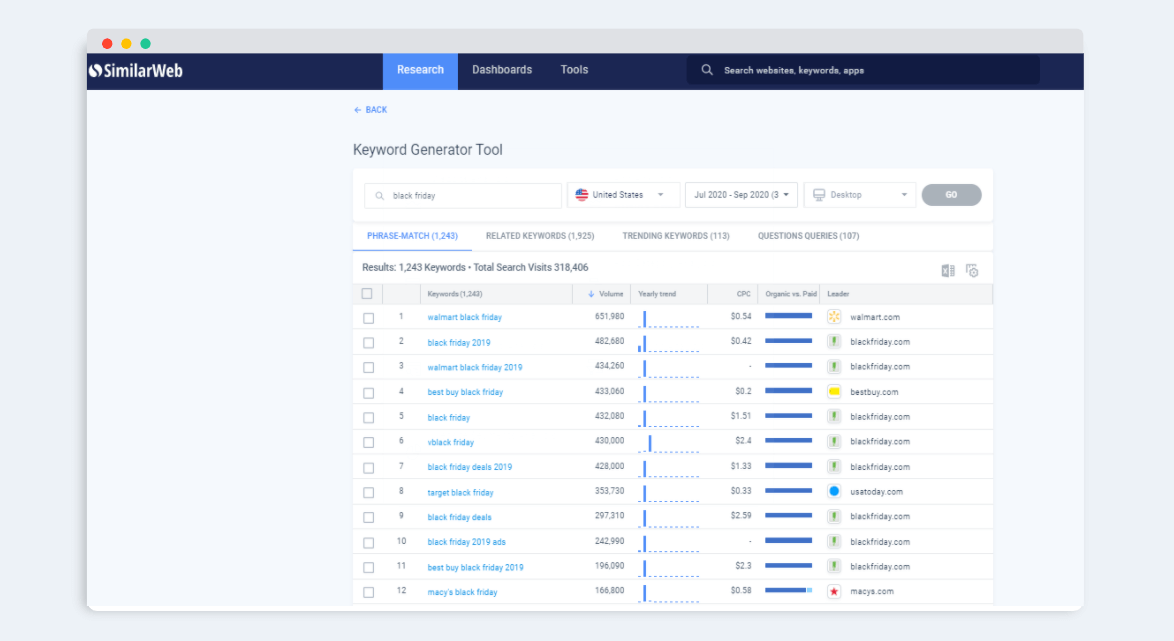
Holiday marketing

You can use the tool to receive the freshest keyword-related data and identify trends before anyone else. Can you see how you would lead the keyword competition for paid traffic? The tool also lets you generate and prioritize keywords, optimize traffic share, benchmark against your industry, and more.
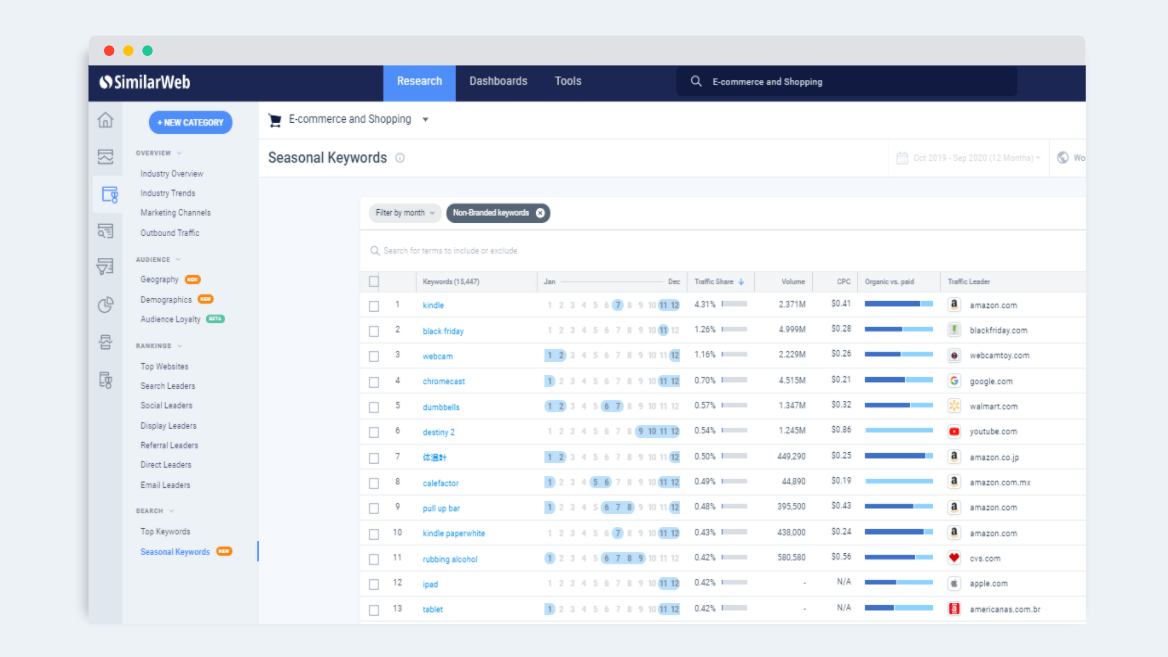
Holiday marketing

Next, we want to see if brands also snatch the majority of the traffic. Spoiler: No! SimilarWeb data shows that publishers and Black Friday sites receive the majority of search traffic in the U.S..

This underlines the importance of partnering with affiliate and coupon websites- such as Slickdeals and CouponChef – that know how to leverage search traffic and seasonal trends. The top winners were bestblackfriday.com and blackfriday.com, both with approximately 11% traffic share, followed by bestbuy.com and walmart.com at around 9%.

Which sites won the most keyword traffic in the holiday season?

Black Friday marketing: November 2019

A review of popular keywords in November 2019 shows that three out of the top ten paid search keywords were related to gaming, representing 24% of total paid search traffic.

Battlefield 5′, ‘Assassin’s Creed Odyssey’, and ‘Fire Emblem Warriors’ were popular video games, and it’s fair to assume that they appeared on innumerable wish lists that people were attempting to fulfill. It seems Black Friday marketing that considers Christmas wish lists are a good bet.

It is also interesting to note that amazon.com claimed over 96% of all traffic from these terms in the time period analyzed. When we look at Black Friday keywords specifically, things get more interesting.

The top PPC-related queries at that time included the term ‘Black Friday’ in combination with a branded term. The keywords ‘Black Friday ads 2019′, ‘call of duty black ops 4’, ‘Nintendo Switch Black Friday’, and ‘black Friday deals’ claimed traffic shares ranging from 9% to 12%.

Specific Black Friday campaigns paid off. Most of the traffic winners were well-loved retail brands such as Best Buy and Walmart.

Most searched organic terms related to Black Friday in 2019 were ‘deals’, ‘black friday’, ‘cyber monday deals’, and ‘black friday ads 2019’ claiming respective traffic shares of 3% to 5% each. Unlike PPC-driven traffic, none of the leading organic search terms were branded.

Not only did big box retail names win traffic from these keywords, top affiliates such as blackfriday.com and bestblackfriday.com also made it into the top 10, which you can see in the graph below.

To sum this up:

  • Top organic searches were generic 
  • Top PPC terms were 50% branded and 50% generic
  • Organic search traffic went to retailers, brands, and affiliates 
  • PPC traffic went to popular household brands

The top ten winners can be seen below.

Christmas marketing strategy: December 2019

As expected, the overall November trends continued throughout December. The highest traffic-driving keywords were again gaming-related gifts and gadgets. The three most searched terms were ‘just dance 2020’, ‘star wars jedi fallen order ps4’, and ‘the witcher 3’. 

Interestingly, Amazon scooped up over 96% of all traffic for ‘just dance 2020’, and ‘the witcher 3’; rd.bizrate.com won 97% of the traffic for the keyword ‘star wars jedi fallen order ps4’.

Holiday marketing

Now let’s take a closer look at terms related to the December holidays to see how Christmas marketing campaigns compare.

Most searched organic terms were ‘cyber monday’, ‘deals’, ‘ugly Christmas sweaters’, and ‘laptop deals’ with traffic shares of  3% to 9%. 

Paid keyword terms with the highest traffic shares were ‘cyber monday deals’, ‘siberian husky christmas blowups’, ‘black friday deals’ – still a high traffic share, however 68% down month-over-month (MoM), ‘christmas tree’, ‘icicle christmas lights’, ‘die hard christmas book’, and ‘nintendo switch games for christmas list’. Interestingly, several of the top keywords were related to Christmas decorations, with gift-related keywords coming in closely behind them.

Ugly Christmas sweaters’ was the top Christmas related keyword driving organic traffic in December.

See the ten winners for Christmas related keywords here:

Build strong display and referral partnerships

Referral sites and a Display Ads strategy are crucial during this time. Why? Consumers are looking for deals, but they also know that not every ‘deal’ is a good bargain for them. They trust 3rd party sites to review and guide them through the jungle of deals during the holiday seasons.

We found that SimilarWeb data supports this assessment. Some of the affiliate and display publisher sites driving the most traffic fell within the 10 top winners of keyword traffic over the holiday season in 2019. 

Here’s your opportunity to generate more traffic to your site. A display publisher will show your display ads on the ad space of their websites. Rather than publishing your display ads by yourself, use affiliates to do it for you. The same goes for other referral sites such as deal comparison sites and review sites that can help you win a bigger chunk of the traffic share.

Use SimilarWeb’s digital marketing intelligence tool to find your best affiliates by analyzing performance statistics of display publishers and referral sites. You can compare relevant sites and identify the biggest traffic providers. The tool also lets you benchmark against your main competitors for traffic from the significant sites.

Analyze historic conversion data

Looking at the stats from 2019, we see that direct traffic brought the highest conversions volume on average in November. Retailers experienced the largest growth in converted traffic from Display and Referral channels during this month, growing MoM 42% and 32%, respectively. Also, referral was the best converting marketing channel at 11%, overtaking even direct traffic, which converted approximately 9% during that same period.

Referral traffic spiked during the last week of November. Display ads’ traffic growth wasn’t as concentrated and was used more evenly to promote future deals and increase brand recognition.

The biggest display and referral sites (and the brands winning traffic)

Black Friday marketing strategy: November 2019

When looking at retail winners, Kohs and BBB experienced the largest increase in overall traffic during the last week of November in 2019. Other big winners include CostoWalmartTarget, and Wayfair.

During this time, Costco and Sam’s Club saw the highest growth of referral traffic during, growing 241% and 199% from October to November, respectively. Another big referral traffic winner, Walmart, came in third, increasing its traffic on this channel by a whopping 114%.

Referral leaders have received more than 50% of referral traffic from the top two coupon and rebate sites, with bestblackfridaydeals.com sending about 45% of all referral traffic to the competitive set during November. Walmart seems to have had a solid relationship with the referral site. About 81% of all its outgoing traffic went directly to the retail giant.

While slickdeals.net was the second-largest referral site during that period, it only drove about 6% of traffic. However, display traffic tells a very different story, as slickdeals.com claims the number one spot.

Bestblackfridaydeal.com dropped down to the third spot with shares of  18% and 2% of display traffic, respectively. Cosco.com scooped up about 73% of that traffic in November. Shopping-category leaders utilized display advertising traffic analytics to increase their brand awareness on affiliate sites.

Did we mention the importance of display and referral sites for your holiday marketing? The numbers speak for themselves.

Christmas marketing: December 2019

Now, take a look at the interesting shifts in winners throughout the holiday season of last year. November’s big winners were overtaken in December. As Christmas approached, michaelkors.com grew by 191% when compared to October the same year, claiming the number one spot for overall growth.

While neither Walmart or Target landed in the top spots for MoM growth, the retail conglomerates did win massive overall traffic. Walmart.com saw a mind-blowing 450M visits while target.com was able to rake in upwards of 250M.

Swagbucks.com was the top referral site in December 2019 for the best-performing sites during that period with an 8% traffic share. It drove about 63% of its traffic to worldmarket.com. Other big referrals sites were slickdeals.net and cashbackholic.com.

Among the display publishers, Rakuten secured the largest traffic share with almost 17%. Dealmoon could seize 9% and Slickdeals managed to grab 4%. In fourth place was Dealsplus, everyone else in the top 10 got less than 2%.

The holiday marketing games are on, roll up your sleeves!

During the holiday season, optimizing your digital strategies is more critical than during any other time of the year. You can only be sure of it’s efficiency when you build on reliable data about you and your main competitors’ performance. Make no mistake, they are getting ready for the winter games as well.

Understand how different channels work together to drive success. Leverage marco and seasonal market trends and determine how to make consumer behavior work in your favor. In our example, we’ve learned that brands who partner with affiliates have the best chance of winning traffic from top keywords. 

Now use SimilarWeb Pro to find the best affiliates to partner with, the most successful channels to utilize, and the highest trending keywords in real-time. Get started by opening an account now!

And if you can’t wait to see how you can fine-tune your marketing strategy for this holiday season, use the form below to download the most-up-to-date data for this year and get the competitive edge you need to blow your competition away.

Holiday marketing

The post Holiday marketing: Get the data that puts you ahead of the competition appeared first on Search Engine Watch.


from Search Engine Watch https://ift.tt/3kjz0bX

How visual content can give a boost to your SEO and how to take advantage

30-second summary:

  • Visual content offers a ton of value for your website.
  • It can boost critical statistics such as time on page.
  • Visuals guide the reader through your content more smoothly.
  • They make your content more consumable and increase sharing.
  • Google loves images that are optimized for search.
  • Read on to learn more about how adding optimized images to your site can boost your search visits from your target audience.
  • See examples of how companies are successfully incorporating visual content into their marketing and websites.

It’s no secret that visual content is hot right now (queue the Zoolander references). You know content formats like video, infographics, GIFs, memes, and more should be a part of your content strategy, but did you know these also impact your site’s SEO?

How does visual content impact SEO?

There is so much value to adding visual content on your website. While your written content serves the purpose of enabling you to naturally incorporate keywords and create more content to rank in search engines, the visual content you add to your site and elsewhere can help give that content a further boost.

1. Video content keeps visitors on the page

One stat Google loves is “time on page”. If visitors are checking out your site and leaving after an average of 10 seconds, that signifies to Google that your content is bad or isn’t relevant. By placing a video in the middle of your written content, you can keep people on page longer.

Think about it. Let’s say it takes someone 10 seconds to read the first two paragraphs of your article. Then, directly on your site is a video your visitors can easily click on that adds more value to the piece.

They click to view and end up watching the full two-minute video. This intrigues your visitors to dig deeper. Before they know it, they’ve been on your site for five minutes. This can give a huge boost to your time on page stats.

Video also impacts critical stats like your bounce rate, which is also a critical factor used by Google. The last thing you want is people visiting your site and bouncing away after just reading a few lines on one page. Video can help reduce your bounce rate and convince people to stick around.

While we’re on the subject, here’s a video from Neil Patel that explains this concept a bit more. In the video, Patel highlights a few ways (including video) that you can use to reduce your bounce rate.

2. Visuals help guide the reader through your content

Reading straight through a 1000-word article, no matter how well-written, can become tedious quickly. To keep site visitors flowing through the content, you can add things like infographics, screenshots, and more to help visualize the concepts you’re presenting and push your visitors further down the page.

Breaking up your content with related visuals allows readers to take a break from soaking up the copy and instead check out a few related graphics, videos, or other visual content. It also provides an opportunity for the reader to pause and look at a graphic that might more easily explain a complex subject you’re presenting or highlight some related stats visually to really drive home the impact, so they don’t get lost in the text.

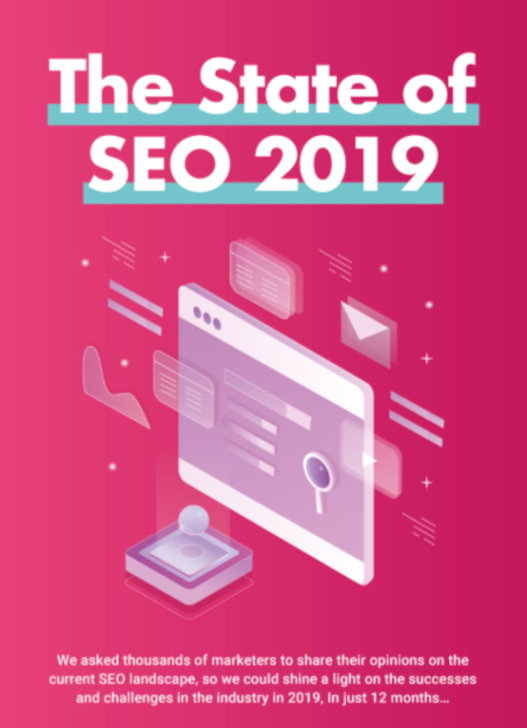
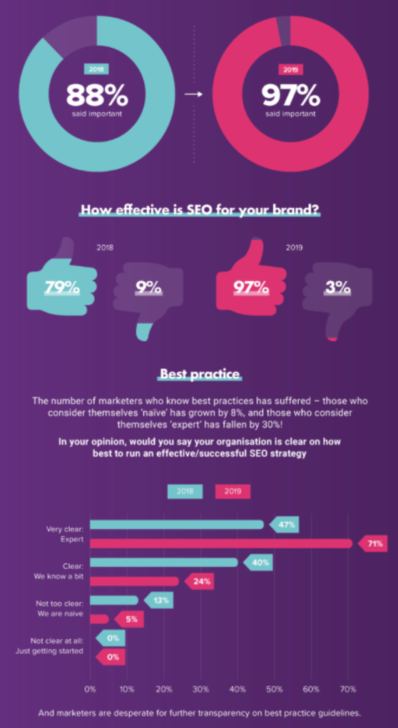
Here’s a great example of an infographic that grabs readers’ attention and gives them something more to soak up in addition to just text. These are a few screenshots from a larger infographic that appeared in an article highlighting the state of SEO in 2019.

visual content - example visual content - infographic

To view the full infographic, click here.

3. Google’s machine learning is learning to read visuals

While it’s not 100% clear how this works, it’s out there and known well enough that Google is actively learning how to read images on pages. With billions of images online, Google’s machine learning becomes adept at using shapes and other elements to compare and comprehend what the images on your site represent.

I mean, is there really much more I need to say here? If Google is focusing on learning how to crawl something and then attribute it to the value your site brings to the Internet, you need to pay attention. That’s why it’s so important to ensure your images are relevant and are formatted in a way Google can read them.

How can you use images to boost SEO?

So, now that you know the “why” part, let’s dig into the “how” part. It’s important to dig a bit deeper and explore some of the ways you can apply visual marketing to your efforts to boost your SEO.

1. Make sure your images add to the story

There is a ton of value in adding things like graphs, screenshots, and other content that actually relate to your article and adds value. There is decidedly less value in adding generic images that simply represent the concepts and don’t really add anything. Since we’re on the topic, why don’t I use some visuals to show you what I mean?

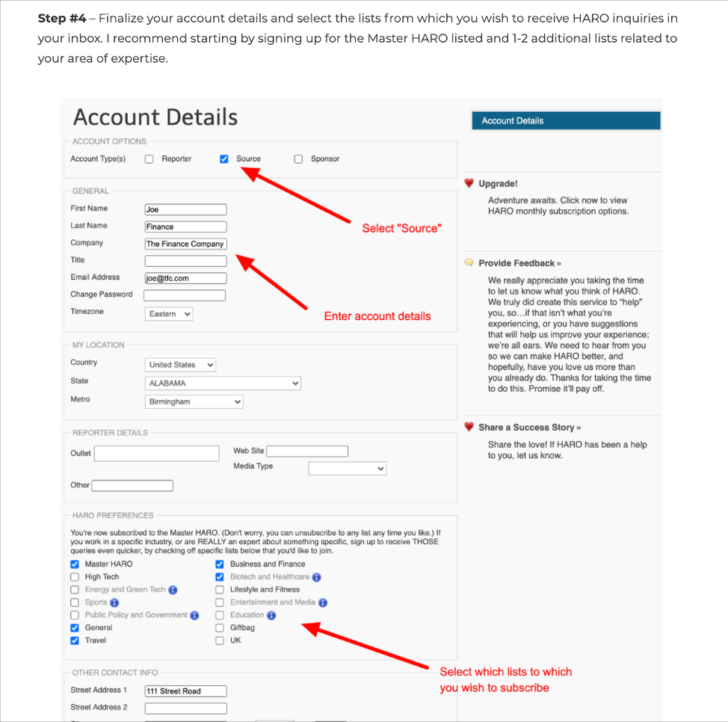
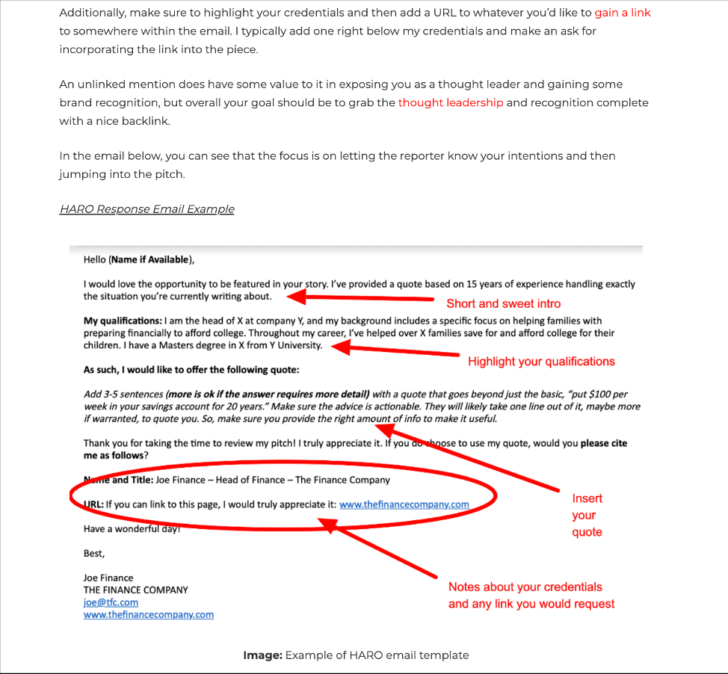
For example number one, you can see instructive screenshots dropped into this piece of content. These are screenshots from an article I recently wrote that details how to use HARO for SEO and backlink building. I used screenshots to walk readers through each step and provide them with actionable guides like the image of the email template and the walkthrough of how to set up an email.

visual content example - HARO HARO

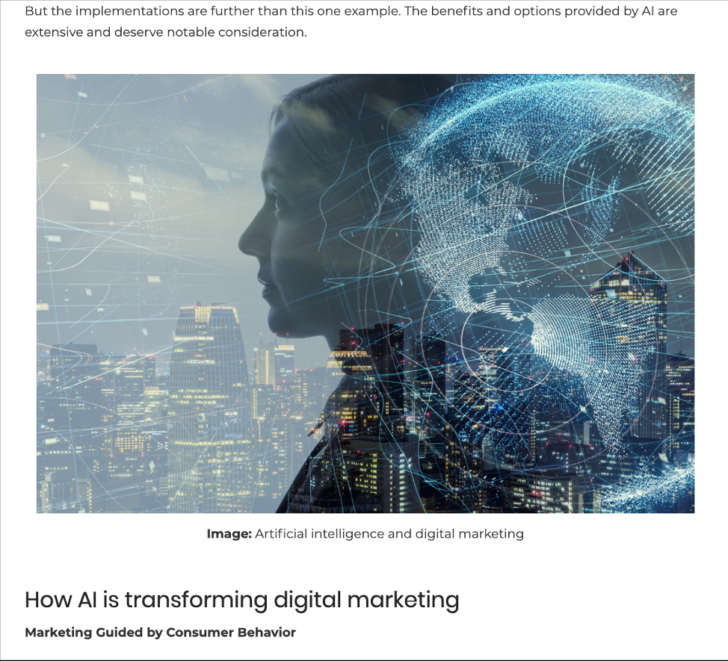
On the opposite side, you have the images below that show an example of using images that relate to the topic but don’t really add value. This is another article on my site. I decided to test out generic images on this piece, as you can see in the screenshots below. The images relate to the content, but they really don’t add much extra.

Adding alt tags to optimize images Adding alt tags to images for optimization

As you can see, both do add a certain level of appeal to their respective articles. That said, for example one, the HARO article, has 12 times the number of page views, 11 more comments, and double the time on-page. So, you can see the value is clear that adding relevant images that add to the story brings a boost to your SEO.

2. Optimize your images

It’s not enough to just add images to your pages and posts. You also need to ensure they are optimized. If you ignore this step, you can run into issues with the performance of your site. For example, images that aren’t optimized can lead to slow load times on your site, and site speed is a critical ranking factor for Google.

To ensure you aren’t bogging down your site with heavy images, try using appropriate image types. The best formats to use are JPEG, PNG, and GIF. And as for videos, host the videos elsewhere (YouTube, for example) and then embed them on your site rather than uploading them directly.

Another important factor in optimizing your images is the tags you add. Just like you need to add meta tags to your posts, you need to add tags to your images as well. This serves as a way to tell Google (and let’s not forget other search engines, of course) what your images are about.

Kayako

Source: Kayako

3. Take advantage of off-site search

You’ve likely heard this before, but it deserves being restated. YouTube is the second largest search engine. Second only to…drumroll please…Google!

So, why not take advantage of posting videos to YouTube and optimizing those videos to give you more content to rank in search?

While this is obviously an off-site strategy, if you create excellent video content and then optimize it properly to appear in search, your videos can grab some SEO value.

You can then add links back to your website in your video descriptions and on your YouTube channel, and as your videos become more popular, clicks from the links on your YouTube channel will give a boost to your site traffic.

Wrapping it up

So, you get it now, right? Images are good for the health of your website and the impact of your SEO strategy. They not only add some life to your website and grab readers’ attention, they also help you improve critical stats that can help give your SEO a boost.

If you’ve been using visuals in your content, your first step should be to review those visuals to ensure they are optimized. Make sure they add to the story and then check to catch any missed opportunities to enhance your files with the right file types along with proper tagging.

Using images and video content on and off your website is a no-brainer. In today’s visual world, it’s important to stay on top of the continuing trend toward a preference for visual content. Make sure to work visuals into your content to give your SEO a serious boost.

Anthony is the Founder of AnthonyGaenzle.com a marketing and business blog. He also serves as the Head of Marketing and Business Development at Granite Creative Group, a full-service marketing firm. He is a storyteller, strategist, and eternal student of marketing and business strategy.

The post How visual content can give a boost to your SEO and how to take advantage appeared first on Search Engine Watch.


from Search Engine Watch https://ift.tt/35cR1o2

Monday, 9 November 2020

Artificial intelligence (AI) is key to reducing digital ad waste

30-second summary:

  • As PPC costs continue to increase, it’s more important than ever for marketers and agencies to be able to access their data – all of their data.
  • What’s even more critical is to track true conversions, meaning the leads that actually convert into paying customers for a business.
  • The issue is that Google and other ad platforms treat all conversions as equal, a major flaw in the system.
  • Do you really want your advertising budget being wasted on ads that are producing solicitations instead of qualified leads?
  • More insights on how the world’s first AI Smart Core, SherloQ™ is revolutionizing how websites and digital ad campaigns operate altogether.
As pay-per-click (PPC) costs continue to increase, it’s more important than ever for marketers and digital ad agencies to be able to access their data – all of their data.

A recent article by Susan Wenogard talks about just how critical it is to track all conversions. I would argue what’s even more critical is to track true conversions, meaning the leads that actually convert into paying customers for a business.

The issue is that Google and other ad platforms treat all conversions as equal, a major flaw in the system. Here’s an example. Let’s say an ad generates 10 clicks and out of those clicks, five of them convert into a lead on the site either through a phone call, email, or chat. Out of those five conversions, only one converts into a customer while the rest are solicitations. However, the automation systems of the advertising platform will equate all of these conversions as valuable to the business and optimize its campaigns accordingly.

Do you really want your advertising budget being wasted on ads that are producing solicitations instead of qualified leads? I think not.

Content created in partnership with SherloQ™, Inc.

Here we go, again: Disappearing data

Google Ads also recently started to limit the data shared in its Search Terms Report to only include terms that were searched for by a significant number of users. Google has stated that this change is in regard to privacy compliance.

But, what does Google define as significant or insignificant data? This change reduces an advertiser’s ability to identify the search queries that triggered an ad, even for those that generated a click or conversion. This spells even more waste for advertisers and is equivalent to losing 28% of your budget’s visibility.

Are you ready to throw away 28% of your advertising budget? Again, I think not.

The real solution to reducing digital ad waste

With the world’s first AI Smart Core, SherloQ™ is revolutionizing how websites and ad campaigns operate altogether.

Powered by IBM Watson, SherloQ™ allows marketers to easily train their AI-models on the types of leads that are most valuable to their business. First-party customer data from call tracking, chat vendors and on-site form submissions are piped into the system, and then SherloQ™ rates and assigns each lead with an Ad Rank Score™, while also accounting for bio-patented feedback from the end-user.

SherloQ™ continuously feeds this data back into individual advertising platforms, informing them to optimize for the ad campaigns that are driving real customers for the business – thus eliminating ad waste.

In a recent case study of the McKnight’s Senior Living Directory, the number one publisher for senior living in the United States, the team shared some insights on how they are using SherloQ™ with IBM Watson:

“Our directory has over 14,000 retirement and assisted living communities listed, including the multiple agencies we work with to manage assisted living websites and digital advertising for our listings. SherloQ’s™ AI automation and data mining capabilities allows us to expand our digital media offerings and effectively run PPC advertisements for all 14,000 facilities while having a global view that would otherwise be impossible.”

Additionally, SherloQ™ is giving marketers control over their data, at a critical time, too. SherloQ™ provides marketers and agencies with user intent and intelligence that’s based on first-party data, identifying the specific landing pages and language/keywords consumers use to describe or find a business. This intelligence can be used to improve website SEO and content marketing strategies, ad copy and creative, and identifies potential new markets to enter.

For marketers and agencies seriously looking to reduce or eliminate their digital ad waste, download our white paper to learn more and contact SherloQ™ to sign up for a demo or free 30 data trial.

The post Artificial intelligence (AI) is key to reducing digital ad waste appeared first on Search Engine Watch.


from Search Engine Watch https://ift.tt/3l9isVg

Friday, 6 November 2020

Customer experience optimization (CXO) for online stores: Three proven SEO tactics

30-second summary:

  • Once you have the right product and pricing, succeeding with your online store essentially boils down to effective digital marketing and delivering a top-notch customer experience.
  • For ecommerce, in particular, SEO — or ranking on the first page of Google — plays a huge role in effective marketing and online branding, as it builds trust in the eyes of your audience which paid ads can’t. And trust translates to a better customer experience.
  • Here we discuss three proven SEO tactics that boost your search engine rankings while also enhancing your brand’s customer experience in ways that go beyond trust-building.

Your modern online store has a lot of moving parts, with hundreds to thousands of different product pages, numerous variations of the same page, and dynamic elements. And you’re well aware of the importance of having your store rank on the first page of Google — more traffic, brand awareness, trust, and sales. However, SEO today is not just about including the right keywords and building backlinks to your online store but is closely knit with providing a great user or customer experience (CX).

When you work on your SEO by keeping the customer experience aspect in mind, you’ll build a store that not only garners top rankings and tons of organic traffic but also converts that traffic into customers.

In this post, let’s take a look at three tried-and-true SEO tactics that directly improve your store’s search visibility while also establishing an outstanding customer experience.

Tactic #1: Make your store load lightning fast

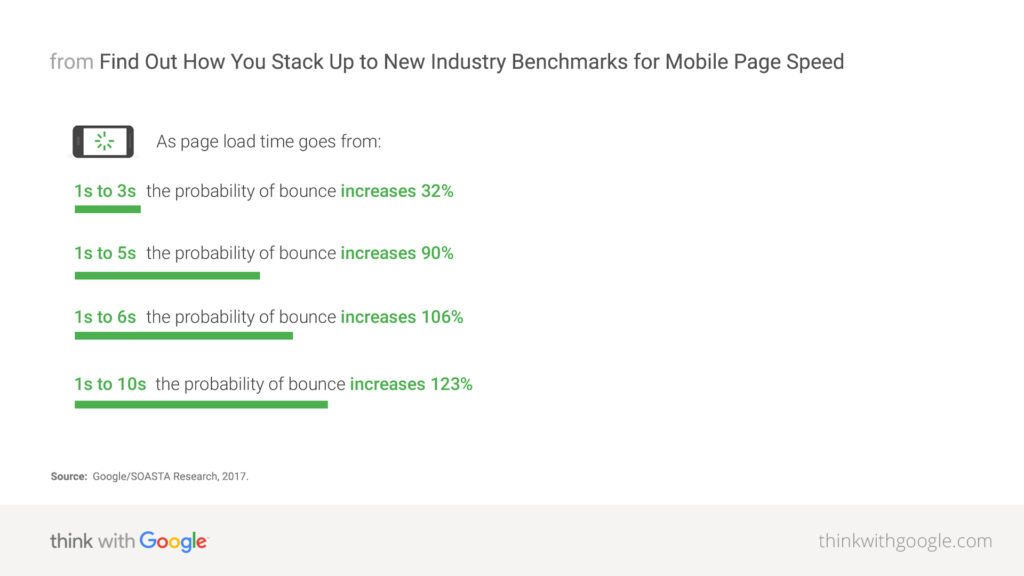
Page speed is one of the most critical factors that can make or break your store’s rankings and CX. Most people today lack the patience to wait for even three-to-five seconds for your website to load, and won’t think twice before bouncing off to a competitor.

mobile page speed new industry benchmarks that impact customer experience

Source: Think With Google

Site speed is an official Google ranking factor since 2010. Thus, optimizing your store’s speed is pivotal to both search rankings and CX.

That being said, the sheer number of visuals and dynamic elements on your store can make this seemingly straightforward task a tall order.

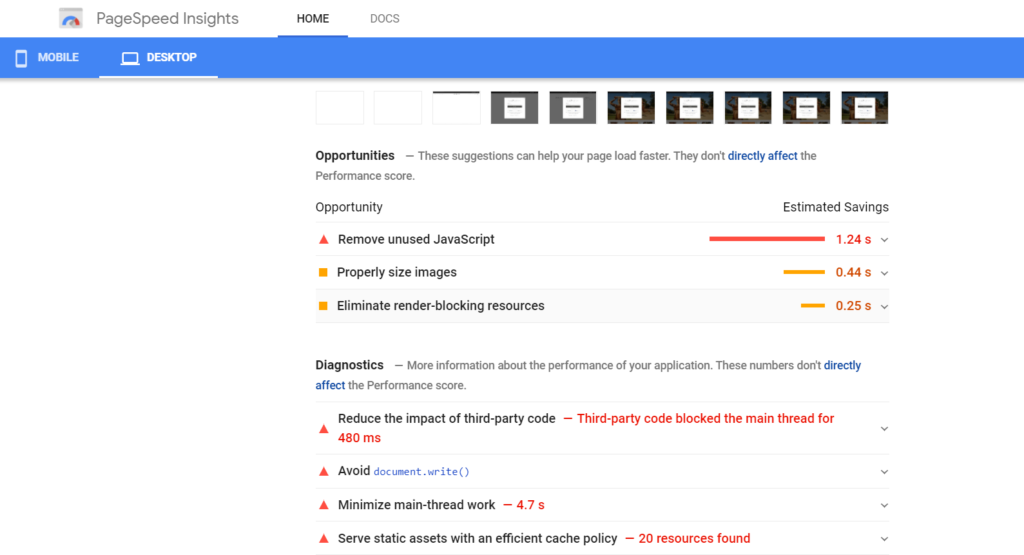
The best way to go about optimizing your site speed is to run your site through a free tool such as GTmetrix or Google’s PageSpeed Insights to assess how your site performs currently. These tools will generate a list of suggestions and optimization opportunities that you can then check off one by one to make your store lightning fast.

For example, you may have bulky image files that need to be compressed using an image compression tool. Or, you may have yet to enable browser caching so repeat visitors don’t have to reload the entire page each time.

page speed insights and how they can help improve customer experience

Similarly, it is possible that you have too many unnecessary redirects in your product pages or render-blocking resources that negatively impact your site speed. Use the aforementioned tools to pinpoint the exact reasons for suboptimal speed, and then work to individually improve every aspect.

Tactic #2: Ensure content on all pages is unique and updated

Google wants you to have unique, high-quality content on every URL of your store. But with countless URLs owing to product variations and categories, this can become a tough nut to crack.

That’s because, on top of creating unique, keyword-optimized, and descriptive content for each product page, you must take care of internal search result pages and product filters (such as color and size) that result in too many low-value duplicate pages which you don’t want Google to index.

And duplicate content (for instance, multiple colors or sizes of the same shirt) can seriously hurt your SEO.

To dodge this, opt for one of these three options:

  • Include a canonical tag (rel=canonical) on product variation pages that points to the main product page.
  • Place a “noindex” tag on the pages you don’t want Google to index.
  • Block the variations within your robots.txt file.

Next, you need to have a plan for dealing with outdated content, such as products that are discontinued or seasonal. You need to deal with such content in a way such that the SEO value is not lost and customers aren’t left confused.

The easiest way to do that is to use 301 redirects to point old URLs to the new ones. This way, visitors get the most up-to-date content on the product they are looking for (thus ensuring consistent customer experience), while the link juice from the original URL is correctly passed on to the new page.

Tactic #3: Focus on the mobile experience

Online shopping on smartphones and tablets has become mainstream in the last decade. Today, mobile is where the money’s at.

Take a look at these numbers from the recent holiday shopping seasons:

  • On Black Friday ($6.2 billion in online revenue in 2018), nearly 40% of sales on the conventionally brick and mortar shopping day came via a mobile device.
  • On Cyber Monday ($9.2 billion in online revenue in 2019), 54% of visitors came from mobile devices, while around 33% purchases on their mobile device, up over 40% from the previous year.

What’s more, in 2021, 53.9% of all retail ecommerce is expected to be generated via mobile. In other words, odds are that the bulk of your visitors are coming from a smartphone or tablet than a desktop.

Despite that, 84% of users have experienced difficulties in completing mobile transactions. This means you have a great opportunity to surpass your competitors in terms of customer experience (CX) and rankings by creating a mobile-friendly store.

Due to Google’s mobile-first indexing, the mobile version of your store (not the desktop!) is the benchmark for how Google indexes your website and determines your rankings.

Follow these best practices for a stronger mobile experience:

  • Incorporate a responsive design, so all the content on your store automatically adjusts to the screen size. This way, you serve the same HTML code and URLs regardless of the visitor’s device.
  • Mobile page speed is an official ranking factor, so ensure optimal speed on mobile by optimizing images, enabling compression, minifying CSS and JS, avoiding redirects, improving server response times, and leveraging browser caching.
  • Don’t forget usability. Make your store easy to navigate, even on mobile. Enable autofill for contact forms, wherever possible. Make buttons large enough to be easily clickable. After all, Google rewards excellent experience no matter the device.

Furthermore, make sure to avoid these common mobile UX mistakes:

  • Blocked JavaScript and CSS files
  • Unplayable video content (due to Flash)
  • Illegibly small font size
  • Cluttered touch elements

Simply put, smartphone ecommerce is a growing trend and Google is prioritizing mobile experience. And so, focus on your store’s mobile-friendliness for better rankings and CX.

SEO and customer experience (CX) are two sides of the same coin

The modern customer won’t settle for anything less than a sublime online shopping experience, which starts from finding your store on the first page of search results to a fast loading site, up-to-date content, and beyond.

Coupled with the fact that search engines like Google have now evolved to a point where they’re able to reward remarkable customer experience with first-page rankings, you know you’ve got to work on your store’s SEO from a CX perspective.

The three tactics outlined above directly improve your SEO and CX, so focus on getting these right to not only boost your store’s search rankings and drive more organic traffic but also to render an impressive shopping experience that customers keep coming back to.

Harsh Agrawal is the pioneering blogger behind ShoutMeLoud, an award-winning blog with over 832K subscribers and a million Pageviews per month.

The post Customer experience optimization (CXO) for online stores: Three proven SEO tactics appeared first on Search Engine Watch.


from Search Engine Watch https://ift.tt/2I3thtU