
Tuesday, 27 February 2018

Event recap: State of Search with Brainlabs
On February 22nd, leading digital media agency Brainlabs hosted the latest in its series of PPC Chat Live events at its London HQ.
With speakers from Google, Verve Search, and of course from Brainlabs too, there were plenty of talking points to consider and digest. In this article, we recap the highlights from an enlightening event.
The theme for this edition of PPC Chat Live was ‘the state of search’, with the focus squarely on the trends set to shape the industry in 2018 and beyond. The speakers delivered a wide variety of presentations that reflected on the industry’s beginnings, not just for nostalgia’s sake but also to illuminate the future too.
Brainlabs has carved out a position as an innovative, data-driven search agency and this tone was carried through the evening, all ably assisted by Pepper the robot receptionist.

Although paid search took up the majority of air time, there was still plentiful room for ruminations on the evolving role of SEO and what the nature of search tells us about the modern consumer.
Digital assistants: empowering or simply enabling?
Peter Giles from Google opened the evening with a thought-provoking talk on the impact of new technologies on the way people find information.
Peter noted that the increased accuracy of voice-enabled digital assistants has led to a range of changes in consumer behavior. Some of these could be seen as empowering, while others perhaps play only to our innate laziness and desire for a friction-free life.
There were three core behavioral trends noted within this session:
Increased curiosity
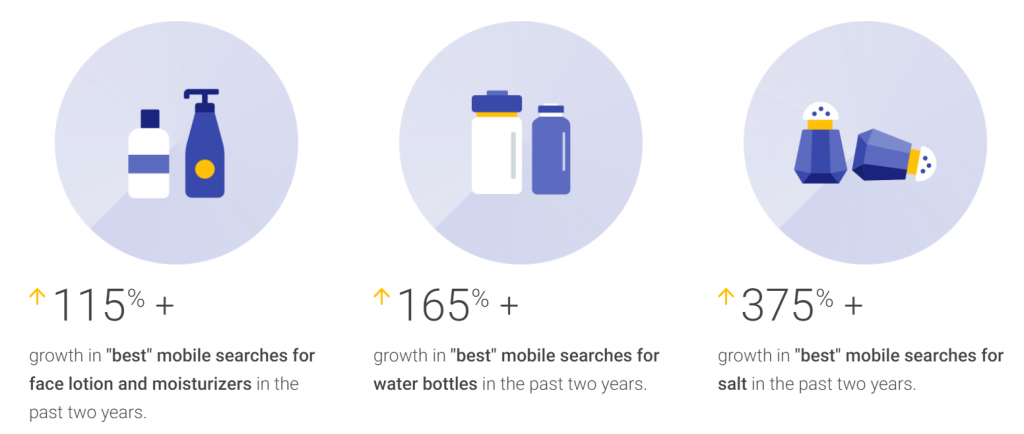
Because people have access to an unprecedented amount of information, they are more inclined to ask questions. When the answers are always close to hand, this is an understandable development.
Google has seen some interesting trends over the past two years, including an increase of 150% in search volume for [best umbrellas]. What was once a simple purchase is now subject to a more discerning research process.
Higher expectations
Although there is initial resistance to some technologies that fundamentally change how we live, once we are accustomed to them we quickly start to expect more. In 2015, Google reported that it had seen a 37x increase in the number of searches including the phrase “near me”.
Consumers now expect their device to know this intent implicitly and Peter revealed that the growth in “near me” phrases has slowed considerably.
Decreased patience
As expectations grow, patience levels decrease. In fact, there has been an increase of over 200% in searches containing the phrase “open now” since 2015 in the US. Meanwhile, consumers are coming to expect same-day delivery as standard in major metropolitan areas.

Throughout all of these changes, Peter Giles made clear that brands need to focus on being the most helpful, available option for their target audience. By honing in on these areas, the ways in which consumers access the information are not so important.
The more significant factor is making this information easy to locate and to surface, whether through search engines, social networks, or digital assistants.
The past, present, and future of PPC and SEO
Brainlabs’ exec chair Jim Brigden reflected on the history of the paid search industry, going back to the early 2000’s when most brands were skeptical of the fledgling ad format’s potential.
In fact, only £5 million was spent on paid search in the UK as recently as 2001. The industry’s growth, projected to exceed $100 billion globally this year, should also give us reason to pause and consider what will happen next. The pace of change is increasing, so marketers need to be able to adapt to new realities all the time.
Jim Brigden’s advice to budding search marketers was to absorb as much new knowledge as possible and remain open to new opportunities, rather than trying to position oneself based on speculation around future trends. Many marketers have specialized in search for well over a decade and, while the industry may have changed dramatically in that time, its core elements remain largely intact.
This was a topic touched on by Lisa Myers of Verve Search too, when discussing organic search. For many years, we have discussed the role (and even potential demise) of SEO, as Google moves to foreground paid search to an ever greater degree.
Myers’ presentation showcased just how much the SEO industry has changed, from link buying to infographics, through to the modern approach that has as much in common with a creative agency as it does with a web development team.
Just one highlight from the team at Verve Search, carried out in collaboration with their client Expedia, was the Unknown Tourism campaign. Comprised of a range of digital posters, the campaign commemorates animals that have been lost from some of the world’s most popular tourist spots.

Such was the popularity of the campaign, one fan created a package for The Sims video game to make it possible to pin the posters on their computer-generated walls. Verve has received almost endless requests to create and sell the posters, too.
This isn’t what most people think of when they think of SEO, but it is a perfect example of how creative campaigns can drive performance. For Expedia, Verve has achieved an average increase in visibility of 54% across all international markets.
The core lesson we can take away here from both Jim Brigden and Lisa Myers is that the medium of search remains hugely popular and there is therefore a need for brands to try and stand out to get to the top. The means of doing so may change, but the underlying concepts and objectives remain the same.
The predictable nature of people
For the final part of the evening, Jim Brigden was joined by Dan Gilbert, CEO of Brainlabs and the third most influential person in digital, according to Econsultancy.
Dan shared his sophisticated and elucidative perspective on the search industry, which is inextricably linked to the intrinsic nature of people.
A variety of studies have shown that people’s behavioral patterns are almost entirely predictable, with one paper noting that “Spontaneous individuals are largely absent from the population. Despite the significant differences in travel patterns, we found that most people are equally predictable.”
As irrational and unique as we would like to think we are, most of our actions can be reduced to mathematical equations.
That matters for search, when we consider the current state of the industry.
After all, companies like Google excel at creating rational systems, such as the machine learning algorithms that continue to grow in prominence across its product suite.
As Dan Gilbert stated, this gives good cause to believe that the nature of search will be fundamentally different in the future.
Our digital assistants will have little reason to offer us a choice, if they already know what we want next.
That choice is the hallmark of the search industry, but Gilbert sees no reason to create a monetizable tension where no tension needs to exist.
Google’s focus has always been on getting the product right and figuring out the commercial aspect once users are on board and this seems likely to be the approach with voice-enabled assistants.

In fact, the technology is already available to preempt these decisions and start serving consumers content and products before they even know they want to receive them. The field of predictive analytics has evolved significantly over the last few years and the capability to model out future behavioral trends is already in use for companies like Netflix and Amazon.
The inflection point for this technology is dependent on people’s readiness to accept such a level of intrusion in their daily lives, rather than any innate technological shortcomings.
History suggests that, while a certain initial resistance is to be expected, ultimately we will grow accustomed to this assimilation of technology into our lives. And, soon after, we will grow impatient with any limitations we encounter.
That will create a seismic shift in how the search industry operates, but it will open up new and more innovative ways to connect consumers with brands.
from Search Engine Watch http://ift.tt/2CLTqEw


Use Status Pages to Evaluate Cloud-based Vendors
Evaluating the performance of cloud-based vendors can be tricky. You can read reviews, but it’s sometimes difficult to find unbiased opinions.
One little-known method of evaluating cloud platforms is to analyze ...
The post Use Status Pages to Evaluate Cloud-based Vendors appeared first on Practical Ecommerce.
from Practical Ecommerce http://ift.tt/2GPDPpU
Sprint names first 6 ‘5G-ready’ cities for 2018’s Massive MIMO rollout

Though Sprint’s 5G cellular network won’t go online until “the first half of 2019,” the carrier today named the first six cities that will receive “5G-ready” network upgrades in 2018, enabling select phones to enjoy “5G-like capabilities” before the official 5G launch. This April, Sprint will bring a radio technology called Massive MIMO to cell towers in Chicago, Dallas, and Los Angeles, followed by Atlanta, Houston, and Washington, D.C. later in 2018.
Sprint describes the 4.5G technology Massive MIMO as “a critical bridge” and “a huge step toward Sprint being first to offer a 5G mobile network.” Massive MIMO uses a large collection of transmitting and receiving antennas to transfer data simultaneously, enabling much faster data speeds than only one or two antennas can achieve.
Built by Ericsson, Nokia, and Samsung, Sprint’s Massive MIMO radios contain 128 small antennas per unit, with 64 transmitting and 64 receiving. The units will start by offering 4G service, but will be “software-upgradable to 5G without additional tower climbs,” and can operate in split modes to support 4G and 5G devices simultaneously.
The good news for Sprint customers is that some Sprint phones will be able to take advantage of Massive MIMO this year. Any 4G/LTE phone with support for 2.5GHz (band 41) spectrum will see “significant increases in data speed and capacity” when connected to towers with Massive MIMO. It’s unclear what speeds Sprint expects to deliver with Massive MIMO over 4G, but a multiple of two to four times current speeds would not be unusual. Sprint says only that its new hardware offers “up to 10 times the capacity of current LTE systems,” which should help improve overall performance for customers in high-traffic locations.
Importantly, Sprint will continue to use 2.5GHz spectrum for 5G, noting that its “160 MHz of 2.5 GHz spectrum in the top 100 markets” will give it a unique ability to offer 4G and 5G simultaneously nationwide. Qualcomm’s Snapdragon X50 5G modem supports band 41, which will mean even faster data speeds and markedly reduced latency in next year’s 5G phones.
As the fourth-largest U.S. carrier, Sprint’s strategy for 5G differs considerably from competitors. Unlike AT&T, which has announced plans to sell 5G wireless hotspots this year, and Verizon, which intends to sell 5G home and office broadband modems this year, Sprint is holding off on selling 5G hardware until 5G smartphones are available in 2019. However, its decision to rely on already-purchased 2.5GHz spectrum for 5G — as well as adding more towers with 800MHz and 1.9GHz support — may give it a practical advantage over rivals that are still working to acquire lower and higher frequency spectrum, which is expected to deliver superior data rates.
from Social – VentureBeat http://ift.tt/2Cobclx
What These 5 Statistics Can Teach You About E-Commerce Marketing

Sound marketing relies on a foundation of informed decision making. The better we understand the e-commerce marketplace, the better we will be at marketing ourselves in it. That’s why, today, I’ve collected five statistics that say something important about this marketplace, along with my advice based on the facts presented here.
Let’s dive in.
1. Customers Are Twice as Likely to Leave a Review If You Ask
According to the Trustpilot “How Consumers Use Reviews Today” report, only 14 percent of consumers are “very likely” to write an unsolicited review, while 29 percent are “very likely” to write a review if the company invites them to.
The report discovered other related points, such as:
- 19 percent of consumers are reading reviews before they visit a company website.
- Most consumers (about 57 percent) are using search engines to find those reviews.
- 79 percent of consumers want to see companies respond to negative reviews.
- 89 percent check reviews at least sometimes when they shop.
- 47 percent of consumers check online reviews while on a brand’s website, before putting items in their cart. In other words, consumers are checking to see what previous customers think of products while they are actively shopping.
It’s impossible for the modern e-commerce site to neglect views and claim to have a complete marketing strategy. The stats above make it clear that reviews are strongly influencing consumer behavior. The report may even underestimate how strong of an impact it makes to ask customers for a review.
If you’re concerned that asking customers to leave reviews will lead to more negative reviews, you shouldn’t be. In my experience, people are far more likely to leave negative reviews on their own than positive ones.
Just as importantly, no matter what people might say in surveys, scientific research published in the Association for Psychological Science indicates that people favor products with more reviews, regardless of the star rating.
Retailers that display ratings on their sites see conversion rates rise by 270 percent, and people are actually more likely to buy products in the 4.0- to 4.7-star range than products with a perfect five-star score.

In short, ask your customers to leave reviews in your communications, and make it as easy as possible for them to do so.
2. 9 Out of 10 Consumers Prefer Personalized Sites
According to a study conducted by Swirl Networks, 88 percent of consumers say that the more personalized and interconnected their online, mobile, and in-store experiences are, the more likely they are to shop with that retailer. 87 percent of consumers also said they’d be more loyal to a retailer who was capable of accomplishing this.
The same study found that 56 percent of consumers feel Amazon understands their needs on a regular basis. This number dwarfed traditional retailers, where only 25 percent of consumers felt the same way. This has clearly played a part in Amazon’s success.

Any talk of personalization in today’s e-commerce scenario is incomplete without exploring the usefulness of chatbots. Forrester research shows that live chat is expected and effective, with 44 percent of customers agreeing that it’s one of the most important features an online business can offer. It is therefore essential that businesses harness customer data in such a way that marketing and support teams can use it to deliver better, more personalized service.
There are the tools out there to help you accomplish this within your budget and with almost no programming resources. Morph.ai, for example, is a chatbot building platform that suits small businesses and retailers. This software lets you create chatbots that use “conversational marketing.” This means you can have one-on-one conversations with your customers, take orders directly from Facebook Messenger, transact using all payment systems, and provide instant service.

Modern consumers expect live support, sites that understand their preferences, and expect communications from the company to be tailored to their purchase and interaction history, and customer support to be clued in on what is happening so that they can deliver results quickly.
E-commerce sites that ignore this fact will struggle to find success.
3. B2B Shoppers Conduct an Average of 12 Searches, Consumers Visit at Least 3 Sites
According to research by Google, B2B influencers conduct an average of 12 searches before they engage with a specific brand’s website. Search is the number one place these decision makers are performing their research. In fact, 90 percent of B2B shoppers use search specifically to inform their business purchases.
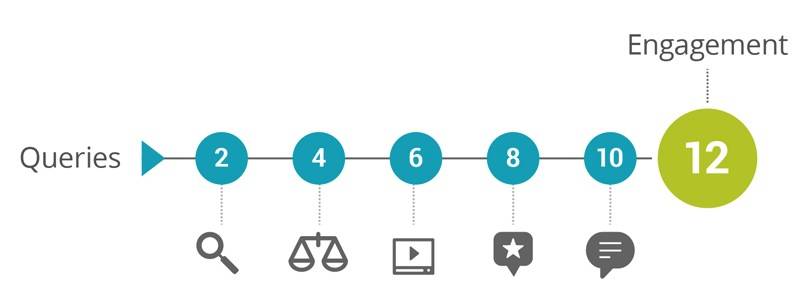
Seventy-one percent of B2B researchers start their research with a generic search, not a branded query. If you want to be exposed to these decision makers sooner rather than later, you should be targeting these more general informational queries.
But if you think this behavior is limited to the B2B sector, you’re mistaken. While reliable data is harder to come by, the average consumer visits three stores before they make a purchase, and 60 percent of them use a search engine to find the products that they want.
The lesson here is one the marketing industry has wholeheartedly embraced: Customer relationship management and marketing automation software play a huge role in setting and managing expectations, and there’s no excuse for modern businesses to avoid using them.
And if you thought a CRM is expensive, you couldn’t be more wrong. HubSpot’s CRM, for instance, is totally free and gives marketers an up-to-the-minute view of the sales funnel, qualifies leads, and automatically tracks customer interactions across multiple channels—on email, social media, or phone calls.

When you’re trying to convert prospects, proper keyword targeting and remarketing tend to have the highest immediate conversion rates. However, relevant information at the right time is the main contributor to sales and separates small-time retailers from the big successes.
4. E-Commerce Shoppers Spend Nearly as Much On Brands as On Marketplaces
According to a study conducted by e-commerce platform BigCommerce, the perception that all of the money is going to Amazon and marketplace sites like it is flat out wrong. In reality, e-commerce shoppers spend almost as much on single brand websites as they do on marketplaces. Shoppers spent an average of $409 on brand websites, compared to $488 at marketplaces.
Many people equate e-commerce with the marketplace model. However, when Amazon is taken out of the equation, it is actually the exception rather than the rule. Amazon accounts for 43 percent of online US retail sales. That means that outside of Amazon, brand websites are making the most money, not marketplaces.
In fact, the same study found that while slightly more money was going to marketplaces than brand websites, the reverse was true in number of consumers. More shoppers had visited a brand website (74 percent) than a marketplace (54 percent).
I’m not trying to argue that marketplace e-commerce sites should abandon their business model. But I am highlighting the value of branding and how strong its impact can be. Obsession with Amazon’s business model can cloud your judgment if you aren’t careful. Offer exclusive products, and find innovative ways to differentiate your brand.
Outside of Amazon, brand websites rake in the most e-commerce dollars, not marketplaces.
Click To Tweet
5. Price, Shipping, and Discounts Are Hugely Influential
We online marketers spend a lot of time talking about the importance of identifying a unique selling proposition and competing on differentiators other than price. But it would be a huge mistake to conclude that price is anything less than incredibly important.
The BigCommerce trends report we referenced earlier also found that the top three factors considered “very” or “extremely” influential in deciding where Americans shop were price (87 percent), shipping cost and speed (80 percent), and discount offers (71 percent).
Now, I understand that small retailers struggle to compete with big ones on price. Competing on price alone is a losing strategy for all but one retailer. It offers no lasting branding on its own, either.
But we need to understand how incredibly price-conscious our shoppers are. If you are selling the exact same make and model as another retailer at a higher price, you aren’t going to move a lot of product. In fact, you may need to consider if it’s worth having the product in stock in the first place. Pushing for exclusive items is crucial in order to offer something of value when you cannot compete on price.
Here, you have the most control over shipping costs. Folding the cost of shipping into the price of the product and offering free shipping almost always has a positive impact on conversion rates. While most consumers are at this point savvy enough to know that they are still paying for shipping, the certainty in pricing is a major draw.
The post What These 5 Statistics Can Teach You About E-Commerce Marketing appeared first on Convince and Convert: Social Media Consulting and Content Marketing Consulting.
from Convince and Convert: Social Media Consulting and Content Marketing Consulting http://ift.tt/2F9IhD2
15 actionable SEO tips to improve your search rankings
Google’s RankBrain is an algorithm that uses machine learning and artificial intelligence to rank results based on feedback from searcher intent and user experience.
Diving deep to learn what makes RankBrain tick, here are 15 actionable tips to improve your SEO rankings.
Optimizing keyword research
Keywords have long been the foundation to high-ranking SEO content. Most of your content, whether it be blogs or website copy, begin with hours of definitive keyword research you could rank for, and outrank your competitors for.
However, RankBrain has in some ways changed those run-of-the-mill SEO keyword research strategies you may have used in the past. It is all about searcher intent when it comes to the future of ranking, so it’s time to adjust your keyword research strategy.
1. Rethink synonymous long-tail keywords
Long-tail keywords were once effective, before Google used semantic analysis and understood the meaning of words. You were able to compile a list of long-tail keywords from Google’s “related searches” at the bottom of a SERP and create a page for each keyword.
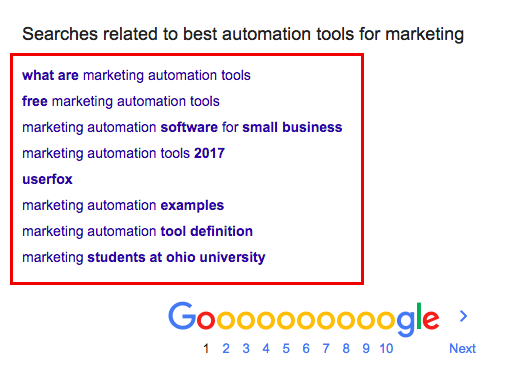
Unfortunately, synonymous long-tail keywords are not as effective in the RankBrain SEO world. RankBrain’s algorithm is actually quite intelligent when it comes to differentiating very similar long-tail keywords. Instead of ranking for multiple keywords, it will deliver pretty much the same results to a user.
For example, the long-tail keywords, “best automation tools for marketing” and “best marketing automation tools” will return the same results to satisfy searcher intent.

So what do you do instead of leveraging those long-tail keywords? Read on to find out how to do RankBrain-minded keyword research.
2. Leverage medium-sized keywords
Since long-tail keywords are on their way out, you should begin optimizing for root keywords instead. Root keywords are the middle of the pack search terms with higher search volume than long-tail. They are more competitive and may require more links and quality content to rank.
For example, let’s say you are crafting an article with “lemon tea” as your primary keyword. Your keyword research should look something like:
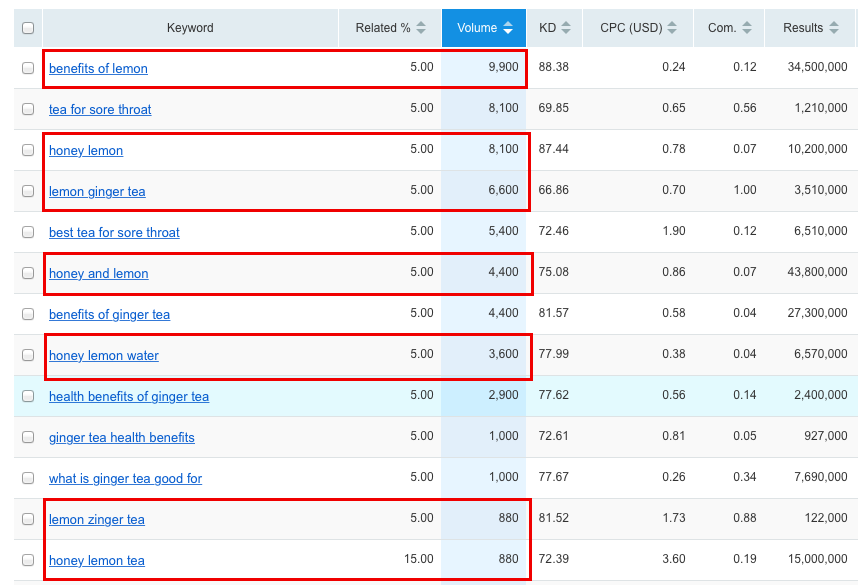
You’ll notice that there are a number of medium sized keywords to choose from. Interestingly, the primary keyword “lemon tea” only nets about 3,600 monthly searches.

However, medium sized keywords like, “benefits of lemon” and “honey lemon” drive around 8,000 to 9,000 monthly searches.
Using medium sized keywords in the RankBrain SEO world will also automatically rank your content for a number of other related keywords. If you want to optimize your content for highest SERP position possible, use medium-tail keywords.
3. Add more LSI keywords
Now before you toss out the idea of long-tail keywords altogether, it is important to understand that they still have some benefits. For instance, they help you identify the LSI keywords RankBrain loves to rank content for.
This doesn’t mean you should keep using those synonymous long-tail keywords, but you should leverage the LSI potential of them. These would be any words or phrases very strongly associated with your topic.
Using the previous “lemon tea” example, you can easily identify a number of excellent LSI keywords for that primary keyword. How? Good question!
One way is to use Google’s “related searches” and note any words in bold blue.

You can also use Google’s drop down to help you identify commonly searched for LSI keywords.
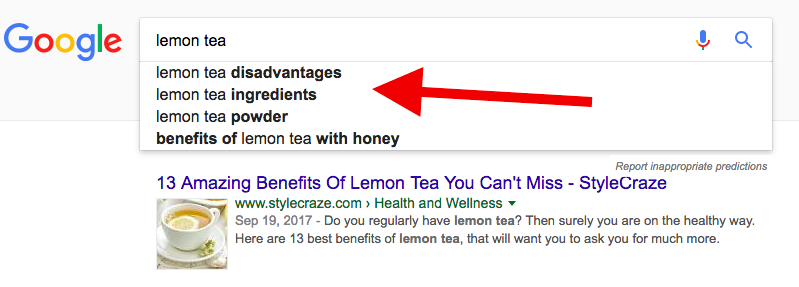
You can also use a handy little LSI keyword finder tool called LSI Graph:

Simply type in your primary keyword and LSI Graph will return a number of LSI Keyword rich phrases for you to choose.
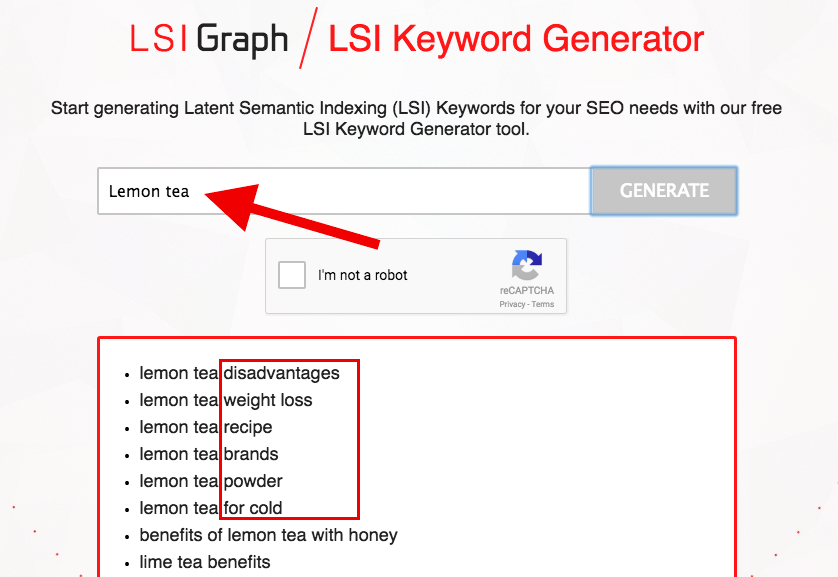
Between Google and LSI Graph you can compile a number of powerful SEO LSI keywords like:
- Disadvantages
- Ingredients
- Powder
- Benefits
- Weight loss
- For cold
- Brands
- Recipe
These LSI keywords will give you more keywords, and pages, to rank for, as long as they are not synonymous like in the case of those traditional long-tail keywords.
Optimizing title tags for higher CTR
Organic click-through-rate (CTR) is a major signaling factor. In fact, the very nature of RankBrain is all about how users interact with the content provided in the SERPs.
Want to improve your SEO rankings? First improve your CTR!
What can you do to ensure your content is netting the CTR it deserves in order to get ranked accordingly? Well, there are actually a number of CTR hacks to improve your SEO rankings.
4. Make your title tags emotional
Putting a little emotion into your title tags can have a big impact on your CTR. Most searchers will land on page one of Google and start scrolling through titles until one hits home emotionally.
In fact, a study by CoSchedule found that an emotional score of 40 gets around 1,000 more shares.

Emotional score, what is that? CoSchedule actually has a Headline Analyzer to ensure your blog titles, email subject lines, and social posts are appealing to your audience’s emotions.

Drawing from our “lemon tea” example, let’s say you type, “7 Lemon Tea Benefits” into the Headline Analyzer. Not a great title, and these were the results from the analyzer tool.

A score of 34 will get me near 1,000 shares, but it could definitely be better. The title definitely needs a bit more emotion and it needs to be longer.

Let’s try it again. This time with the title tag, “7 Lemon Tea Weight Loss Benefits for Summer,” which did much better.

It can be challenging to pick a title that brings about emotion. The best way to nail down the perfect title tag is to think like your audience, research other high-ranking titles like yours, and use online tools.
5. Use brackets in your titles
This is definitely an easy one to implement to quickly improve your CTR and SEO rankings. By using brackets in your post titles, you are drawing more attention to your title among the masses in SERPs.
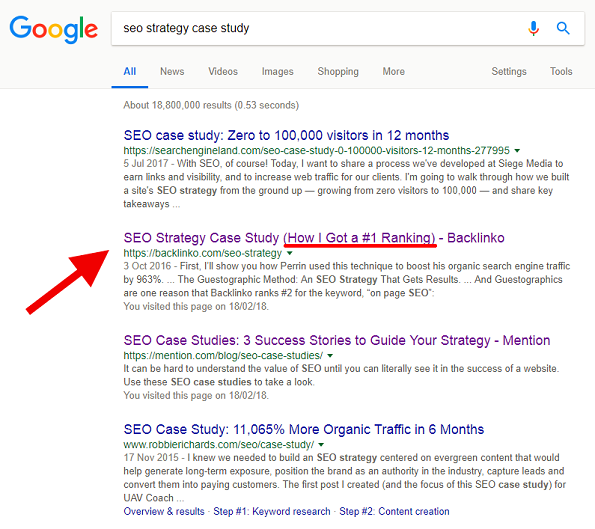
In fact, research by HubSpot and Outbrain found that titles with brackets performed 33 percent better than titles without.

This was a study that compiled 3.3 million titles, so quite a large sample. A few bracket examples you can use include, (Step-By-Step Case Study), (With Infographic), (Proven Tips from the Pros), or (How I Got X from Z).
6. Use power words
In the same mindset of developing more emotional title tags to increase CTR, power words are, well, powerful. They have the ability to draw searchers in and will make your headline irresistible.
Power words include:
- Insane
- Effective
- Case study
- Fast
- Proven
- Best
- Definitive guide
- Scientifically
For example, these titles in page one Google take up the top three positions.
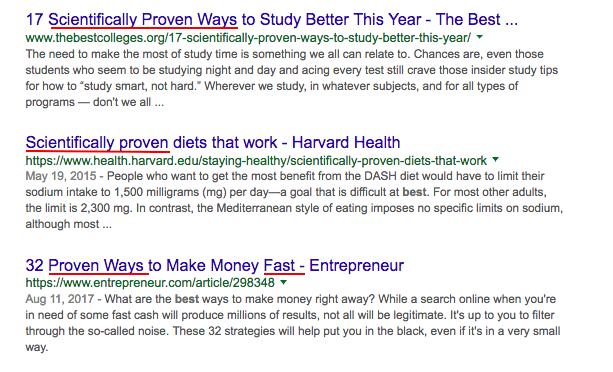
Increase your CTR and improve your SEO rankings by adding power words into your post titles. But don’t forget about those numbers either.
7. Use more numbers and statistics in titles
Lists are great, but don’t shy away from adding numbers and statistics to your titles. Numbers in titles highlighting percentages from research or a certain number of days can have a big impact on your content’s CTR.
Your headlines could look something like these:
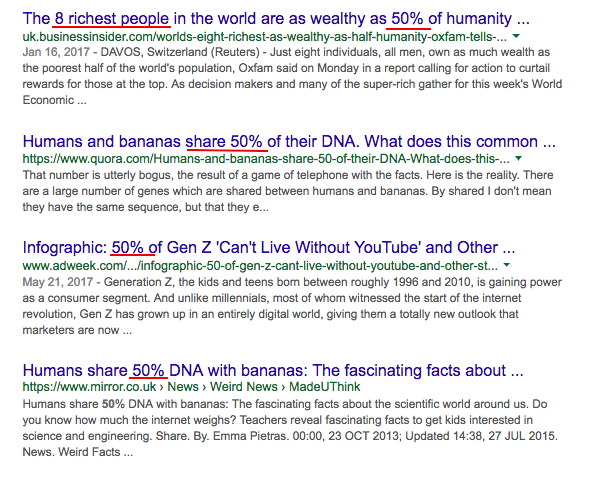
For example, let’s say you are writing content about a new study outlining the benefits of a low glycemic diet for decreasing acne. If the study found 51 percent of participants to have decreased acne after 14-weeks, your title could be, “New Study Found a 51% Decrease in Acne after 14 Weeks.”
You can also combine your numbers with power words for the perfect CTR storm. Like this:
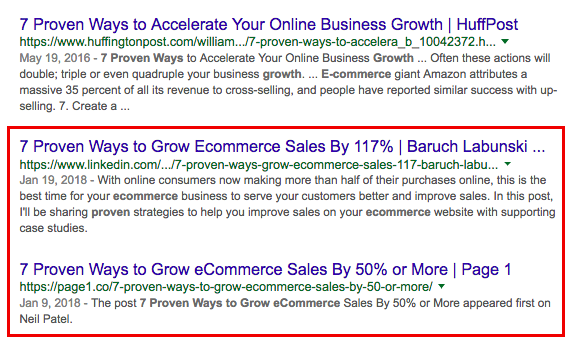
With your title tag optimization efforts well under way, it’s time to focus on those very important description tags.
Optimizing description tags for higher CTR
Title tags are not the only aspect of a higher CTR to improve your SEO rankings. Someone may have stopped scrolling at your title, but may read your description tag just to be sure your content is click-worthy. This makes optimizing your description tags a priority.
8. Make your description tag emotional too
Just like your title tag, you want to keep the emotional juices flowing if a searcher reads your description tag. This can be done in a similar fashion as your title tag, using those powerful emotion words that satisfy searcher intent in a meaningful way.
Here’s one example:
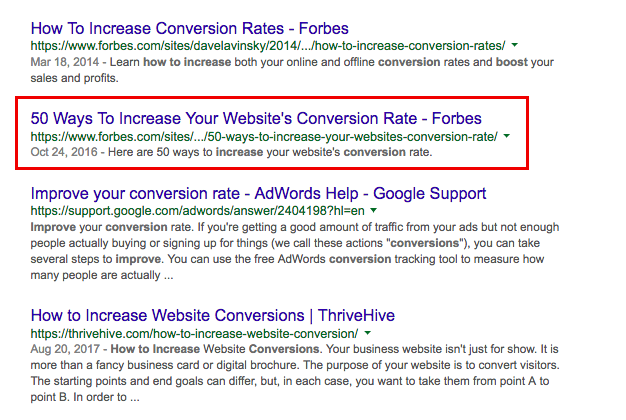
Not exactly stirring up the emotions you would want if searching for information on how to increase your website’s conversion rates.
Now how about this one:

This description tag points out a problem that many business owners have, traffic but not so many conversions.
And finally this description tag:
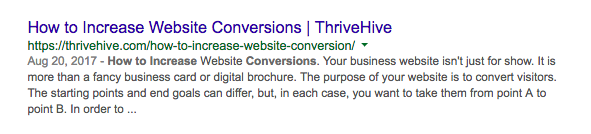
This longer form approach puts conversions into emotional perspective. It is personal and has a very clear emotional call to action.
9. Highlight benefits and supporting data
Why would anyone want to click on your content based solely on the description tag? This is the mindset that will take your CTR to the next level. Don’t be afraid to highlight the benefits or the supporting data you are serving up.
This is a great example of highlighting where the content data is coming from, as well as the benefits.

Creating content after an industry conference is the perfect way to highlight key takeaways for your audience. It is also makes developing those emotional description tags easy.
10. Make use of current AdWords content
One description tag hack many people fail to leverage is using keywords and phrases placed in multiple relevant AdWords description tags. If you want to optimize your description tags for improved SEO rankings, this CTR hack is a must.
For example, if your content was about marketing automation tools, you could run a quick Google search and find a number of ads. Then examine them to find recurring words or phrases, like “ROI.”
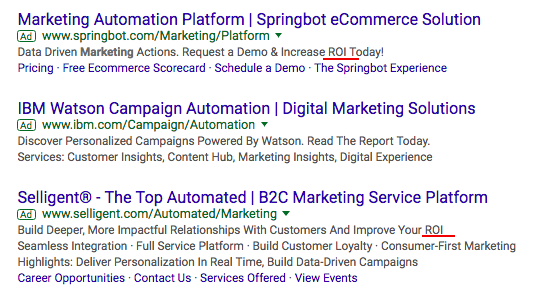
This would be a pretty good indicator that you should place ROI somewhere in your description tag. After all, companies are paying thousands of dollars to have these ads up and running daily, so capitalize on their marketing investment.
11. Don’t forget your primary keyword
This should be a no-brainer, but still happens. Placing your primary keyword in your description tag solidifies that your content is indeed going to fulfill searcher intent.
Like these examples:
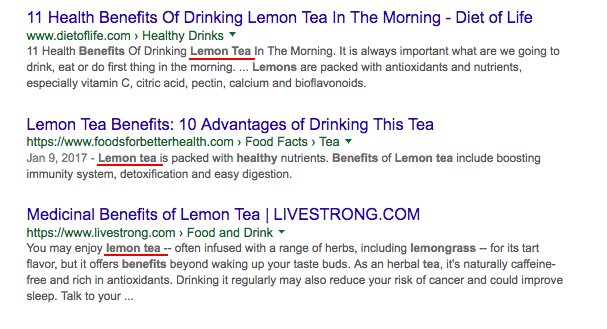
Be sure to place your primary keyword as close to the beginning of your description as possible. You can also sprinkle in a few of your LSI and power keywords as well, if it reads naturally.

Reducing bounce rate and dwell time
The RankBrain algorithm looks at your content CTR and will rank it accordingly. However, if your content isn’t quality after a user clicks on it, they will “bounce out” quickly and keep searching.
This ultimately weeds out any clickbait and emphasizes the need to have a very low bounce rate and long searcher dwell time on page. The more you optimize for these two very important factors, the more your SEO rankings will improve.
But what is dwell time? Well, this is how long a searcher will spend on one particular page. Like anything sales minded, you want them to stick around for a while.
In fact, the average dwell time of a top 10 Google result is three minutes and ten seconds, according to a Searchmetrics study. How do you get searchers to stick around for three minutes or more? Develop quality, authoritative content that satisfies searcher intent.
12. Place content above the fold
When someone is searching for an answer to their question on Google, they want their answer immediately. This makes having your content (introduction paragraph) above the fold crucial to keeping bounce rate low.
An example of what could cause a quick “bounce out”:

You’ll notice that there is no content to be found but the title tag. In fact, the brand logo takes up much of the above the fold area. This could be problematic.
Instead, get your content front and center once a searcher lands on your post or page.

This will showcase your introduction right from the get go, making the searcher read on. But how do you hook them? Well, highly engaging introductions.
13. Develop concise and engaging introductions
By making your content above the fold, your introduction will be the first thing readers will see. This makes hooking them with a concise and engaging introduction essential. This will keep them reading and reduce bounce rate while increasing dwell time.
There are three main elements to a powerful introduction: Hook, Transition, and Thesis.
The intro hook should pull in the reader. It is specific, brief, and compelling. For example:
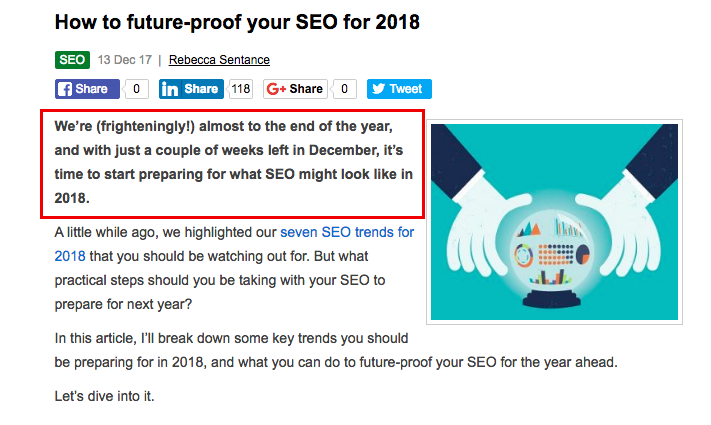
Introduction Transitions are usually connectors. They connect the hook to the posts content and supports the title (why a searcher clicked in the first place). An introduction looks like this:
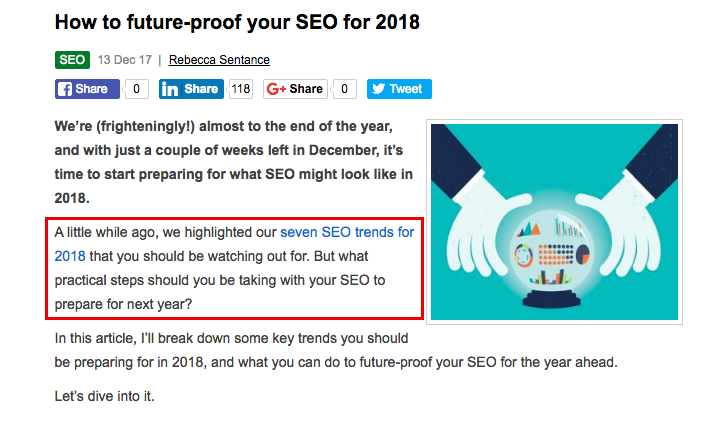
The thesis of any post introduction strengthens why the reader should keep reading. Normally, if your transition is powerful, the thesis will simply fall into place. For instance:
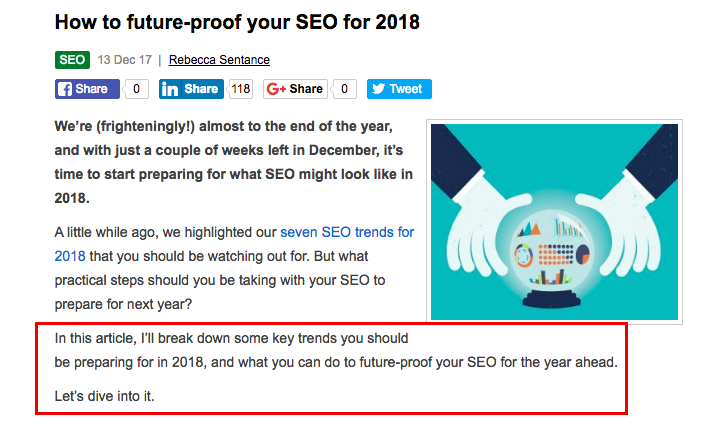
Spend some time on your introductions. These are in many ways the most important element of any content and will improve your SEO rankings in the RankBrain world.
14. Long, in-depth content ranks
One way to improve your SEO rankings is to develop longer, more in-depth content. Long-form content also increases your backlink portfolio, according to HubSpot research.

More links and higher position on SERPs will definitely have an impact on your SEO rankings. If a reader makes it through your entire post, dwell time will definitely be in upwards of three minutes.
More in-depth content also showcases your expertise on the topic you’re writing about. This makes you and your brand more authoritative in your industry.
15. Make content easy to digest
You know that long, in-depth content improves dwell time, ranks better, and nets more backlinks. But how do you make 2,000-plus words easy to digest for your readers?
The best way to keep your readers from experiencing vertigo on page is to break up your content with lots of subheadings and actionable images. For example, you can do something like this:
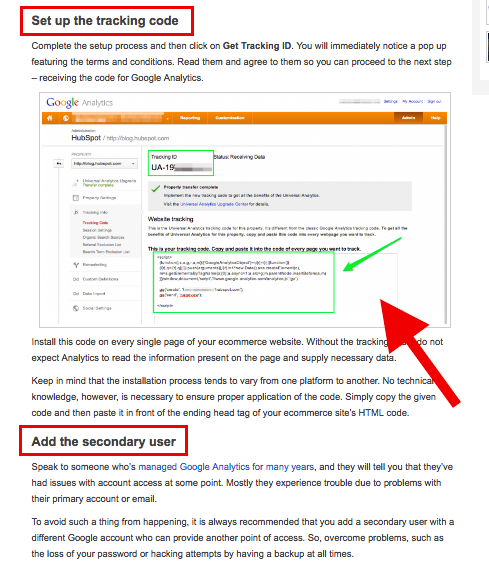
Subheadings are very clear and there’s an actionable image that guides readers on just “how-to” achieve the answers to their questions.
Another important tip for breaking up your long-form content is to keep paragraphs very short and concise.
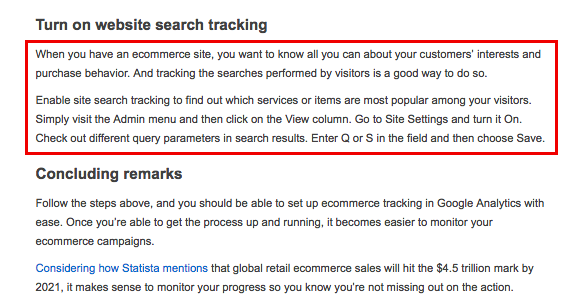
Paragraphs can be two to three sentences long, or simply one long sentence.

The main aim is to ensure readers can avoid eyestrain and take in all the authoritative information you outlined in your content. This will keep readers on page and increase your dwell time, thus improving your SEO rankings.
Conclusion
If you are ready to adapt your SEO strategies to new developments in AI and the evolution of Google’s algorithms, follow the tips above to start seeing improved rankings.
As algorithms evolve, so should your strategy. Have you tried optimizing for RankBrain? What are your favorite tips?
from Search Engine Watch http://ift.tt/2EUTLuF