Wednesday, 27 February 2019

Link building for bloggers

As your blog grows, the situations you’re dealing with seem to become harder. Whoever says blogging is for the lazy, has not dealt with optimization for search engines, the ever-changing algorithms of Facebook and Instagram, the best practices of Pinterest or the ever dreaded link building.

What is link building?

Link building means, in short, that you’re getting links from other websites to your own blog. It helps your posts to rank. Link building is not an easy task, as you are depending on third parties to link to your website. And not only that, you don’t want a link from every website. Spammy websites or websites that have little to do with your niche, are not valuable at all. I’ve tried link building, the holistic SEO way, and will share my experiences here. If you want to learn more about this, read this article Marieke wrote about link building from a holistic SEO perspective.

Asking for relevant links

To get relevant backlinks, you should know the websites you would like to get a backlink from. Send them a polite email requesting to place a link to your content, if it’s relevant to their audience as well. Please note that often, you will not get a reply at all. To improve your chances of getting a link to your website, your content should really be unique. Trying to get a link for a blogpost that is extremely basic and could’ve been written by anyone, is less likely to succeed than when you provide some very good content: content people can only find on your website. If you, for example, are a planner guru or the nation’s funniest mom blogger, it’s way easier to get a link to your website than if you just started out.

Facebook Groups

Do your hands get sweaty by the idea of having to email your fellow bloggers to ask for links? Fear not! Luckily, there are a lot of Facebook Groups, where bloggers post they might be working on a blog post that, for example, collects the best recipes for Easter, the best bullet journal tips or something different. You can often drop your link in the comments if you’ve written about the topic requested and with a little bit of luck, you’ll be featured in a blog post. It depends on your country which Facebook groups could be suitable, so ask your fellow bloggers or look around on Facebook.

Guest blogging

Another option to get links to your website, is through guest blogging for other blogs. Often, blogs are looking for input from fellow bloggers and in return will let you link to your own content. You’ll not only get a link to your website from a relevant website, you’ll get attention from the readers of that particular blog as well. Visit your favorite blogs and check to see if they accept guest submissions. They’ll usually mention this on their contact page or their collaboration page. Please note that a website could have certain guidelines before they accept your guest blog. It has to be unique content, but it also has to be in line with that website.

Do your thing

Link building for bloggers can be hard. I’ve said it before and I’ll say it again. When you’re already working on optimizing your posts, finding your voice and creating original blog posts, you might not want to add another massive project to your list. Because that is what link building is: it is not something you do just once. That’s why I’ve decided to quit my attempts at link building. I find it removes the focus from my blog entirely and turns into a popularity contest, at least in my mind. Not only that, I am not someone who finds it easy to reach out to other bloggers to request links in their content.

Instead, I’ve decided to focus on my own website and on helping others. I’ve found that I’ve received backlinks whenever I give a talk at a conference or after I helped someone with their website. This is not something that I take for granted, but when it happens, I realize why I’ve spent a few hours helping a blogger out with a bug on her website. For me, this means that I stay true to my own beliefs without having to focus on an entire strategy that is not my thing. And I found out that this is a link building strategy in itself: it helps my reputation as a blogger in the Dutch community. Find whatever works for you. And if you are actively building links, could you tell me your strategy?

The post Link building for bloggers appeared first on Yoast.


from Yoast • SEO for everyone https://ift.tt/2XsGHT5

5G Will Enable the Industrial Revolution

We’ve been talking about 5G for a very long time and now the opportunity is really here, says Kathrin Buvac, President and CSO of Nokia Enterprise. “We’ve said for a number of years that 5G will enable the Industrial Revolution.” Buvac added. “It’s clear that 5G has to be a lot more than mobility services. When I talk with enterprise customers I really do believe that these productivity gains that are spoken about are real. Operational efficiencies, process automation, all the way to dark factory operations to full autonomy, that is really what’s coming.”

Kathrin Buvac, President of Nokia Enterprise and Chief Strategy Officer (CSO), discusses how 5G will enable the Industrial Revolution at the Bloomberg CEO Forum at the Mobile World Congress in Barcelona:

5G Will Enable the Industrial Revolution

We’ve been talking about 5G for a very long time and now the opportunity is really here. We’ve said for a number of years that 5G will enable the Industrial Revolution. It’s clear that 5G has to be a lot more than mobility services. When I talk with enterprise customers I really do believe that these productivity gains that are spoken about are real. Operational efficiencies, process automation, all the way to dark factory operations to full autonomy, that is really what’s coming.

Before we go to the deep depths of 5g technology I think they’re really two things. One is the convergence of IT and OT technologies. Enterprises need to bring their enterprise IT services and the operations technology together. That is not so easily done. The other thing is digital. Think about Amazon and Netflix and what they’ve done transforming physical goods, books into eBooks, and DVDs into streaming. That will not be possible unfortunately with Industry 4.0, meaning we cannot digitize a crane or a truck in a mine. That’s just not possible.

Industrial Digital Twins Powered Via 5G

What we will do is create digital copies of the big machines or robots. That is what we call the digital twins. What that has to do with 5G technology is that it all starts in connecting these sensors, these machines, these robots, these devices, the co-workers in the factories, in the minds, and in the energy networks. That is where ultimately we will need 5G technology because of the big promise of lower latencies or higher bandwidth capacity, etc.

I think there are a few geographies that are leading the industrial automation. I would say from our standpoint it’s clearly the US. It is clearly Germany where car manufacturing and many manufacturing opportunities are coming. It’s Japan and it’s a few other geographies across the globe that are really leading the pack right now in terms of the Fourth Industrial Revolution that we have to look into.

The Industrial Opportunity is Striking

One thing that is striking me is the industrial opportunity. Over 15 million industrial sites will be deployed in the next decade. We have today 6.5 to 7 million base stations deployed in LTE worldwide. So it’s more than double the number of industrial sites that we somehow all together need to deploy to enable IoT. How are we going to do that?

There is the issue of spectrum availability. We have to be super creative, whether that is shared license, CBRS, 3.5, large scale carrier subleasing spectrum, and making money through that. It’s so critical and that also determines which country, which geography, which enterprise customer will go first. Industrial devices will just not be as quickly available as the smartphone’s which will be made available this year. There is still a lag.

5G Is a Complete Redefinition of the Network

5G is a complete redefinition of the network. We have all discussed AI, edge, and cloud. But we have to bridge now for a couple of years for enterprise customers as we take them to 5G. The question is really because enterprise customers want to leverage productivity gains now, not tomorrow, like yesterday. The question is really how do we do that? Can we potentially provide private wireless networks, with the help of our telco customers, to enterprises that can then just be a software upgrade to 5G? We would do this while we deploy industrial sites today based on LTE technology.

Enterprise customers are wired a little bit differently than us consumers. think about uplink video. We’re just so used to down-linking from tablets as consumers. We need a lot of uplink capacity if we use email or if we browse. If for a millisecond the network doesn’t work it bothers us, but it’s not the end of the world. But we need six nines reliability in the network in order to make sure we have the unmanned vehicles in the mines or the robots and the factories running precisely with that accuracy. A lot of work is needed still to get the 5G networks where they need to be, but it’s really exciting times to build that infrastructure.

>> Watch the full Bloomberg CEO Forum discussion.

The post 5G Will Enable the Industrial Revolution appeared first on WebProNews.


from WebProNews https://ift.tt/2EbS2he

Shopify Excelled in 2018, Attracted More Merchants

Operating in the shadow of online marketplaces and located in Ottawa Canada, Shopify — an ecommerce platform provider — does not get as much attention as it should. A $41 billion business, Shopify is the choice of approximately 820,000 online merchants in 175 countries, growing from 600,000 in 2018.

The post Shopify Excelled in 2018, Attracted More Merchants appeared first on Practical Ecommerce.


from Practical Ecommerce https://ift.tt/2TlArNz

The Account-Based Marketing (ABM) Mega Guide

The 3 Best Copywriting Formulas for Email Marketing

copywriting formulas

Wouldn’t it be nice to have a recipe to follow when it came to writing your emails? A recipe that not only sparks interest among your subscribers, but also encourages them to complete a call-to-action? You can! Many marketers use copywriting formulas, which are proven structures to help you write all your copy faster and with greater likelihood of success. Copywriting formulas provide a starting point to help you organize your message for the most persuasive impact. It’s how you turn so-so copy into killer copy, and convert subscribers into buyers. Take a look at three tried-and-true copywriting formulas that are optimal for email marketing, below. You can also use them on your social media feeds or in blog headlines, too! That way, you reach your audience no matter where they are.

Copywriting Formulas for Email Marketing

Formula 1: F-A-B

You understand your product or service from the inside out, but it can be tough to communicate all the important details about it in an email or two. Plus, you run the risk of losing your reader’s interest if you drone on too long about your product features. Yes, it’s important to explain the features of your product — but where the magic happens is when you connect those features with the advantages and benefits they bring to your customers. With the F-A-B formula (which stands for Features, Advantages, Benefits), you can touch on your product’s bells and whistles, but you focus on why a person would find your product beneficial. Here’s the breakdown:
  • Feature: Briefly explain the elements of your product. Keep it short and sweet.
  • Advantages: Highlight why these features are unique and how they can make a difference in your customer’s business, life, etc.
  • Benefits: Showcase the value of your product and how it can solve your customer’s problems.
The emphasis is on why your product’s features are great and how they can help your customers rather than dissecting each feature ad naseaum. So, how can you implement this formula? It might look something like this:

{Insert feature} will help you {insert advantage} so you can {insert benefit}

Example of F-A-B in a Tweet: Our wireless Smart Robot Vacuum will clean your pet’s hair off floors and carpets, so you don’t have to spend time chasing down hairballs.

These same principles can be used in subject lines or stretched out to serve as body copy. For the latter, you may expand on the advantage and benefits in multiple paragraphs to really drive the value home.

Formula 2: P-A-S

It may not come as a surprise that P-A-S made our list, but it’s a tried-and-true copywriting formula that works for just about every scenario. In fact, marketing legend Dan Kennedy calls it the most reliable sales formula ever invented. Let’s take a look at how it works:
  • Problem: State your audience’s issue.
  • Agitator: Agitate the problem by talking about why it’s a problem in the first place.
  • Solution: Solve your audience’s issue by presenting your product or service as the solution.
This copywriting formula works best if you focus on the "A" aspect. To “agitate,” you need to stir up all the negative emotions attached to their problem. Make the reader squirm in their seat. Get inside their head. And just before they’re ready to scream “Enough!”, present them with a solution (your product or service!). (Not sure what your audience’s "P" — a.k.a. their biggest problem — is? Here’s a great guide to finding your subscribers’ biggest pain point.) Here’s how you could use it: State a problem: Got pet hair all over your carpet or floor? Agitate the problem: More pet hair means more time sweeping your floors. You're already busy enough. Do you really want to spend all this extra time cleaning when you could be doing other things? (Like napping or reading or watching Netflix.) Present the solution: Or you could control your pet hair problem with our new Smart Robot Vacuum. Just charge it, turn it on, and get back to your day. Like the F-A-B formula, the P-A-S formula translates well on platforms like Twitter, Facebook, or in headlines because of its directness. Using this same example, you could send a Tweet that says:

Pet hair everywhere? Spending more time cleaning up pet hair means less time for the things you want to do — like napping or watching Netflix. You could spend time sweeping every day, or you could let our Smart Robot Vacuum clean it up FOR you.

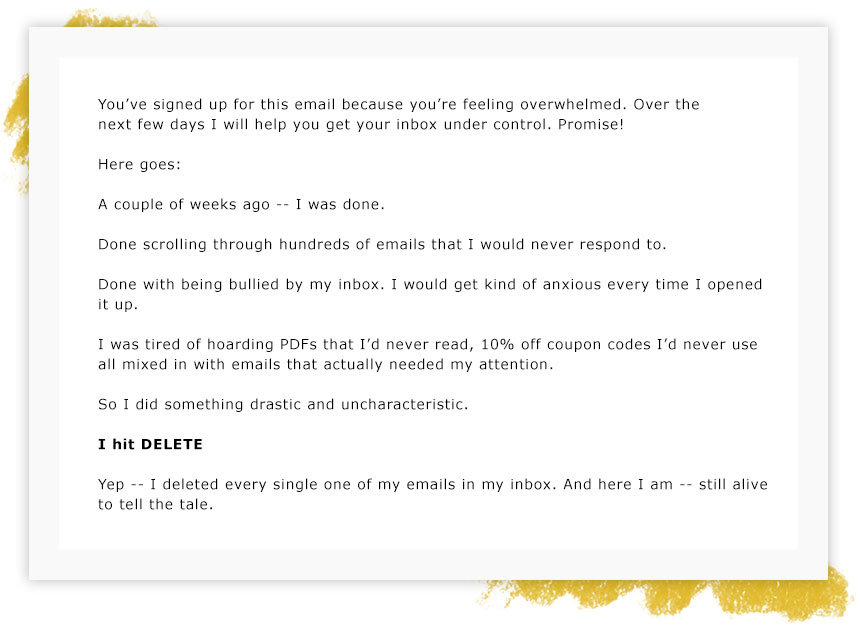
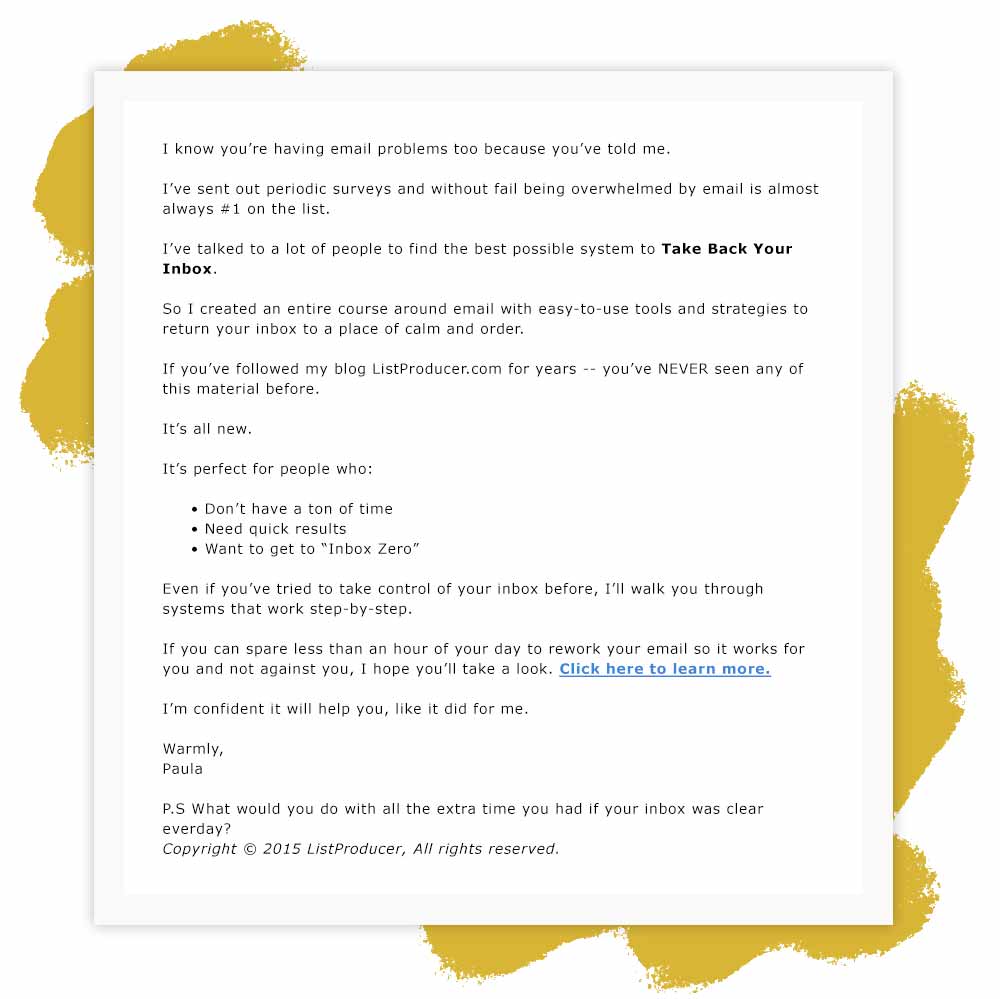
The P-A-S formula is excellent for subject lines, but it’s also a fast and easy way to explain your value proposition in a quick way. Many email marketing geniuses use this formula in their own emails. Here’s an example from Paula Rizzo, an AWeber user and a TV producer who has an entire side business called The List Producer. Through this business, she helps customers stay organized with various checklists and courses. Subscribers who sign up for Rizzo’s email below have stated they’re feeling a lack of control in their digital world. Their inbox is overflowing and they can’t keep up! In her first email, Rizzo welcomes her new subscriber, tells them a little bit about her business, and then launches into agitating their problem. The agitation section is shown below: PAS copywriting formula Then, Rizzo hits the reader with a solution: a paid course “Take Back Your Inbox: Stop Drowning in Unread Messages, Respond Quicker and Finally Achieve Inbox Zero.” (Check out all that’s included in her $47 course.)   PAS copywriting formula
Formula 3: A-I-D-A

A-I-D-A is arguably one of the most-used copywriting tactics of all. First, here’s what it stands for:
  • Attention: Catch the reader’s eye.
  • Interest: Pique their interest with a compelling setup.
  • Desire: Make them crave the thing you’re offering.
  • Action: Tell them how to get the thing.
This is a classic formula for selling, so it makes sense to deploy it in an email environment where you want readers to take action and move from their inboxes to the next stepping stone in the conversion path. Here’s how you could use it: Attention: No matter how much you love your pet, there’s probably one thing that drives you nuts. Interest: Pet hair is a never-ending battle (and it’s one you’re always losing). Right? Desire: Smart pet owners know it doesn’t have to be that way. The Smart Robot Vacuum is always on top of hairballs (so you don’t have to be). Action: Click here to get 20% off your purchase today only! With a simple, actionable setup that solves problem and reduces a customer’s pain points, this formula is a sales-driving machine not only in emails, but also on landing pages and in video scripts.

Stretch it out!

You can use these copywriting formulas in one email — or you can expand it over a series of automated emails. For instance, with P-A-S, you could use it over the following 5-email series: Email 1: Introduce the reader’s biggest pain point Email 2: Agitate the problem Email 3: Really get in there! Agitate the problem some more. Start to hint that there may be a solution for their issue... Email 4: Offer the solution — your product or service! Email 5: If the reader doesn’t convert, you can offer a coupon or special incentive to buy. Digital marketer gurus like Amy Porterfield, Henneke Duistermaat, and Jeff Walker have used similar email series when they launch a new online course or product.

Additional copywriting tips

Once you find a copywriting formula that works best for you, keep these tips in mind as you begin writing. Avoid jargon Using words that your customer may not understand is a quick way to lose their interest. Make sure they understand your message and what value you can provide them. Nail the subject line It’s been said a million times, but it rings true. Having a solid subject line that piques the interest of your subscribers will ensure the email content you worked so hard to create has a chance to be seen. Be sure to deploy A/B testing to find your strongest option. Related: 6 Email Split Tests You Can Set Up in 1 Minute Be conversational Being personable with your copy is a great way to engage with your customers and show them that there are real humans behind your brand. Conversational tones not only make your brand sound more relatable, but it’ll ensure your customers understand what you’re saying, too. For more email copywriting advice, check out our full list of copywriting tips.

Formulas save time and maximize ROI

Copywriting formulas are an excellent way to make sure you communicate your message clearly and present it in a way that will be most receptive to your audience. Different formulas work for various products and messages, so keep testing and tracking what you learn from each formula use. Ready to see a greater ROI on your email marketing? Sign up for AWeber today or contact a Customer Solutions member. (Our team is available 24/7 at our Pennsylvania headquarters!)

The post The 3 Best Copywriting Formulas for Email Marketing appeared first on Email Marketing Tips.


from Email Marketing Tips https://ift.tt/2Nu5MYY

Forecasting Marketing Data At Scale

Written By Annmarie Stockinger & Lindsay Stecklein

What if we told you that you can make informed decisions using forecasts for the most common business predicaments? And what if we sweetened the deal by saying you could have the answers to these questions constantly at your beck and call?…

The post Forecasting Marketing Data At Scale appeared first on Seer Interactive.


from Seer Interactive https://ift.tt/2GPnOES

Why Done is Better Than Perfect is Now a Broken and Unworkable Philosophy

Done is Better than Perfect is Now a Broken Philosophy

Facebook’s mantra for developers has long been “Move Fast and Break Things.”

This idea of doing something, even if it’s not ideal was also adopted by Facebook’s Sheryl Sandberg, who serves as the tech Oprah for millions of people. Her version of the slogan is “Done is Better than Perfect.”

In the startup and “personal brand” worlds, the premise of “just ship it” is dogma so universally embraced that it joins the “hustle” mantra to form the twin peaks of self-actualization.

Even acknowledged genius Seth Godin advocated for releasing work with known flaws. In his book Poke the Box, Godin urged readers to behave more like computer programmers, shipping out minimum viable products and improving them in real time. In this way, at least when he wrote the book in 2010/2011, Godin was aligned with the Facebook approach of anything goes, as long as it goes.

And in those days — just 8 or 9 years but seemingly a lifetime ago — customers were wandering around in slack-jawed wonderment, giddy about all the new innovations that improved their lives.

In 2010 alone, Facebook passed Google to become the most-visited website, making social networking fully mainstream.

The iPad was launched, creating a whole new computing category.

Foursquare got popular, kicking off the notion of location-based personalization.

Microsoft Kinect appeared for the Xbox 360, taking the “your body is the controller” trend up a level after it was created by Nintendo’s Wii.

The Apple app store took off, ushering in a whole new way to get software and media.

Netflix became the #1 app for iPhone in 2010, making portable streaming viable for all.

Groupon was Time Magazine’s #2 iPhone app for 2010, popularizing the daily deals business model.

In short, technology and customer experience advances were MASSIVE in this period, with meaningful shifts in consumer computing, connectivity, and entertainment.

And in this period, a philosophy of “Done is Better Than Perfect” may have added up. The public was justifiably blown away by the scope and scale of these advances, so if the Kinect was a little buggy or the app store was hard to figure out — whatever. It’s worth fighting the frustration to get access to something that has a fundamental impact on how you interact with others or spend time.

Today, however, the scope and scale of the advances are primarily in the “same but more” and “same, but a little better” category. Bigger TVs. Faster streaming. Some AR/VR frosting on the same, old cake. A paradox of choice at every turn. Even what is billed as “new” isn’t all that “new” these days.

And for their part, it’s vastly more difficult to shock and awe consumers today. All the amazing advances of the recent past have raised the bar again and again and again such that customer expectations are higher than ever and continue to escalate.

I vividly remember when the Taco Bell restaurant in my town went to 24-hours-a-day. It was like a magic trick performed with refried beans and a talking Chihuaha. Now, everything is 24-hours-a-day, and I couldn’t care less. I expect it now.

When Zappos popularized free, two-way shipping? We throw around the term “game-changer” with regularity, but that actually altered the fabric of e-commerce, forever. Today, most online stores offer free, two-way shipping. They can’t NOT do it, because consumers expect it.

This is the yoke of customer experience, and why CX optimization is so hard in companies. CX is one of the only elements of business where consumer expectations go up and up and up. What was a remarkable customer experience three years ago is commonplace today.

Simultaneously, the long-running economic expansion has also helped shape how and why customers buy. When times are bad, price becomes the primary criterion. But when times are good, consumers take other attributes into account when making a decision. And these days, customer experience is a driving factor in more, and more, and more purchases.

Research from Walker suggests that customer experience will be the deciding factor in a MAJORITY of B2B purchases by next year.

A research study from PwC shows that 75% of Americans say customer experience is an important factor in their buying decisions.

Further, consumers will pay up to a 16% price premium for a great experience.

And, 63% of consumers say they’d provide more, personal data in exchange for better CX.

In this present-day era, where consumers are making decisions that are significantly dictated by customer experience, how in the world do you justify putting a product or service into the marketplace that is knowingly less than great?

The whole idea of “Done is Better Than Perfect” is that speed trumps quality. But today, if you make that trade-off, you are strategically and purposefully sacrificing customer experience for nimbleness. That may accomplish corporate goals. and may help you cross some parking lot items off your next 2-week product dev sprint, but it does NOT serve the customer.

Right now — and at least until the economy turns markedly worse — customers want it ALL. They want it fast, and they want it great. To give them something less than your best because you’ve convinced yourself that okay is adequate as long as you’re moving fast is counter-cyclical at best, and ritual business suicide at worst.

The entire wheelbarrow of startup culture thinking that prioritizes progress over making the customers’ job easier has merit when consumers are genuinely delighted that your new thing finally exists (even imperfectly). But those days are long past. And thus, until further notice, it’s time to put a giant fork in “Done is Better Than Perfect” and similar claptrap, for they are well and truly past their prime.

The post Why Done is Better Than Perfect is Now a Broken and Unworkable Philosophy appeared first on Convince and Convert: Social Media Consulting and Content Marketing Consulting.


from Convince and Convert: Social Media Consulting and Content Marketing Consulting https://ift.tt/2BXwVPs