Wednesday, 30 September 2020

Post-COVID-19 strategy to restore your social media reputation

30-second summary:

  • Trends suggest that about 25% of businesses paused their marketing and advertising on social media during the first six months of 2020.
  • Facebook reports that 89% of advertisers reconsidered their budget in response to the coronavirus outbreak.
  • This post attempts to underline some of the strategies you can consider practicing to restore your reputation and recognition on social media.

COVID-19 has had an impact on everyone and everything – starting from our lives and lifestyle to economies and businesses across the world. Business processes were forcefully shut down as a preventive measure to stop the pandemic earlier this year and the same has reflected in paid advertising, digital marketing strategies, and brands’ social media reputation management efforts.

COVID-19 and digital marketing

The number of people using social media has skyrocketed during the epidemic. Despite that, many organizations paused their digital marketing and even social media due to the lockdown.

Social network is one of the most effective tools businesses use for marketing, branding, sales, engagement, and delivering customer care. And to make the most of it, you should not stop your brand’s social media activities. This is something that a brand should never do.

Contrarily, trends suggest that about 25% of businesses paused their marketing and advertising on social media during the first six months of 2020.

However, this can’t be said for forward-looking marketers.

Facebook reports that 89% of advertisers reconsidered their budget in response to the coronavirus outbreak.

But there is no denying that the activities of brands have reduced to a great extent and has changed a lot during the pandemic. As a result, many have lost their customers and other their online reputation.

This post attempts to underline some of the strategies you can consider practicing to restore your reputation and recognition on social media.

1. Evaluate your situation

If you too had closed off your social media at the beginning of the pandemic, the first step for you to take would be – evaluate. Peep into the insights and evaluate the condition of your social networks.

Run an audit involving all your social networks. This will give insights related to engagement and traffic your activities generated during this period. You will also learn what worked well and what didn’t work for you.

You will be able to identify and understand the mistakes you made. Doing all this will help you develop or modify your social media strategy.

2. Develop a positive and supportive brand voice

When looking to rebuild your lost empire on social networks, you might want to reconsider your brand’s voice as well.

Review the voice and tone of your updates on each social network, and ponder – does it represent your brand?

The idea is to develop a positive voice for your brand that is supportive and feels like you care for customers.

It is obvious that people do not want to be pitched directly by marketers in a difficult time like this. In that picture, it perfectly makes sense to build a brand voice that does not sound overly promotional.

So, this would be the right strategy to give your social networks a new voice – a voice and tone that is calm, positive, and always ready-to-help.

3. Do campaigns broadcasting the benefits of your brand

While direct pitches may have a negative influence on customer behavior, there are ways you can promote your brand indirectly. One such way is – telling the benefits of your products and services.

Another would be to share stories around how your product helped a customer or how your service eased an individual’s life. Posts like this are a great motivator; they help build a positive brand image among your audience.

You can also encourage your customers to share their experiences or review on your brand’s social network. Such campaigns do indirect marketing for your brand, apart from adding to your efforts to rediscover your reputation.

You might want to make some strategic adjustments in your approach to social networks. For example, you can create and share visual content backed by keyword-rich captions or descriptions on your social networks. However, the type of content you share depends largely on factors like your brand, your products, and the media preferences of your audience.

This way, not only will you generate traffic, engagement, and sales for you, but also build a name for sharing high-quality, valuable, and above-all useful content.

And just for a reminder: you don’t need a big budget to get started with a completely new style of posts.

4. Social media influencer marketing

Influencers can also help you turn up your social media reputation. Influencers are celebrities that you can partner with to promote your brand among their fans and followers. In short, they will influence their followers – who follow suggestions and advice from their idols. This is how influencer marketing works.

Since 63% of customers trust their favorite influencer more than they trust brands, you can consider hiring an industry-specific influencer for your brand to give your brand-building efforts a quick boost.

If celebrities don’t fit into your budget, you can shift your focus on onboarding micro and small influencers. When it comes to influencing, micro-influencers get you better engagement and results than celebrities do.

Micro-influencers are students and professionals with a few thousand followers looking to earn some extra cash. They have an active follower base, with which they interact on a daily basis. They can help you reach specific market segments and target audiences more effectively that too without much investment.

And to get started with that, you will need to have a well-planned social media cum influencer marketing strategy.

5. Introduce social media tools

The best part of social media is – everything you do here is measurable. Impressions, likes, dislikes, engagement, clicks, and several other user actions can be traced using the default analytics feature of all leading social networks.

You can analyze user behavior on various factors such as the time zone, the age group, the device, the location, and the gender of those who engaged on your updates. You can use these metrics to develop a new or modify your existing social media marketing strategies.

But, using the inbuilt analytics of social networks could be a time-consuming job, because as a brand you have to manage and analyze multiple social networks at a time.

So, you could consider having an all-inclusive social media management and marketing tool that gives you access to all important metrics related to the performance of all your social networks on a single dashboard. Imagine how much time your team will save with one such tool!

6. Respond to reviews

Reviews are possibly the best thing that helps brands in building social media reputation. While positive reviews make everyone happy, negative reviews on social networks can boost your sales and reputation.

Take negative reviews and criticism as a chance for improvement. Address each issue and complaint raised by customers, and try to resolve their concerns on the same thread. It has two advantages.

First, it turns an unhappy and unsatisfied customer into a happy and satisfied customer. And second, it builds a positive impression which ultimately improves your online reputation.

But, that does not mean you should respond to negative reviews only. Don’t skip positive reviews as well. Thank everyone who posts a review on your timeline.

If it is a positive review, thank them for their kind words. And if it is a negative review, thank them for bringing their concern to you and assure them that you will leave no stone unturned in resolving their issue.

Bottom line

When you restart your social network to regain your lost online reputation, try to be consistent with your activities. Respond to comments and inboxes on an everyday basis. In addition to that, never miss a chance to socialize (that’s what social media is meant for) and engage with your audience.

Encourage your followers to share their opinions on your posts. Celebrate festivities and special days and display the pictures on your brand’s social network. These small yet impactful steps and tactics help you connect with your audience in a more humane way and add to your online reputation.

Birbahadur Singh Kathayat is an Entrepreneur, internet marketer, and Co-founder of Lbswebsoft. He can be found on Twitter @bskathayat.

The post Post-COVID-19 strategy to restore your social media reputation appeared first on Search Engine Watch.


from Search Engine Watch https://ift.tt/2SdE3iq

Tuesday, 29 September 2020

VMWare & Nvidia Partner To Democratize AI

WebProNews
VMWare & Nvidia Partner To Democratize AI

“What we’re announcing today is the democratization of AI,” says VMWare CEO Pat Gelsinger. “VMWare and Nvidia are coming together to leverage all the work they have done over the last decade and a half in AI. This partnership will put it on the industry-standard VMWare footprint to enable every enterprise to have this game-changing technology of AI. We see it as a game-changer for the AI industry broadly.”

Patrick Gelsinger, CEO of VMWare, announced just before this year’s huge virtual VMworld 2020 conference a partnership with Nvidia that will bring on the democratization of AI:

The Democratization Of AI

Nvidia and VMWare are coming together in a new partnership. Nvidia has been building their capabilities in artificial intelligence are for quite a number of years. But AI is used by only 10 to 15% of enterprises where specialized hardware sits in the corner of the data center and is only available in remote cloud environments. What we’re announcing today is the democratization of AI. VMWare and Nvidia are coming together to leverage all the work they have done over the last decade and a half in AI.

This partnership will put it on the industry-standard VMWare footprint to enable every enterprise to have this game-changing technology of AI. Literally, that software can introspect on data and write software and bring that to every enterprise application. We are quite excited about the partnership. Nvidia CEO Jensen Huang and I have known each other for several decades and it really is exciting to see us bring the partnership to the next level.

Making AI Broadly Available For Enterprises

We are excited about it. We do see that this idea that we can now make AI broadly available for enterprises. It’s exciting for Nvidia because even as successful as they’ve been, they are still only cracking a small piece of the application workload. For us, this is a major accelerant not just in the data center but also extending to the Edge. As we see 5G and Edge emerge this is a major new area for both companies.

With our Tanzu offerings and virtualization offerings, it really is saying that now every enterprise can start to take availability of these powerful AI capabilities. We see it as a game-changer for the AI industry broadly and cleary an accelerant for us and for Nvidia and for our financials.

The Edge – Next Major Move Of Application Development

Multi-cloud is the core of our Tanzu offerings. We want to help companies take advantage of the most modern CI/CD pipeline DevOps, DevSecOps capabilities. But they need to be able to take advantage of it in their private data centers, across multiple clouds, and to the Edge. For this, clearly, our preferred partnership with Amazon has really taken off. Now with Azure and Google and Oracle and the Alibaba partnership showing up now they can take advantage of that across any cloud and be able to go from their private data centers to the cloud and back.

We now have major customers of which a number of those we are highlighting at VMWorld who really are taking advantage of both to the cloud as well as from the cloud. This hybrid approach enables us to save 30% on average for customers. It’s a big savings but it also enables customers to have consistent developer environments and take advantage of the Edge. The Edge will be the next major move of application development as 5G starts to become broadly available in the industry.

VMWare & Nvidia Partner To Democratize AI
Rich Ord


from WebProNews https://ift.tt/3iacvFb

WDS Camp Goes Virtual!

In the wake of a pandemic when event after event and WordCamp after WordCamp are all going virtual, it should come as no surprise that our annual WebDevStudios (WDS) company retreat is following suit. Normally held in a scenic location at a venue where we can all live together for a week, WDS Camp has had to go virtual, taking place October 1-2, 2020. Our offices, and those of Maintainn and Pluginize, will all be closed so we can truly focus on and experience the retreat together.

Photo of Brad Williams, smiling and looking directly at camera
Brad Williams, CEO

“Despite the global pandemic putting a damper on our ability to hold an in-person WDS Camp this year, as the great rock band Queen once said, ‘the show must go on,'” explains WDS CEO, Brad Williams. “By leveraging the same videoconferencing tools that we use for internal collaboration and client engagement, we can still hold a virtual event that gives us a chance to reflect on our accomplishments from the past year, draw out our roadmap to success for the next, and take advantage of some well-deserved downtime in between sessions to build even higher camaraderie.”

The goals of WDS Virtual Camp are to connect as a team, strategize, and set goals to work towards for the year to come. The tone was set by the delivery of swag bags to every WDS team member, which include WDS-branded items, such as socks, a hoodie, a notebook, hand sanitizer, and even a WDS face mask.

The schedule of events is set up much like a WordCamp with three tracks available and talks that address topics such as relieving workplace stressors, scrum methodologies, and striving for a positive client experience every time. Other activities include yoga and trivia.

Will Schmierer, Lead Engineer, has been with WDS since 2014. In that time, he’s been to four WDS Camps, but this will be his first virtual one. He says he will, of course, miss the opportunity to see his coworkers in person, but he’s still looking forward to WDS Virtual Camp.

Photograph of Will Schmierer, Lead Frontend Engineer at WordPress website design and development agency WebDevStudios.
Will Schmierer, Lead Engineer

“I think for somebody like myself being in the comfort of my own home with all the things I’m used to having in a regular week will actually in some ways help me focus on what’s important,” says Will. “I mean, we do a really good job of putting together the WDS Camp as a group and everybody is really good about helping out and pitching in, but I think everybody would also agree there is nothing like the comfort of your own home. I’m also interested in having a lot of discussions and seeing what’s working, what’s not, and how we can improve, help, mentor across-the-board. I’m excited that we’re going to have an event this year. It will be new but also a good time to reflect and decompress and relax for a day or two because we’ve remained incredibly busy in a challenging year for everyone across the globe.”

Julie Sarnik, Employee Experience Coordinator

Planning a two-day virtual company retreat is no easy feat, but somehow, our planning team figured it out. “Even though it’s virtual and we still have to be in front of our computers instead of in person with each other, we are hoping that the breakout sessions will provide some collaboration and facilitate conversations about the direction we are going, from both the leadership’s perspective and from each team member’s perspective,” explains Julie Sarnik, WDS Employee Experience Coordinator. “Our hope is that WDS Camp will open up new thoughts and ideas for how to better our processes. It’s a nice break to celebrate all the work that’s been accomplished over the last year and recharge, especially in a year that’s been full of firsts for everyone.”

A portrait photograph of Christine Dixon, Project Manager at WebDevStudios.
Christine Dixon, Project Manager


One of those experiencing a first is Project Manager, Christine Dixon, as this is her first-ever WDS Camp. She says the thing she is looking forward to most is connecting with her colleagues on yet another level.

“I think this is only possible through WDS Camp,” remarks Christine. “Although we have plenty of team-building activities throughout the year, having two dedicated days to learning, growing, and just interacting with one another is definitely something I’m looking forward to the most. Although I may have to wait another year to meet my team members in person, I know WDS is amazing at building connections virtually. I think WDS Camp will just elevate that to a whole other level.”

Photograph of Jodie Riccelli, the Director of Business Development for the WordPress website design and development agency WebDevStudios.
Jodie Riccelli, Director of Business Development

Christine definitely has the right attitude, but just in case she and our other WDS newbies need some guidance on getting the most out of WDS Virtual Camp, Jodie Riccelli, WDS Director of Business Development and an experienced company retreat attendee, has this advice to offer: “Use the opportunity to engage with your coworkers and allow yourself to soak it all in. Don’t go with answers; go in with questions. WDS Camp is a time of inspiration and renewal. You should leave feeling energized and excited to implement everything you learn.”


As you can see, these two days in October are a big deal for us. We look forward to taking the time to connect, grow, and return to our usual workday (on Monday, October 5th) feeling hyped and eager to get back to making the web a better place.

The post WDS Camp Goes Virtual! appeared first on WebDevStudios.


from WebDevStudios https://ift.tt/2GeJH17

EU Regulators Set to Approve Google/Fitbit Deal

WebProNews
EU Regulators Set to Approve Google/Fitbit Deal

Following concessions by Google, the EU looks ready to approve its acquisition of Fitbit.

Google made headlines in November with its plans to purchase wearable company Fitbit for $2.1 billion. Despite the company’s promise to protect user privacy, the deal was immediately met with scrutiny by US and EU officials.

According to Reuters, however, it appears Google has managed to assuage concerns through concessions. The company promised to restrict how Fitbit data is used, in relation to Google ads, and to improve the monitoring process. The company also committed to supporting other manufacturers and services.

“We’re also formalizing our longstanding commitment to supporting other wearable manufacturers on Android and to continue to allow Fitbit users to connect to third party services via APIs (application programming interfaces) if they want to,” Google said in a statement.

Given that the EU is generally stricter than the US in regulatory matters, winning EU approval is an encouraging sign that the deal will proceed unhindered.

EU Regulators Set to Approve Google/Fitbit Deal
Matt Milano


from WebProNews https://ift.tt/2GdjJv8

The Potential of Real-time Payments for Ecommerce

Real-time payments are immediate transfers of funds from a payor to a payee. The topic is trending and for good reason. The promise of immediate settlements and instant access to funds is compelling, especially for merchants frustrated by their bank's policy of holds and reserves.

The post The Potential of Real-time Payments for Ecommerce appeared first on Practical Ecommerce.


from Practical Ecommerce https://ift.tt/3n5TJCS

Microsoft Teams Adding Virtual Commutes

WebProNews
Microsoft Teams Adding Virtual Commutes

If you are missing your daily commute to and from your office, Microsoft Teams is coming to your rescue. According to the Wall Street Journal, Microsoft Teams is developing an update to Teams that will give you and your colleagues a virtual commute. The Teams update launching next year will let you schedule virtual commutes at the beginning and end of each workday. The idea is to bring back definition to your workday for those that are working remotely, where there is a beginning and an end to work.

This feature is designed to bring a sense of healthiness and balance to your life for those that find themselves always connected to work. “Enterprises across the world right now are coming to us and saying, ‘I don’t think we will have organizational resilience if we don’t make well-being a priority,’” said Kamal Janardhan, General Manager, Workplace Intelligence, Microsoft 365, which runs Teams. “I think we at Microsoft have a role, almost a responsibility, to give enterprises the capabilities to create these better daily structures and help people be their best.”

Half of the chat volume on Teams occurred between 5 p.m. and midnight in the past six months, up 48% from the months before the pandemic, according to Microsoft.

Source: WSJ

With many offices still closed throughout the world workers are feeling like their work life never ends.

“I don’t miss my commute per se,” said Adam Clenton, a London-based lawyer who spent 80 minutes commuting each day before his office closed during the pandemic. “But it did give me the chance to switch off on the way home. It helped demarcate the day in a way that isn’t possible now.”

Source: WSJ

Some Teams users don’t see the point of this feature:

“Right…people will start their day earlier and end it later for goal setting and reflection. What planet does Microsoft live on?” says Stephen Johnson.

“In a work from home setup, adding *more* time sitting in front of your computer isn’t helping the separation of work and home,” notes Anne Jackson.

“The people who came up with this clearly have no idea what the commute is for most people,” said David Weingart. “If you’re driving, you’re not thinking about the day ahead or the day just past. You’re listening to the radio, drinking your coffee, maybe talking to your carpool if you have one. If you’re on the train, you’re either sleeping or talking to the people you ride with every day. Coffee in the morning, beer in the evening.”

“This is a meaningless update,” adds Weingart. “The best way to deal with the “virtual commute” is to not turn your computer on in the morning until it’s time to be “at the office” and to turn it off at night when you leave.”

Microsoft Teams Adding Virtual Commutes
Rich Ord


from WebProNews https://ift.tt/3ikRpEs

How to Improve E-Commerce Landing Pages with Paid Ads Data

Paid advertising plays a vital role in e-commerce success. When it comes to getting eyes on your website’s landing pages, few marketing channels offer results as fast and at such a reasonable initial investment.

Sure, content marketing is super scalable, and direct email marketing may offer fantastic returns. But the thing is, these channels assume that you’re ready to play the long game.

Meanwhile, most e-commerce businesses are going to find themselves in a position where they want eyes on their site within hours of launching a new product. They may also want to make use of advertising platforms’ excellent targeting technology to ensure that they get the right kind of visitors to their landing pages.

No matter what kind of online business you’re running, it’s essential to run integrated marketing campaigns across various channels, maximizing the benefits each one offers. Paid advertising is affordable, its returns are virtually instantaneous, and it offers excellent targeting. There are obviously many more benefits, but we’ve hit the big ones here.

But what if we told you there’s another, little-used reward to paid advertising that few marketers are only now beginning to use appropriately?

While it may not have an immediate impact on conversions, using existing paid advertising campaigns to improve your landing pages offers an excellent alternative to traditional methods of conducting A/B testing.

Book My Free E-Commerce Marketing Consultation


The Importance of A/B Testing in E-Commerce

We’re not going to waste too much digital ink on this topic, but it still bears mentioning.

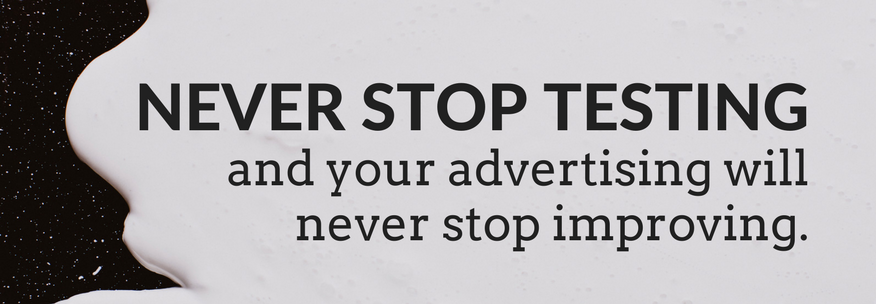
Advertising pioneer David Ogilvy was no longer around when testing started yielding results with an exceptional level of detail. But that doesn’t make his famous quote from 1962 about its importance any less relevant:

Never-Stop-Testing_Ogilvy

If Ogilvy had had access to the tools that monitor user interaction, generating bounce and click-through rate metrics along the way, he’d have been an even bigger advocate for it.

Nowadays, marketers can harvest virtually endless streams of customer-interaction data via dozens of integrated channels. If we’re not using each of these to their full potential to spot opportunities for improvement, we’re severely damaging business growth.

It’s important to note that in this article, we’re not referring to testing advertisements themselves. Instead, we’re taking a broad look at how paid advertising campaigns can improve customers’ experience on your landing pages.

Optimized e-commerce UX is one of the major factors in conversion. And no designer, content writer or marketing expert is going to get it right the first time. Optimization takes time, effort and willingness to listen to what your customers are telling you.

This brings us to the question of what should be tested. What are the typical UX elements on an e-commerce site’s landing page that contribute to conversion? While there are no absolute answers here, industry experts will agree that the following components of a landing page are worth testing:

  • Page headline
  • Hero images
  • Product image and placement
  • Call-to-action (CTA) text, color and placement
  • Product descriptions
  • Discount or special offer phrasing, design, and placement

More exhaustive lists on e-commerce A/B testing have been created, along with some excellent justifications and methods of how to test these elements. Do some research on this topic – it’s well worth your time.

Dive Deeper:
* What Is A/B SEO Testing?
* The 4 Fundamentals of E-commerce Website Design
* How to Set Up Your E-commerce Product Page for Maximum Conversions

Method One: An Inexpensive, Effective Testing Channel

In this section, we’ll talk about the first method of leveraging paid advertisements to improve an e-commerce site’s UX. This involves running two concurrent paid advertisements, each linked to two instances of the same landing page. The only difference between the two landing pages is the element that’s being tested.

1) Solving Two of the Biggest A/B Testing Challenges

There are numerous challenges facing a marketer who wants to conduct an A/B test on a particular e-commerce landing page. And using paid advertising as the channel to obtain test subjects solves two of the biggest ones.

a) Reaching a Significant Sample Size

Any test that’s dependent on subject input needs a large enough sample size to be statistically relevant. This is not only best practice for A/B testing – it’s also just solid science.

If a marketer wants to weigh the potential customers’ response to a new style of product imagery, there’s a point where the data gathered becomes valuable. Depending on the industry, niche and product itself, this point might be found closer or further along in the process. This will be something that the person conducting the test will have to define prior to running it.

Channeling subjects from an email newsletter is an option, but it largely depends on the size of the subscriber-base, as well as their appetite for conducting a test without any incentive. Running a real-world focus group is also an option – but to reach that level of statistical feasibility would mean that tests could take weeks, given how high-touch they would be.

The answer?

Create an A/B test trigger that’s going to reach a very large audience pool, without the subjects knowing that their response is being analyzed.

Run two concurrent, identical Google or Facebook advertisements, each pointing the visitor to a different instance of the landing page being tested. The primary goal of the advertisement is still to convert visitors to customers; this isn’t compromised. However, the slight UX variation on each of the two pages is very likely to result in varying engagement metrics.

When using paid advertisements for this purpose, reaching a satisfying sample size is dependent on how much the marketer is willing to spend on the advert. Their number of email subscribers or the time they have available to conduct in-person testing is no longer an issue.

b) Turnaround Time

In the above example, data on landing page engagement can be measured instantly once the advertisements go live.

Using paid advertisements to obtain test subjects means minutes, as opposed to days or weeks, before people even become aware of the test.

And if effective keyword bidding methods are used, there’s no reason why landing page B (the one with the red CTA, for instance) couldn't emerge as the clear winner within two days of launching the campaign. Try to emulate this turnaround time with a newsletter, blog post or in-person test session.

By leveraging paid advertisements to gather engagement data on two landing pages that are identical in every way but one small detail (like the CTA button color), marketers are shortening the length of time that their users are interacting with an unoptimized design.

This has a direct effect on the company’s bottom line, making this approach to A/B testing an even more attractive proposition.

2) Limit the Test Variables

The knowledge harvested from these tests is only accurate when the number of variables involved is kept to an absolute minimum. To that end, it’s critical that the content of the advertisements linking to the two landing page instances is exactly the same.

When engaging with an advertisement, certain expectations are created with the potential customer. This is referred to as “ad scent”:

Ad scent is essentially the consistent informational relationship between the advertisement and its landing page.

Paid advertising best practices suggest that the expectations created with the advertisement must be consistent with the information presented on the landing page itself.

If the advert creates particular expectations through its content, the marketer will want to recreate these expectations for both versions of the landing page. Otherwise, test results could be compromised. Users may interact differently with the landing page purely because different expectations were created in the test “trigger.”

To keep it simple: If you’re using this method to conduct A/B testing, make sure you’re using the exact same advert.

The second space where we need to avoid skewing research data is if there are too many variations between the two landing page versions. Ideally, testers will want only one visible UX variation between the two pages. This way, any variation in user engagement can be mapped to only the element being tested.

Essentially, it takes the guesswork out of the analysis process. For instance: Landing page A resulted in a 12% higher conversion rate than landing page B because of a known variable – like the CTA button color or the page headline.

Dive Deeper:
* 5 Important Landing Page Elements You Should Be A/B Testing
* How to Run A/B Tests that Actually Increase Conversions
* Ecommerce Advertising Strategy: How We Doubled PPC Sales for ThinSlim Foods (with a 3X+ ROAS)

Examples

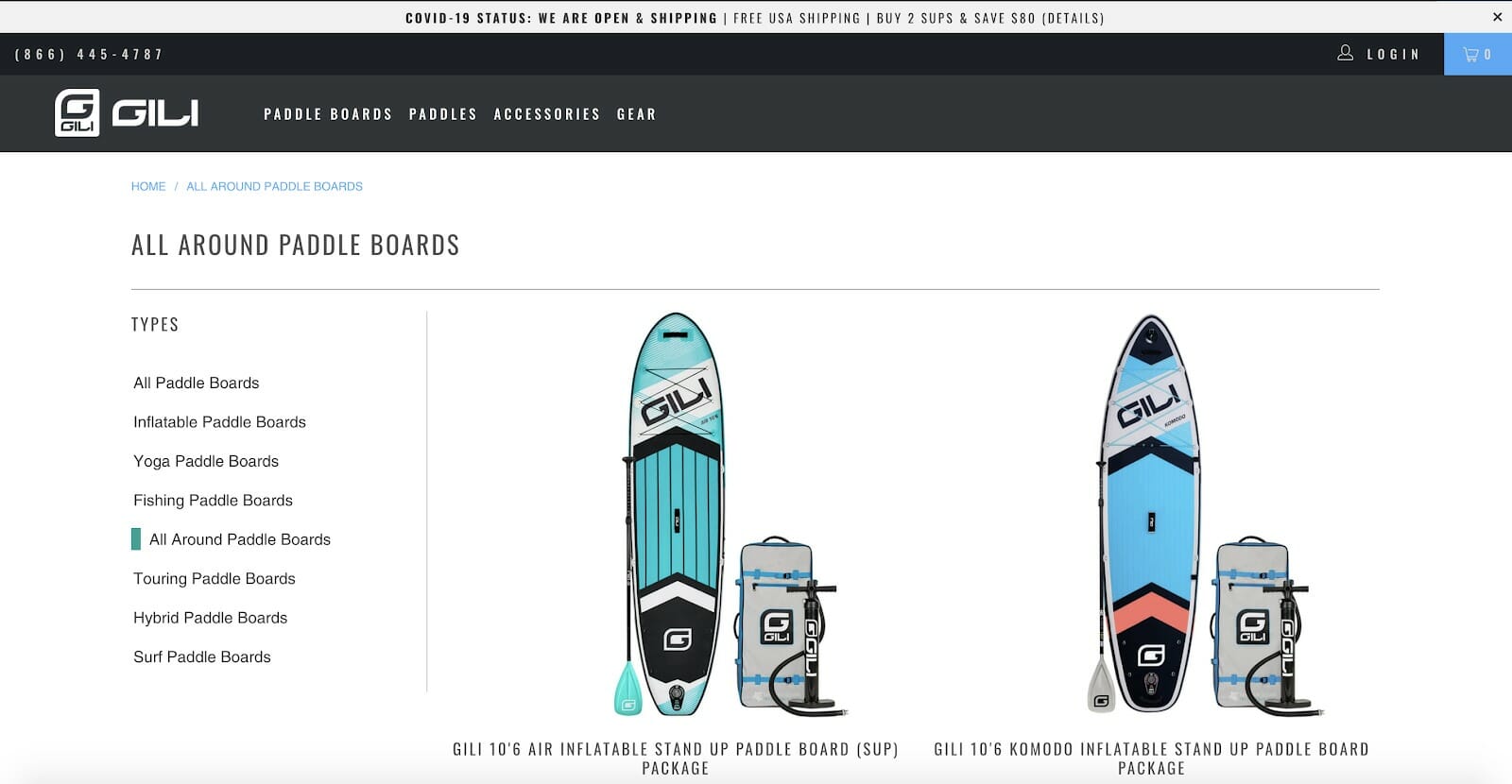
1) Gili Sports Paddle Boards

Screen Shot 2020 07 24 at 4.00.58 PM

The product category landing page for this paddle board manufacturer shows a number of UX elements that are ripe for testing using the method we described above:

  • By placing identical Google ads that correspond with a keyword like “Best All Around Paddle Boards,” the designer can link to two different instances of this page, with a particular UX element variation.
  • In this case, the absence of an “Order Now” CTA placed alongside each item in the product category page could be tested against a version where a user can instantly place an order without having to click through to the product page itself.
  • The number of products that end up in a user’s shopping cart from one version of the page can be compared to the other. And, as we said before, this information can be obtained in a relatively short period.
  • Alternatively, the site designers could also experiment with a second page where the product images are smaller, but a larger selection is visible without the user needing to scroll down the page. For this test, valuable information on the click-through rate to the product page can be mined from Google Analytics.

2) Birchbury “Bramfords” Shoes

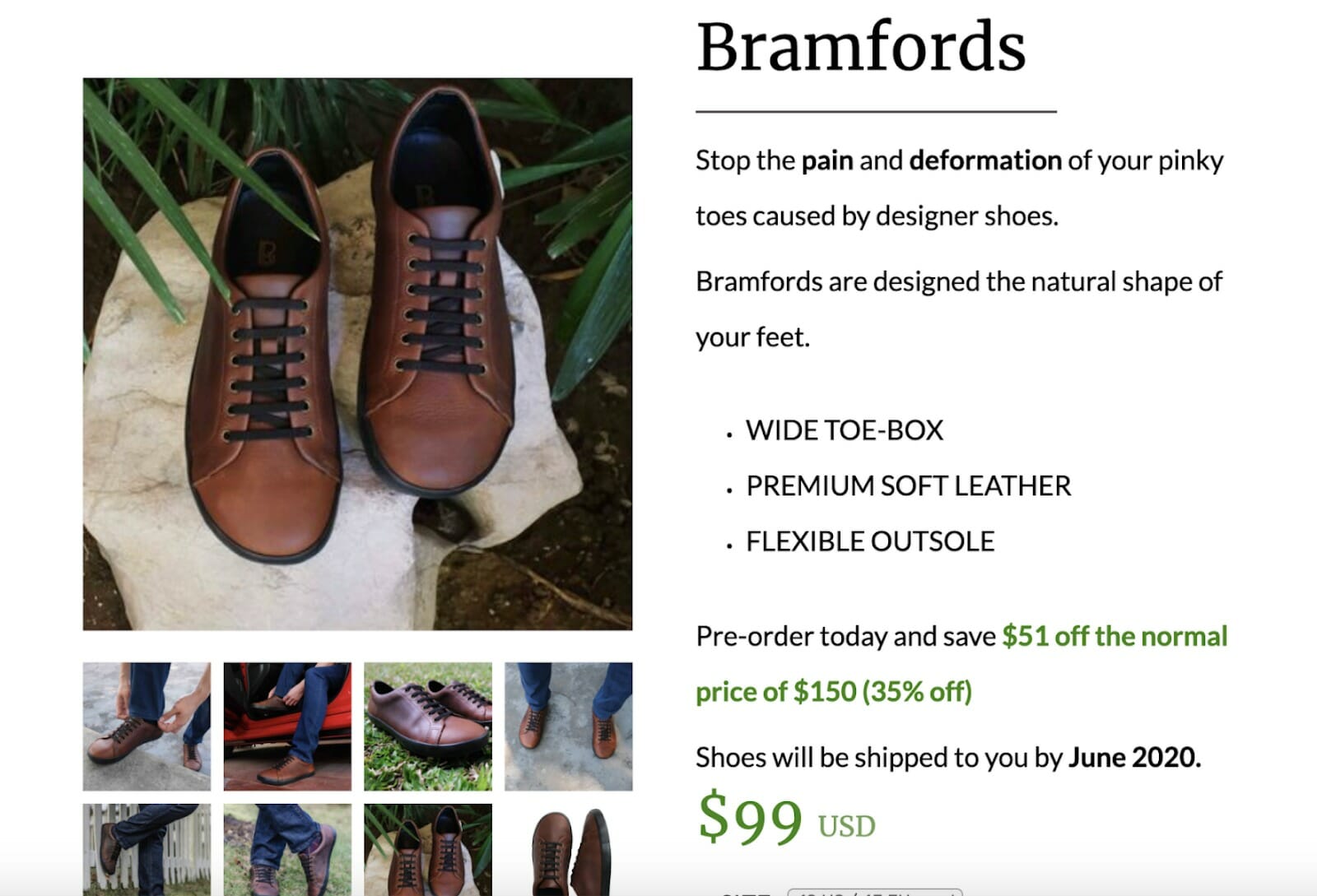
The first version of the Birchbury Home Page – which was also the main “ordering” page for their flagship shoe – had relatively disappointing results from a conversion perspective. This version of the landing page only made reference to the price discount in the product description’s text:

birchbury bramfords A The site owners used a second, identical advertisement to lead users to an alternative version of the page, where the discount was given further visibility below the product description text.
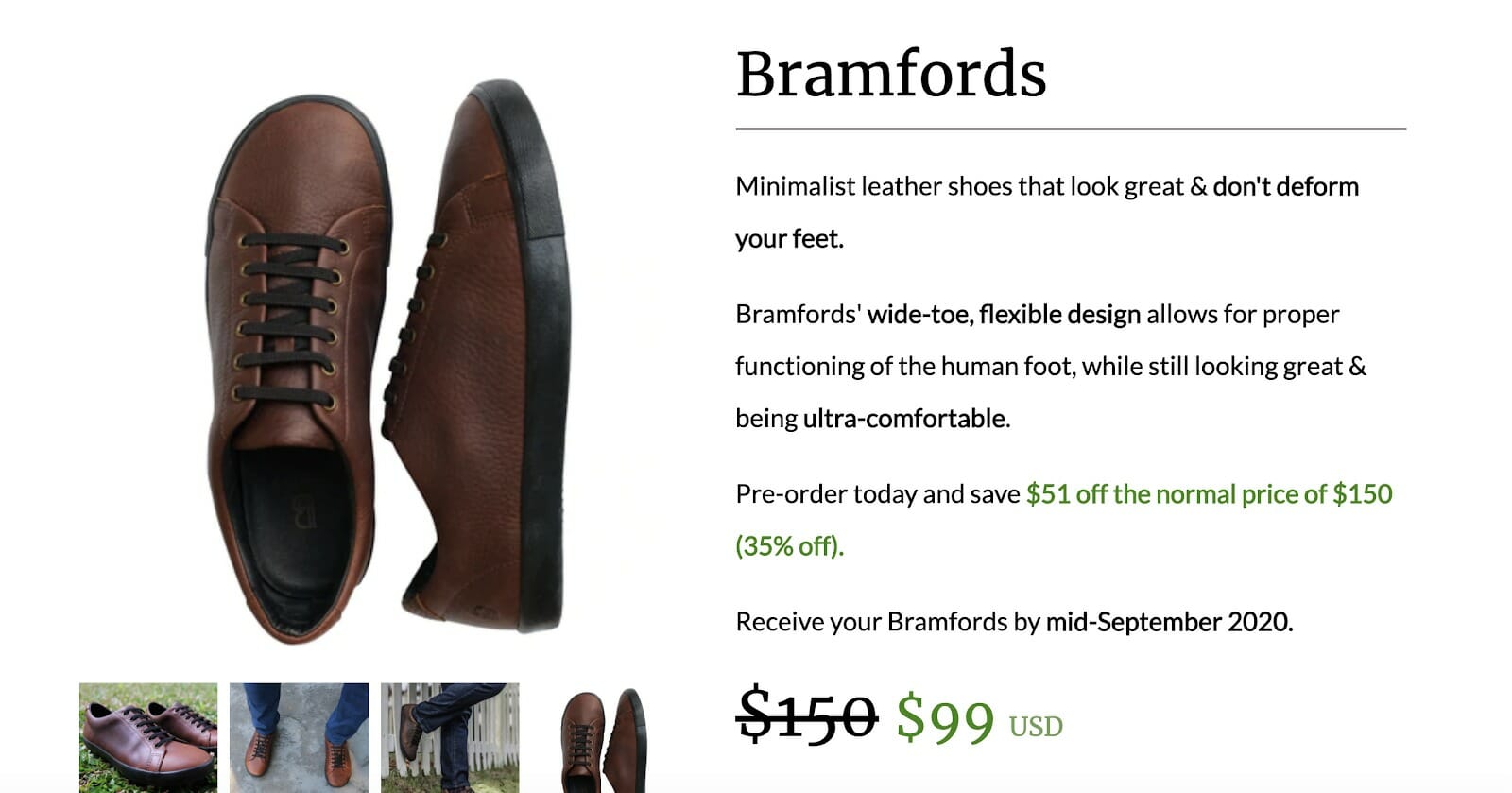
In this version, the previous price is clearly struck-through and the new price is shown in a different color. This extra spotlight on what the customer will be saving turned out to be an incredibly effective UX element and saw an increase in conversion from 1% to 1.85%:

birchbury bramfords BThe speed and ease with which this information was harvested meant that the alternative version of the landing page could quickly be adopted as the new default page.
Birchbury was able to expose a conversion-optimized page to their visitors much earlier than if they had used an alternative method of triggering an A/B test. And, once again, piggybacking this test onto a process that was already “in action” meant that they had to do very little legwork to obtain this valuable information.

Book My Free E-Commerce Marketing Consultation


Method Two: An Alternative to Landing Page Testing

While this may seem a bit like the tail wagging the dog, using multiple versions of advertisements is also a very feasible way to drive the design of a landing page.

This method differs dramatically from the previous one, and it’s best implemented on a platform like Facebook or Instagram, where ad copy is combined with other visual elements like photographs or video. Here, marketers will create two or more versions of the same advertisement, each with a slight difference in design. The product image, the customer testimonial or even the main CTA text may be different across the various ads.

By simply monitoring each advert’s click-through rate, marketers will build a wealth of information on how the first version of the landing page should look. Where there is a clear winner in terms of click-throughs, it’s obvious that a particular combination of visual elements resonates with the target audience.

Once a feasible sample size is reached, site designers can take the lead from the design of the winning advertisement to fine-tune the design of their landing page.

Dive Deeper:
* 7 Easy Ways to Optimize Your Facebook Ads
* 8 Facebook Ad Copywriting Tricks to Maximize Conversions
* The Power of Social Shopping on Instagram (and How to Sell More in 2020)

Example

1) Zoma Mattresses

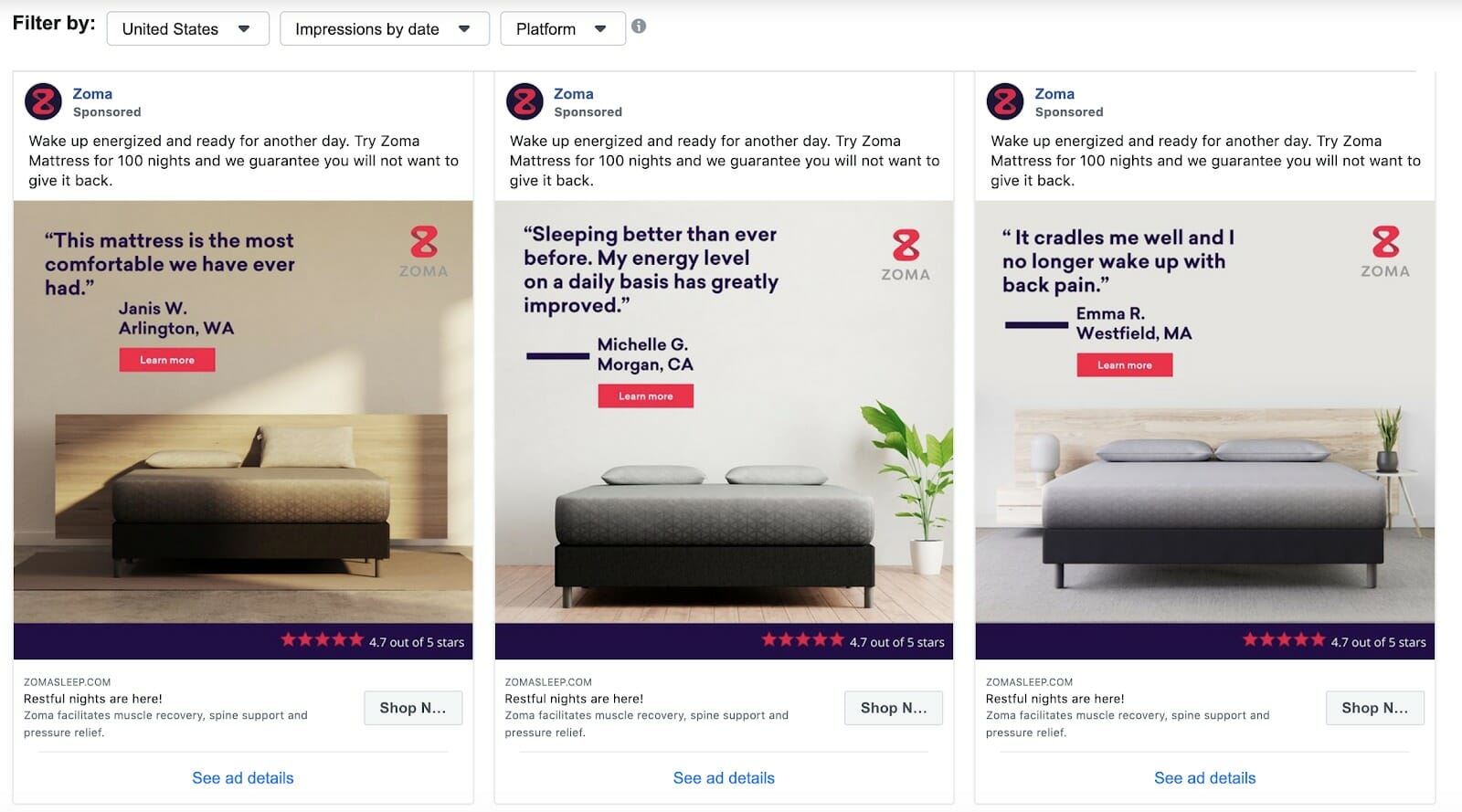
Zoma’s selection of advertisements, all linking to the same product landing page, is an excellent example of how ad performance can shape UX design. The selection of Facebook advertisements below shows the range of designs that the company’s marketing team used:

Screen Shot 2020 07 15 at 11.09.02 AM

As you can see from the three adverts, the designers opted to limit the variables between the ads to only the product image and the customer testimonial. Even though other elements like the CTA, ad headline and product description could also have been changed, this would have cluttered the engagement data and made spotting the reason for the winning advert a tough task.

What Zoma might have discovered after a reasonable sample size was reached was that a product image that didn’t distract from the mattress itself resulted in the highest click-through rate. Armed with this knowledge, site designers can create as much alignment between the design of the winning advert and the landing page design.

Book My Free E-Commerce Marketing Consultation


Last Word on Using Paid Ads Data for E-Commerce UX

Committing to constantly improving landing pages is something that e-commerce companies should embrace with open arms. Those that aren’t already aware of the benefits, or are simply too busy with other strategies, are very likely to be running at a lower ROI than their competitors.

There’s a wealth of technology and methods available to excel at this important process. All it takes is for business owners to grasp the concept and make use of marketing channels they’re already likely to have in place.

The overhead necessary for mining this information is more than reasonable. No new marketing or communication channels need to be created. Existing ones simply need to be smartly appropriated.

The post How to Improve E-Commerce Landing Pages with Paid Ads Data appeared first on Single Grain.


from Single Grain https://ift.tt/3n0TDw7