
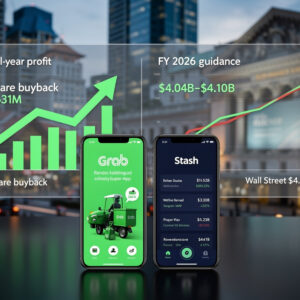
Southeast Asia’s dominant ride-hailing and delivery super-app is making its most ambitious move yet into financial services, but investors are being asked to reconcile that ambition with a revenue outlook that fell short of expectations. Grab Holdings announced it will acquire U.S.-based digital investing platform Stash Financial Inc. in a deal initially valued at approximately $425 million, while simultaneously forecasting fiscal 2026 revenue of $4.04 billion to $4.10 billion—below the $4.13 billion consensus estimate compiled by Wall Street analysts.
The twin announcements, delivered alongside Grab’s fourth-quarter and full-year 2025 results, paint a picture of a company at an inflection point: profitable for the first time on a full-year basis, flush with cash from a new $631 million share buyback program, and yet facing questions about the pace of growth in its core platform businesses. For industry watchers, the Stash acquisition is perhaps the more consequential story—one that could reshape how hundreds of millions of consumers across Southeast Asia interact with investing, savings, and wealth management products.
A First Full-Year Profit and a Massive Buyback
Grab’s results for the fiscal year ended December 2025 marked a watershed moment. The Singapore-headquartered company posted its first-ever full-year net profit, a milestone that CEO Anthony Tan and his leadership team have pursued since the company’s founding in 2012. According to Grab’s official press release, the company achieved this profitability through a combination of improved unit economics across its ride-hailing and delivery segments, disciplined cost management, and growing contributions from its financial services division.
Alongside the earnings, Grab unveiled a $631 million share buyback program, a move reported by The Straits Times as a signal of management’s confidence in the company’s long-term trajectory. Share buybacks of this magnitude are relatively uncommon among Southeast Asian technology companies and suggest that Grab believes its stock is undervalued relative to its future earnings potential. The buyback also serves as a counterweight to the dilutive effects of stock-based compensation, which has been a persistent concern among institutional shareholders.
Revenue Guidance Misses the Mark
Despite the profitability milestone, the revenue forecast for fiscal 2026 injected a note of caution into the narrative. As Reuters reported, Grab’s projected revenue range of $4.04 billion to $4.10 billion fell below the $4.13 billion that analysts had expected, signaling slower momentum in its platform businesses. The shortfall, while modest in percentage terms, raised questions about whether Grab’s core ride-hailing and food delivery operations are approaching a growth ceiling in their most mature markets, including Singapore, Malaysia, and Thailand.
The guidance miss is particularly notable given the broader macroeconomic context in Southeast Asia. While the region’s economies have generally recovered from pandemic-era disruptions, consumer spending patterns have shifted, and competition from local and regional rivals—including Indonesia’s GoTo Group and various food delivery startups—continues to intensify. Grab’s management acknowledged during the earnings call that certain markets are experiencing normalization in demand growth, though they emphasized that newer verticals, including financial services and advertising, would increasingly contribute to top-line expansion. Morningstar’s coverage via Dow Jones noted that the acquisition of Stash is central to this diversification thesis.
Why Stash Financial? Inside the Acquisition Logic
The decision to acquire Stash Financial—a New York-based fintech company that offers fractional investing, automated portfolio management, and financial education tools—may seem counterintuitive at first glance. Stash’s customer base is overwhelmingly American, and its product suite was built for the U.S. regulatory environment. But Grab’s interest lies not in Stash’s existing users; it lies in Stash’s technology stack, its investing infrastructure, and its proven ability to make wealth management accessible to everyday consumers.
According to Grab’s acquisition announcement, the deal is designed to “accelerate Grab’s financial services roadmap” by integrating Stash’s digital investing capabilities into the Grab super-app ecosystem. The vision is to offer Southeast Asian consumers—many of whom have only recently gained access to basic banking services through Grab’s digital wallet and lending products—a pathway into investment products such as equities, exchange-traded funds, and managed portfolios. In a region where retail investment penetration remains in the single digits across most countries, the opportunity is enormous.
The $425 Million Price Tag and Deal Structure
The acquisition is initially valued at approximately $425 million, as reported by Nikkei Asia and TechNode Global. The deal structure has not been fully disclosed, though industry sources suggest it involves a combination of cash and Grab equity. Stash, which had raised over $400 million in venture capital funding from investors including Union Square Ventures and Goodwater Capital, had been exploring strategic options for several months before entering into exclusive negotiations with Grab.
For Stash, the acquisition represents a liquidity event for its investors at a time when the U.S. fintech sector has experienced significant valuation compression. Many consumer-facing fintech companies that raised capital at peak 2021 valuations have struggled to grow into those price tags, and Stash is no exception. The $425 million figure, while substantial, likely represents a discount to Stash’s last private valuation. As Tech in Asia reported, the deal underscores a broader trend of Southeast Asian tech giants acquiring Western fintech capabilities at favorable prices, leveraging the current dislocation in global technology valuations.
Regulatory Hurdles and Integration Challenges
Executing the Stash integration will be far from straightforward. Financial services regulation in Southeast Asia is fragmented across national jurisdictions, each with its own licensing requirements, capital adequacy rules, and consumer protection frameworks. Grab already holds various financial services licenses across the region—including a digital banking license in Singapore through its consortium with Singtel—but offering investment products introduces an entirely new layer of regulatory complexity.
Securities regulation, in particular, varies dramatically from market to market. In Singapore, the Monetary Authority of Singapore (MAS) maintains a relatively sophisticated framework for digital investment platforms, while in countries like Vietnam, the Philippines, and Myanmar, the regulatory infrastructure for retail digital investing is still nascent. Grab will need to navigate these differences carefully, potentially launching investment features on a market-by-market basis over several years. Industry analysts have noted that the Stash acquisition gives Grab a significant head start in terms of technology—automated portfolio rebalancing, fractional share ownership, and compliance monitoring systems—but the go-to-market execution will require deep local expertise.
The Super-App Financial Services Play
Grab’s push into investing is the latest chapter in a broader strategy to transform itself from a transportation and delivery company into a comprehensive financial services provider. The company’s GrabFin division already offers digital payments through GrabPay, micro-lending products, and insurance distribution. The addition of investing capabilities would complete the trifecta of spend, borrow, and invest—a combination that no other super-app in Southeast Asia currently offers at scale.
The strategic logic mirrors what companies like Ant Group and Tencent achieved in China through products like Yu’e Bao and LiCaiTong, which brought money market funds and wealth management products to hundreds of millions of consumers who had never previously invested. Southeast Asia, with its population of over 680 million people and rapidly growing middle class, represents a similar greenfield opportunity. Grab’s existing user base of tens of millions of monthly active consumers provides a built-in distribution channel that standalone fintech startups simply cannot replicate. By embedding investment products within the same app that consumers use to hail rides, order food, and pay bills, Grab can dramatically reduce customer acquisition costs—a critical advantage in a region where fintech unit economics have proven challenging.
What Wall Street Is Watching
For institutional investors, the key question is whether the Stash acquisition and broader financial services expansion can offset the deceleration in Grab’s core platform revenue growth. The below-consensus 2026 guidance suggests that ride-hailing and delivery, while still growing, are no longer the hyper-growth engines they once were. Financial services, by contrast, offers higher margins and stickier customer relationships—but the revenue contribution today remains relatively small as a percentage of the total.
Analysts at several major banks have issued mixed reactions to the announcements. Bulls point to the full-year profitability milestone, the buyback program, and the long-term optionality embedded in the Stash deal. Bears counter that paying $425 million for a U.S. fintech company whose technology must be substantially re-engineered for Southeast Asian markets carries meaningful execution risk, and that the revenue miss signals a more fundamental slowdown in consumer demand. The stock’s reaction in after-hours trading following the announcement was muted, reflecting this ambivalence.
A Defining Moment for Southeast Asia’s Biggest Super-App
Grab’s simultaneous announcement of its first full-year profit, a $631 million buyback, a major cross-border acquisition, and a below-consensus revenue forecast encapsulates the tensions inherent in running a super-app at scale. The company is being asked to demonstrate profitability discipline while investing aggressively in new growth vectors—a balancing act that has tripped up many technology companies before it.
Yet the Stash acquisition, if executed well, could prove transformative. Southeast Asia’s financial services market is estimated to represent a multi-trillion-dollar opportunity over the coming decades as hundreds of millions of consumers move from cash-based economies into the digital financial system. Grab, with its unmatched distribution, brand recognition, and now a proven investing technology platform, is positioning itself to capture a disproportionate share of that opportunity. The next twelve to eighteen months—as Grab integrates Stash’s technology, navigates regulatory approvals, and begins rolling out investment products across its markets—will determine whether this bold bet pays off or becomes another cautionary tale of super-app overreach. For now, Anthony Tan and his team have made their intentions unmistakably clear: Grab’s future is as much about finance as it is about food and rides.
from WebProNews https://ift.tt/oUi5gky


No comments:
Post a Comment