
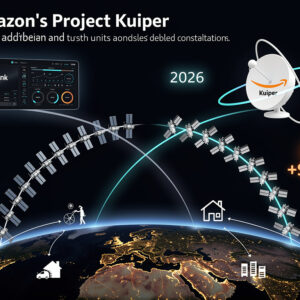
Amazon’s ambitious Project Kuiper just cleared its most significant regulatory hurdle yet, securing Federal Communications Commission approval to launch approximately 4,500 additional low-Earth orbit internet satellites — a move that dramatically escalates the company’s challenge to SpaceX’s Starlink and signals a new phase in the intensifying battle for global broadband dominance from space.
The FCC’s decision, announced in early February 2026, effectively doubles the scope of Amazon’s satellite internet constellation and arrives at a critical juncture for the Seattle-based tech giant. With a looming deadline to deploy half of its originally authorized 3,236-satellite Gen 1 constellation by mid-2026, Amazon has been racing to get hardware into orbit while simultaneously planning the next generation of its network. The new authorization, covering what the company calls its Gen 2 system, will allow Amazon to deploy satellites across multiple orbital shells, including polar orbits that would extend coverage to the Earth’s most remote regions.
A Regulatory Green Light With Strategic Implications
The FCC’s approval is the product of a lengthy regulatory process that saw Amazon file its Gen 2 application well in advance, anticipating the need for a larger constellation to compete effectively with Starlink, which already has thousands of satellites in orbit and millions of subscribers worldwide. According to SpaceNews, the commission approved the expanded constellation despite ongoing debates about orbital debris mitigation and spectrum coordination — issues that have become increasingly contentious as the number of proposed satellite mega-constellations has surged in recent years.
The approval encompasses satellites that will operate in low-Earth orbit at altitudes designed to minimize latency — a key selling point for satellite internet services that aim to rival terrestrial broadband. As GeekWire reported, the Gen 2 authorization notably includes polar orbital planes, which would allow Project Kuiper to provide coverage to polar regions that are difficult or impossible to serve with satellites in lower-inclination orbits. This is a strategically important capability for serving government, military, and scientific customers operating in Arctic and Antarctic regions, and it mirrors similar polar coverage capabilities that SpaceX has been building out for Starlink.
Billions More in Capital Expenditure on the Horizon
Amazon has never been shy about the scale of investment required for Project Kuiper. The company initially committed more than $10 billion to the program, making it one of the largest commercial space ventures ever undertaken outside of SpaceX. Now, with the Gen 2 approval in hand, that figure is set to climb substantially. According to Satellite Today, Amazon expects to increase spending on Project Kuiper by approximately $1 billion in 2026 alone, reflecting the accelerating pace of satellite manufacturing, launch procurement, and ground infrastructure buildout.
The additional spending comes as Amazon has been ramping up its satellite production capabilities at its facility in Kirkland, Washington, where the company has invested heavily in automated manufacturing lines designed to produce satellites at a pace and cost structure that can support a constellation of this magnitude. Amazon CEO Andy Jassy has repeatedly emphasized on earnings calls that Project Kuiper represents a long-term strategic bet — one that the company believes will eventually generate significant returns by tapping into the vast global market of underserved and unserved internet users, as well as enterprise and government customers seeking resilient, low-latency connectivity.
The Gen 1 Deadline Pressure
The timing of the Gen 2 approval is particularly noteworthy given the regulatory pressure Amazon faces on its original Gen 1 authorization. Under FCC rules, Amazon must deploy and operate at least half of its 3,236 Gen 1 satellites by a specified deadline — a requirement designed to prevent companies from warehousing valuable orbital spectrum rights without actually building out their systems. As SpaceNews detailed, that deadline has been a source of significant pressure on Amazon’s launch schedule, pushing the company to secure multiple launch contracts and accelerate its production timeline.
Amazon has booked launch capacity on United Launch Alliance’s Vulcan Centaur rocket, Arianespace’s Ariane 6, and Blue Origin’s New Glenn — the latter being the heavy-lift rocket developed by Blue Origin, the space company founded by Amazon’s own Jeff Bezos. The diversified launch strategy is intended to provide redundancy and throughput, but it has also introduced complexity, as each vehicle has its own development timeline and operational cadence. Blue Origin’s New Glenn, in particular, has faced development delays, though the rocket completed its first flight in early 2025, a milestone that was closely watched by the Kuiper team. The interplay between Amazon’s satellite ambitions and Blue Origin’s rocket development has created an unusual dynamic in which two Bezos-backed ventures are deeply intertwined yet operate as separate entities.
Competing With Starlink’s Enormous Head Start
Any discussion of Project Kuiper inevitably involves comparison with SpaceX’s Starlink, which has established a commanding first-mover advantage in the LEO broadband market. Starlink has launched more than 6,000 satellites to date and serves over 4 million subscribers across dozens of countries. Its parent company, SpaceX, benefits from vertical integration — manufacturing its own satellites and launching them on its own Falcon 9 and, increasingly, Starship rockets at costs that competitors struggle to match.
Amazon’s approach, while different in structure, aims to leverage the company’s unparalleled strengths in cloud computing, logistics, and customer acquisition. As CNBC noted, Amazon has signaled its intention to integrate Project Kuiper with Amazon Web Services, its dominant cloud computing platform, creating bundled offerings that could appeal to enterprise customers seeking seamless connectivity-to-cloud solutions. This integration strategy could prove to be a meaningful differentiator, particularly for corporate and government clients who already rely heavily on AWS infrastructure.
The Global Regulatory Chessboard
Securing FCC approval is a necessary but not sufficient condition for deploying a global satellite constellation. Amazon must also obtain landing rights and spectrum authorizations from regulators in every country where it intends to offer service — a complex, country-by-country process that requires navigating diverse regulatory frameworks, political considerations, and incumbent telecom interests. As Tech in Asia reported, the FCC approval positions Amazon to accelerate its international regulatory efforts, as many foreign regulators look to FCC decisions as a benchmark when evaluating their own authorization processes.
The international dimension is particularly important in regions like Southeast Asia, Sub-Saharan Africa, and Latin America, where terrestrial broadband infrastructure remains limited and the addressable market for satellite internet is enormous. Amazon has been quietly building partnerships and conducting regulatory outreach in these regions, though it has disclosed fewer details publicly than SpaceX, which has already launched Starlink service in multiple developing markets. The Gen 2 constellation’s polar coverage capability also opens up potential government and defense contracts in regions like the Arctic, where geopolitical competition — particularly between NATO allies and Russia — has increased demand for reliable communications infrastructure.
Orbital Debris and Sustainability Concerns
The proliferation of satellite mega-constellations has raised significant concerns among astronomers, space agencies, and environmental advocates about the growing problem of orbital debris and the impact of tens of thousands of bright satellites on astronomical observations. The FCC’s approval of Amazon’s Gen 2 constellation included conditions related to debris mitigation, requiring the company to deorbit satellites within a specified timeframe after the end of their operational lives and to design spacecraft capable of avoiding collisions with other objects in orbit.
Amazon has stated that its satellites are designed with propulsion systems that allow them to maneuver in orbit and to deorbit reliably at end of life, and the company has committed to operating its constellation in a manner consistent with long-term orbital sustainability. However, critics argue that the sheer number of satellites being approved — not just by Amazon, but across the industry — is outpacing the development of comprehensive space traffic management systems. The FCC has been working to update its orbital debris rules, but the regulatory framework remains a work in progress, and the international coordination required to manage a congested orbital environment is still in its early stages.
Wall Street’s View: Patient Capital and Long-Term Payoffs
Investors have watched Amazon’s satellite ambitions with a mixture of enthusiasm and caution. The additional $1 billion in 2026 spending reported by Satellite Today adds to an already substantial capital expenditure program at a time when Amazon is also investing heavily in artificial intelligence infrastructure, logistics automation, and its core e-commerce operations. Some analysts have expressed concern about the near-term impact on free cash flow, while others view Project Kuiper as a potentially transformative asset that could generate tens of billions in annual revenue if it captures even a modest share of the global broadband market.
Morgan Stanley and other major investment banks have published estimates suggesting the total addressable market for satellite broadband could exceed $100 billion annually by the early 2030s, driven by demand from consumers in underserved areas, enterprise connectivity, aviation and maritime broadband, and government applications. Amazon’s ability to bundle Kuiper with AWS, Prime, and other services gives it a unique go-to-market strategy that pure-play satellite operators cannot replicate. The question for investors is whether Amazon can execute on its ambitious timeline and achieve the unit economics necessary to generate attractive returns on what is shaping up to be a $15 billion-plus total investment.
The Broader Race for Connectivity From Space
Amazon and SpaceX are not the only players pursuing LEO broadband constellations. Telesat, the Canadian satellite operator, is developing its Lightspeed constellation. OneWeb, now merged with Eutelsat, operates a constellation in low-Earth orbit focused primarily on enterprise and government customers. And several Chinese state-backed ventures are developing their own mega-constellations, raising questions about the geopolitical dimensions of space-based internet infrastructure.
The FCC’s decision to approve Amazon’s Gen 2 constellation reflects a broader policy orientation in Washington that favors robust commercial competition in the satellite broadband sector. Regulators have generally taken the view that more competition will drive down prices, expand coverage, and accelerate innovation — benefits that align with longstanding U.S. policy goals around closing the digital divide. At the same time, the approval underscores the tension between promoting competition and managing the growing congestion of low-Earth orbit, a shared resource that requires careful stewardship.
What Comes Next for Project Kuiper
With the Gen 2 authorization secured, Amazon’s immediate priorities are clear: continue ramping satellite production, execute on its launch manifest, and begin building out commercial service in its initial markets. The company has already conducted successful prototype satellite missions, demonstrating key technologies including optical inter-satellite links that allow data to be routed between satellites in orbit without touching the ground — a capability that is critical for serving customers in remote areas far from terrestrial internet infrastructure.
As GeekWire noted, the Gen 2 constellation’s polar orbits will also enable Amazon to offer truly global coverage, filling in gaps at high latitudes that the Gen 1 system’s orbital geometry could not reach. This is not merely a technical achievement but a commercial and strategic one, as it positions Amazon to compete for lucrative government contracts that require coverage in polar regions.
The months ahead will be a critical test of Amazon’s ability to execute one of the most complex and capital-intensive commercial space programs in history. The FCC’s approval removes a major regulatory barrier, but the real challenge lies in manufacturing, launching, and operating thousands of sophisticated spacecraft while simultaneously building the ground network and customer base needed to turn Project Kuiper into a viable business. For Amazon, the stakes are enormous — and so is the opportunity. The company that revolutionized e-commerce and cloud computing is now attempting to do the same for global connectivity, and the next chapter of that story is being written in orbit.
from WebProNews https://ift.tt/NVkXPWM


No comments:
Post a Comment