Monday, 2 July 2018

WhatsApp Introduces New Broadcast Feature For Group Chat

WhatsApp recently unveiled a new feature that Telegram users will have no trouble recognizing.

WhatsApp users will now be able to create a one-way broadcast communication stream. With this new feature, only the administrator or owner will be able to send messages to members of the group.

In a blog post uploaded last Friday, the Facebook-owned company explained that the broadcast feature was rolled out to enable admins to streamline group communications. It also emphasized that people often use groups “to receive important announcements and information, including parents and teachers at schools, community centers, and non-profit organizations.”

To use WhatsApp's new feature, users will have to open Group Info then tap on Group Settings. They should then select Send Messages and then choose the Only Admins option.

The platform already allows group admins to send messages to a select set of users. However, this is the first time that one person is given the power to control the entire communication stream. The new feature would also make sure that there won't be any circuitous conversation.

WhatsApp has been quite busy the last few months as it released several new group features. Some of these features include group descriptions, a “catch up” feature for members that have been away for a short while and another that safeguards people from being repeatedly added to groups that they have already left.

WhatsApp's new broadcast feature is strikingly similar to another popular messaging app, Telegram. But basically copying a feature from another platform is nothing new as far as Facebook is concerned. After all, the social media giant has done something similar to Instagram, a platform it also owns. The photo-sharing site has patterned several of its features from Snapchat and has successfully used it to overtake its competitor in terms of active users.

[Featured image via Pixabay]

The post WhatsApp Introduces New Broadcast Feature For Group Chat appeared first on WebProNews.


from WebProNews https://ift.tt/2NhJLMD

Five Tips for Working With or Managing Remote Teams

Here at Seer, we are no strangers to working with people around the country. Many of our clients aren’t based in Philly or San Diego, and as we grow our team, many of our employees aren’t either. We realized that sometimes, the best folks we could work with aren’t in Philly or San Diego, so back in the fall of 2017, we began hiring remote positions.…

The post Five Tips for Working With or Managing Remote Teams appeared first on Seer Interactive.


from Seer Interactive https://ift.tt/2z8X7bc

How to monitor your competitors’ content marketing efforts

Can I tell you a secret? Around one quarter of my content marketing strategy is directly informed by what my competitors are doing. It’s immensely helpful to watch their tactics and see how they work in a real time or historic context. All the information I need is at my fingertips, and I didn’t have to gather, curate or analyze it myself.

Using competitive marketing monitoring is the perfect way to help you to see what your audience (many of whom overlap with those competitors, big or small) are responding to. That gives insight into their needs.

Create your competitive analysis summary

What is it that your customers are looking for right now? Do they have any questions that they are burning to have answered? Maybe you have some information that gives a different perspective on an element of the industry they hadn’t considered.

These are ways in which you can frame your content marketing strategy, part of which is going to come from your own research and labor. The rest will be readily available by watching your competitors and the people they are managing to target.

It is also possible to do your own monitoring through a manual process of curating data.

First, you will need to curate data about your competitor’s content by auditing all of their content, from blogs and podcasts, to videos and social media. Make sure you search for forms of content like webinars, white papers, ebooks and case studies, too.

Once you have a good selection of competitor content, categorize it by Competitor and state what kind of content they make, how often they post it, how much is currently available and the quality. Be sure to notice the finer details, such as length of the most popular posts and the keyword density.

I’ve adapted one of SmartSheet’s templates for this purposes:

[Action items: Download your template here. Then adapt the first column based on what it is you’re going to analyze and monitor. If you plan to collaborate on it with your team, upload it to Google Docs and then use plugins to add it to your WordPress dashboard.]

From there, begin to look at individual pieces and find patterns. What do they do in their most popular pieces? What questions are they answering? What keywords are they targeting within those works?

I will usually make a spreadsheet with this info and update it every few months. It is good to go back and get a full picture of their strategy.

Automating the hunt with competitor monitoring tools

Tools to monitor mentions and writers: Buzzsumo, Google Alerts and Cyfe

Buzzsumo (+Buzzsumo Alerts)

Buzzsumo is one of my personal favorites. It gives you so much information, from web statistics to SEO and social media. It can get a little costly to use the pro version, but it is worth it for most people who want an extensive look at what is going on with other brands, or their own. To try them out you can go to their homepage and carry out a search.

They have all kinds of awesome filters and search operators that allow you to easily dig deeper into your competitors’ content tactics. Author search allows you to search content by a certain writer (e.g. your competitor’s lead blogger) to find all the articles they put outside of their own blog within a certain period of time:

In Buzzsumo Alerts I manage all my competitor monitoring. It works well because their search engine focuses on content, so I get alerts on the mentions that really matter (i.e. those from high traffic blogs and media outlets).

Google Alerts

Google Alerts is a simpler tool that can be used in conjunction with the others, and is an easy way to set alerts for any topic or brand. Create various alerts for different topics, some brand-related and others industry-specific. You can ask it to tell you once per week, day or with every mention.

Sadly, it will give you a fair amount of unrelated content so if you find you are getting too many unhelpful alerts, try specifying your keywords a little more directly.

There are more monitoring tools you can find here and more marketing tools listed here.

Cyfe

Cyfe (Disclaimer: this is my personal content client) is an affordable business dashboard that can be used to monitor almost anything you can think of, including your competitors and their content marketing tactics.

You can create your own custom widgets to form your dashboard and use pre-built ones that include:

  • Google Alerts (you can view and archive alerts using the widget)
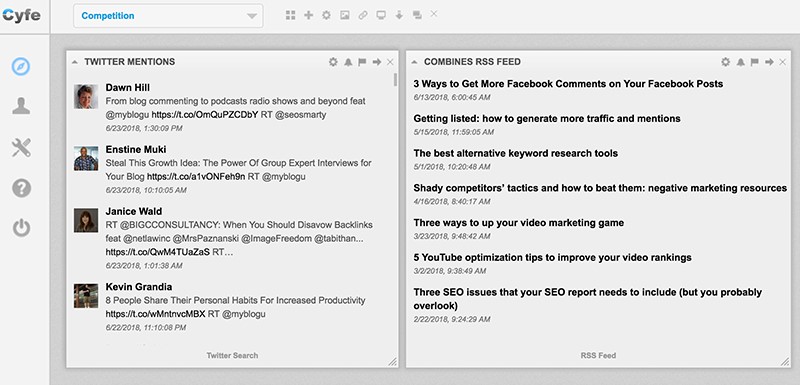
  • Twitter search (you can monitor and archive your competitors’ Tweets – Tweets mentioning them as well as their branded hashtags)
  • Google Trends to spot when there’s a spike of interest in one of your competitors
  • RSS feeds (to easily combine your competitors’ RSS feeds in one).

Tools to monitor on-page tactics: SE Ranking

SE Ranking is the multi-feature SEO platform that can be used for many purposes, including competitive analysis. One of my favorite features is the Page Changes Monitoring, which sends email alerts any time a page is changed.

Add your competitors’ most important pages there. These may include:

  • Core product pages
  • Pages that rank for important and expensive search queries
  • Pages that attract most backlinks.

Any time your competitor is there to optimize or re-optimize one or many of their key landing pages, you’ll get an email alert and will be able to guess what is going on:

  • Have they discovered better keywords (i.e. those that are easier to rank for, those that convert better, etc.) to target?
  • Have they found a better way to get their pages featured in search?
  • Are they expanding/narrowing their product offering?

It’s also a good idea to monitor your competitors’:

  • Home page
  • YouTube channel (to get alerted once they add new videos)
  • Directory and local category pages (to look out for more competitors being added).

Tools to monitor email marketing tactics: Competitor and Owletter

Competitor.email

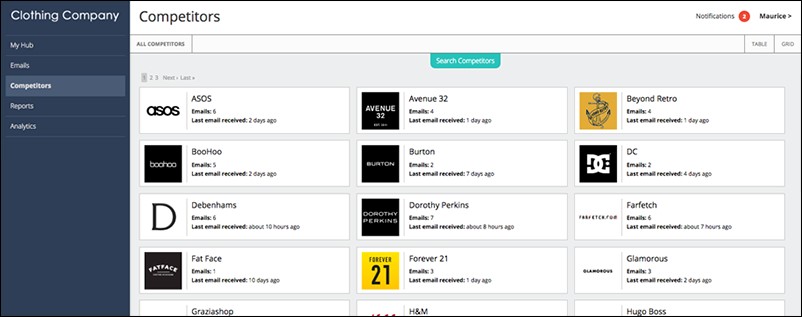
I have not personally used Competitor, but I have heard good things from a number of people who have. It views, tracks and analyzes competitor email marketing campaigns in a handy dashboard. The insights look amazing and the reports could be doubtlessly invaluable.

They have a white paper available that talks more about their tool and how you can apply it to your own monitoring and marketing campaign. You can also try a demo version to get an idea of how it works.

Owletter

For a long time, I have been signing up for competitor newsletters. It is a no-brainer way to see how they are managing their email marketing campaigns, but it can get a bit full in my inbox as a result. Owletter solves the issue by making a dashboard with competitor emails, storing, analyzing and reporting on them in one place.

Do you have a tool you think deserves to be on the list? Know a hot tip for monitoring competitor content? Let us know in the comments.


from Search Engine Watch https://ift.tt/2MInOVJ

How to Turn Your Content From Lousy to Memorable

turn-content-from-lousy-to-memorableMy professor told me I would never have a career in writing.

He had just read a story I wrote about my worst vacation, a trip to Disneyland that my brother won in a sweepstakes. It had the potential of a mediocre story. It held the promise of slight entertainment.

The only problem was my story lacked any substance.

It was a four-page pile of crap. As my friend Shakespeare would say, “It is a tale. Told by an idiot, full of sound and fury, signifying nothing.”

Lousy content comes in many forms – cliché, repetitive, arrogant, boring, busy, and maybe a tad too SEO-focused.

The problem with most writing is that it isn’t memorable. If you want to win loyal readers and create strong readership relationships, you must create memorable content.


The problem with most writing is that it isn’t memorable, says @czollingerBC. #writingtips ‏
Click To Tweet


Let’s look at three memorable communicators.

HANDPICKED RELATED CONTENT: 27 Reasons Why Your Content Sucks

Say more by saying less (Hemingway)

“My aim is to put down on paper what I see and what I feel in the best and simplest way.” – Ernest Hemingway

What can we learn from Ernest Hemingway, winner of a Nobel Prize in literature? He never wasted words. He wrote as if he paid a steep price for each sentence. He placed a higher value in language than most content creators.

Too often, we fluff up articles with nonsense. Hemingway’s insight doesn’t mean all articles must be short. It means every word should teach or tell something.

To simplify your writing, avoid meaningless phrases like:

  • In terms of
  • Needless to say (if it’s needless to say, then don’t say it)
  • In order to
  • It is important to note that
  • Whether or not

As Hemingway wrote in The Art of The Short Story, “You could omit anything if you knew you omitted and the omitted part would strengthen the story and make people feel something more than they understood.”

Don’t use cheap tricks (Orwell)

“When there is a gap between one’s real and one’s declared aims, one turns, as it were, instinctively to long words and exhausted idioms, like a cuttlefish squirting out ink.” – George Orwell

Orwell hated the wordy writing of the “wise.” You’ve likely had to read research papers from leading professionals and academics. Often, it’s the type of writing that makes you feel stupid.

Here’s a tip: If someone’s writing makes you feel stupid, that person is not a good writer.


If someone’s writing makes you feel stupid, that person is not a good writer, says @czollingerBC. #writingtips‏
Click To Tweet


In his essay on the slow destruction of the English language, Orwell criticized the type of writing used by many professionals. He hated the misuse and overuse of words to create a sense of expertise, citing a sentence in an essay from a college professor:

I am not, indeed, sure whether it is not true to say that the Milton who once seemed not unlike a 17th-century Shelley had not become, out of an experience ever more bitter in each year, more alien [sic] to the founder of that Jesuit sect which nothing could induce him to tolerate.

Orwell saw right through this ridiculous writing, a form of writing still practiced today. (Orwell called this “pretentious diction.”) Today’s content writers often create destructive sentences through keyword stuffing and more concern over the sound of words than the feeling or information they convey.

If you would have wanted Orwell to be a fan of your content, avoid the use of the following types of writing:

  • Dead metaphors (overused metaphors)
  • Pretentious diction
  • Meaningless words
  • Pointless repetition

Readers are smarter than you might think. They sense fake and insincerity. They want to feel cleverer, more informed, or more entertained than they were before reading your content. Before you write any content ask yourself, “What is my plan to affect the reader’s mind and heart?”

Reframe the present (Churchill)

“We shall go on to the end. We shall fight in France, we shall fight on the seas and oceans, we shall fight with growing confidence and growing strength in the air, we shall defend our island, whatever the cost may be, we shall fight on the beaches, we shall fight on the landing grounds, we shall fight in the fields and in the streets, we shall fight in the hills; we shall never surrender, and even if, which I do not for a moment believe, this island or a large part of it were subjugated and starving, then our Empire beyond the seas, armed and guarded by the British Fleet, would carry on the struggle, until, in God’s good time, the New World, with all its power and might, steps forth to the rescue and the liberation of the old.” – Winston Churchill

At the time of Churchill’s famous speech to parliament in 1940, England was on the brink of disaster. What does his speech have to do with good writing?

Look closely at the excerpt to see how he told the story of the present situation in future tense. He retold the present to inspire victory from the depths of defeat.

To follow Churchill’s inspired storytelling (without the inherent drama of an ongoing war), learn these three lessons:

  • Allude to an ideal future.
  • Confidently repeat the call to action.
  • Make a stand.

3 more classic writing devices

It’s easy to get bogged down in telling stories if you don’t have many devices in your content arsenal. Now that you’ve added a few inspired by Hemingway, Orwell, and Churchill, let’s shift gears to focus on three other useful writing tactics.

Reinvented clichés

Nothing is more tiresome to a reader than a cliché or an overused phrase. Writers use clichés as crutches, leaning on them instead of taking the time to invent something new and exciting.

For example, at the beginning of this section, I used the cliché, “let’s shift gears.” When you read it, you did not think about a car’s gears shifting and how that relates to a change of subject. You read the phrase as an indication the subject would be changing. Not recognizing the original meaning is a clue to recognizing “a dead metaphor” as Orwell put it. The phrase is now a cliché.

Luckily, reinvented clichés offer an opportunity to breathe new life into your content. Lyricists in the music industry often use them, as they must find new and rhapsodic-sounding lines to move their listeners.


Reinvent clichés to breathe new life into your #content, says @czollingerBC. #writingtips‏
Click To Tweet


Rapper B.o.B. often takes an artistic approach to metaphors by reinventing clichés such as this line from E.T., “I went from being who are you to chillin’ with the who’s who.”

The boring cliché would have been “the who’s who” if left on its own. But pairing it with “who are you,” he makes the phrase come alive again to illustrate his journey to success.

Synecdoche

This writing technique is the act of describing a whole idea by presenting bits and pieces of it. Toni Morrison uses synecdoche to great effect in her novel Beloved:

This is flesh I’m talking about here. Flesh that needs to be loved. Feet that need to rest and to dance; backs that needs support; shoulders that needs arms, strong arms I’m telling you.

In this example, she conveys what the physical parts of a body need to convey what an individual person in need requires.

Any idea or topic can be deconstructed and presented in a more effective way.

TIP: Writing advice can sometimes be contradictory. The key is to identify what tricks and tools work best for what you’re trying to convey to your audience about a particular topic in a particular format at a particular time.

Hypophora

Strategically ask questions that are immediately answered. Both Martin Luther King Jr. and John F. Kennedy used hypophora in their famous speeches.

“There are those who are asking the devotees of Civil Rights, ‘When will you be satisfied?’ 

“We can never be satisfied as long as the Negro is the victim of the unspeakable horrors of police brutality; we can never be satisfied as long as our bodies, heavy with the fatigue of travel, cannot gain lodging in the motels of the highways and the hotels of the cities …” – Martin Luther King Jr., I Have a Dream

“But why, some say, the Moon? Why choose this as our goal? And they may well ask, why climb the highest mountain? Why, 35 years ago, fly the Atlantic? …

“We choose to go to the Moon! We choose to go to the Moon in this decade and do the other things, not because they are easy, but because they are hard …” – John F. Kennedy, We Choose to Go to the Moon

Refocus your writing

Never approach the keyboard without the determination to convey meaning to another person, even if it’s just one individual. One loyal reader will do more for your brand than 100 passive glancers. Capture your audience by crafting memorable stories that avoid the common pitfalls and embrace the success of great communicators like Hemingway, Orwell, Churchill, and others.

Get memorable tips from great writers and editors at Content Marketing World Sept. 4-7 in Cleveland, Ohio. Register today using code BLOG100 to save $100.

Cover image by Joseph Kalinowski/Content Marketing Institute

The post How to Turn Your Content From Lousy to Memorable appeared first on Content Marketing Institute.


from Content Marketing Institute https://ift.tt/2KBKji2

Are Amazon’s Private Label Brands a Trend for Other Merchants?

Amazon has made significant investments in its own private label brands, such as diapers, dog food, and paper towels. The company’s private label strategy may be indicative of a burgeoning ...

The post Are Amazon’s Private Label Brands a Trend for Other Merchants? appeared first on Practical Ecommerce.


from Practical Ecommerce https://ift.tt/2KrZriw

Sunday, 1 July 2018

12 New Ecommerce Books for Summer 2018

Here’s a new batch of ecommerce books to add to your summer reading list. There are titles on digital marketing, customer experience, Instagram, content marketing, branding, and building a side ...

The post 12 New Ecommerce Books for Summer 2018 appeared first on Practical Ecommerce.


from Practical Ecommerce https://ift.tt/2tJsqEe

My 10 Biggest Mistakes in 10 Years as an Entrepreneur

10 mistakes as an entrepreneur

I guess I’m now a 4%-er. According to Inc. Magazine just 4% of new companies make it to 10 years. And guess what? We just made it here at Convince & Convert. Our 10 year anniversary is today! This is the longest I’ve ever done ANYTHING continuously (other than being a husband and a father), and I’m so proud of my team and the work they’ve done – and continue to do.

We’re so fired up; we even created a temporary new logo to commemorate the 10th anniversary of Convince & Convert.

I was an entrepreneur before I started this firm. In fact, Convince & Convert is my fifth startup endeavor, and I’m an investor in dozens of others. But this is certainly my most well-known and longest-running venture, so on this anniversary date, I decided to take some stock and think about the mistakes I’ve made along the way. I hope these confessions will help you in your own entrepreneurial journey.

There’s been a lot of successes, and I am incredibly thankful to my team, my family, and our remarkable clients, partners, collaborators, and friends for each of them. But me writing about what I may have done right isn’t particularly interesting, or illustrative, in my estimation.

Instead, here are the 10 biggest mistakes I’ve made in 10 years with Convince & Convert.

I Didn’t Delegate Early Enough

It feels like this is a classic entrepreneurial blunder. You trust yourself to do everything exactly how you want it done, and taking on more yourself is usually a pretty cost effective angle of attack as well. For the first four years of this company, I wrote every check, and spent every Saturday at my local bank branch depositing checks. Accounting is not something at which I am particularly adept.

Social Media AZ – back in 2009

Fortunately, I eventually realized that for a company to grow, the leadership of the firm needs to concentrate as much as possible on doing what they are UNIQUELY QUALIFIED TO DO. Now, I seek every year to delegate about 15% of my time to others at Convince & Convert. When you do that consistently, it concentrates your own time like a reduction sauce. Eventually, you start to use your own time more and more efficiently and effectively.

I’m not all the way there yet, and I still do some stuff I probably shouldn’t, but I keep working on it. Delegation isn’t a dereliction of duty; it’s how good companies get better. Further, it’s a symptom of great trust in your team, when you let go of things that your formerly held in a death grip of micromanagement.

I Was Late Adopting Systems

Are you a golf fan? If so, you’ll know exactly what I mean when I remind you that there are two types of golfers. The first are practice-based golfers. They have a lot of coaches, and spend a lot of time practicing. They are trying to groove their swing to make it flawlessly repeatable. The second type of golfer are feel players. They seek less coaching and practice less often, trusting their instincts and creativity to take over when they need it.

I am a feel golfer, but in business.

Thus, I’m guilty of believing that if I can’t remember something, it’s probably not worth remembering. I also abhor unnecessary meetings, structure, and process, as I believe it thwarts creative problem solving and breeds inefficient use of time.

The Convince & Convert Team – 2012

This “go with the flow” attitude serves me well in the very early days, when indeed I could actually remember all that mattered. But I waited too long to flip the switch to project management systems, time tracking systems, accounting and finance systems. Fortunately, Kelly Santina, who heads our operations, came aboard and made me see the light about this and a great many other things.

Today, we are religious users of Teamwork Projects for project management, Sococo for communication, QuickBooks for accounting, and a flotilla of other systems to manage other elements of the business, including CoSchedule to maintain our editorial calendar.

I should have systematized earlier.

I Resisted Specialization For Too Long

One of the truisms of most small companies is “everyone wears a lot of hats.” This is equal parts a financial necessity and a cultural necessity. At first, you don’t have the cash to pay someone to do just one job, and it’s also good for esprit de corps when everyone is pitching in to do everything that needs doing.

The Convince & Convert Team hiking in 2014

The Convince & Convert Team hiking in 2014

But you can’t play that game too long, and I did.

It’s true in a lot of areas, but most so in our business development function. For a long time, Kim Corak handled biz dev for all three divisions: speaking, consulting, and media/content. She did an amazing job. But eventually, I realized that to keep moving forward, we needed more specialized skills. Now, Kelly and I handle most media/content sales, Kim focuses almost exclusively on consulting, and the sublime Michelle Joyce handles the speaking side.

This division of labor isn’t always perfect, but it’s much more sensible than putting everything on one person, and it’s enabled us to continue to grow. I should have done this earlier, too.

I Didn’t Set Appropriate Customer Expectations

As we grew, one of our challenges was making sure customers knew/know that while I see have input on everything we create and publish, I am not personally making every slide of every strategic plan, and I’m not writing every blog post on this site (although I did for a long time).

It’s hard to set customer expectations appropriately, especially when I am the most visible member of the team and clients think I will personally manage every project.

We’re very good at this now, and I’m careful to always talk about WE and rarely about ME when discussing the company and our capabilities. But it was definitely a tough transition for a while there.

Today, we have a similar issue, but with timing. We’re often at capacity on strategy projects, and on content projects, meaning that new opportunities may have to wait 3-4 weeks before we can commence work. Being better at setting those expectations accordingly is something I’m still working through.

I Gathered Too Little Customer Feedback

Related to the prior point, when I was fully in the middle of every project, and essentially quarterbacked everything, it was easy to not worry about formalized customer feedback. I had a handle on what customers thought of us, because I was personally talking to all of them, all the time.

Now that we have grown, and the team does more customer interaction than do I, it’s critical that we have a consistent, standardized feedback system so that we all know how we’re doing, and where we stand.

About 18 months ago we moved to a Net Promoter Score survey protocol, whereby we survey consulting clients at least twice during each project. We also use NPS for speaking opportunities, and we’re going to roll it out for media/content. I am incredibly proud that our NPS is 73 right now, which is very, very high and puts us up there with the best brands in the world.

I wish I would have started this program years ago!

I Gave Disorganized Feedback to My Team

Like a lot of entrepreneurs, I can be a bit of a handful. When I have “suggestions” I tend to offer them at less than ideal times, with less than realistic expectations for execution. I used to email Kelly all the time with “ideas” on things we could/should improve. I’m SURE she loved that!

Convince & Convert team - 2014

The Convince & Convert Team – 2014

And then I realized that every time I emailed her, she had to stop what she was doing and address whatever crazy idea I’d come up with in the prior 11 seconds.

Now – and this is especially key because we are 100% virtual and always have been, and we have very few meeting and calls – I send ONE email per week to our head of operations called SOMM: “stuff on my mind”. It’s a compendium of everything that I’m thinking about or upon which I request a status update. Putting all of this in one, weekly email and resisting the temptation to fire off random “but what about…?” emails, has improved operating efficiency dramatically.

I Didn’t Force Proximity EVERY Time

As mentioned, we are an all-virtual firm, with team members all over the USA, and beyond. On occasion groups of us will connect face to face at a client meeting or conference. But the full Convince & Convert team meets in person just ONE time per year, at our annual strategic planning retreat.

convince retreat

Convince & Convert Retreat – 2016

Of our nine retreats, the first one was in Phoenix (when I still lived there) because there were very few of us, and we had no money. Then, we started going to Puerto Vallarta, Mexico where we rent a giant house and the whole team (and their spouse/other/friend) lives together with harmony, good times, and good ideas.

We did Puerto Vallarta together in a house every year except for 2017 when we went to Santa Fe and stayed in a boutique hotel. And it was……..fine. But it was definitely not the same. In a virtual firm, in the rare cases when you do get together you have to make it count, and create as many opportunities for unstructured bonding and closeness as possible.

That one year, I didn’t. We did a hotel instead of a house. And it’s not like it killed the company or anything, but it hurt our cohesion a little, which is why we went back to a house this year.

I Pursued Ideas Without Execution

I’m an idea guy. Always have been. It’s why I love consulting. The challenge of figuring out how to improve someone else’s business is fun and exciting for me. But I’m guilty in my own businesses of letting the idea supersede the execution plan, and sometimes I pursue an opportunity without thinking it through 100%.

And it’s a fine line between a culture of trial and testing, and culture of going off half-cocked without a plan. I try really hard to land on the former, but sometimes I peek over toward the latter.

Perhaps the most egregious example is the ill-fated MarketingPodcasts.com project. This was—and maybe still is—a good idea, in my estimation. The premise back in 2013 was that podcast discovery is hard, and it was nearly impossible to find great marketing podcasts with any degree of efficiency. So, I decided to solve that problem. We worked with a dev team to build MarketingPodcasts.com, a sophisticated, algorithm-powered directory of marketing podcasts; like Google for audio programming. It worked, and people liked it.

Here’s the problem. I was so in love with the idea, and so convinced it solved a real problem, I never fully articulated how we were going to make money, or how MarketingPodcasts.com fit into our other divisions and programs at Convince & Convert. After a year or so (maybe less, I’ve blocked out the details!) we shut it down.

Lesson learned (I hope).

I Gave Up First Mover Advantage

A few years ago, I launched one of the first daily video programs in the marketing space, called Jay Today. It was before the Gary Vee show, and long before a lot of other programs of similar type and intent, of which there are now hundreds.

jay today

Partially because I was first (or nearly so), and partially because the content was at least decent, Jay Today got pretty good traction. Not Gary Vaynerchuk traction, but good by my mortal standards.

I did the Jay Today show three times each week for about 14 months. And then, I quit. I simply got tired of doing it, which is rare for me (my Social Pros podcast is 8+ years old). I think I just felt like I didn’t have anything else to say in that format at the time, and I sunsetted the show.

Afterwards came the big explosion in daily video programs and video podcasts. About 18 months after the end of Jay Today version 1.0, I returned with Jay Today version 2.0. And it was fine, but I’d lost my first mover advantage.

I let fatigue convince me to give away an edge I’d developed. That was a mistake.

I Picked the Wrong Competitors

In the early years, Convince & Convert was really just Jay’s blog, and operated as such. Then, as we grew it became a multi-author home of intermediate to advanced social media and content marketing advice and counsel.

Over time, we saw ourselves competing against Content Marketing Institute, Social Media Examiner, MarketingProfs, TopRank and other terrific online resources that publish daily articles with excellent, tactical, how-to guides to all things digital marketing.

We tried to fight that fire with our own fire, and our editorial approach here began to embrace volume and practical advice as key components.

I realize now that was a mistake. We’re not going to out how-to those great sites, and we never should have tried. We’re a thoughtful, strategic, consulting firm that works with many of the world’s most interesting brands to solve large and thorny marketing and customer experience challenges. We’re not in the how-to business, we’re in the “now what” business.

For a while there, our audience for our content was one persona, and our audience for our consulting services was a different persona. We’ve fixed that now, which is why we publish less frequently here than we used to, our content is purposefully longer-form and more detailed, and a lot of our stuff now is based on first or second party research.

We regained the right focus and are trying to serve the same, smart audience with both content and consulting.

I hope you agree. If you like what we’re doing here, you may want to visit this page to sign up for our feed, where we’ll send you a quick email each time we publish something new.

Thanks again for the opportunity to serve. Whether our relationship began today, 10 years ago, or anywhere in between, I very much appreciate your time and your trust.

And congratulations to all at Convince & Convert for being extraordinary every day, and for getting us to TEN YEARS!  I don’t say it enough, but I love each and every one of you.

The post My 10 Biggest Mistakes in 10 Years as an Entrepreneur appeared first on Convince and Convert: Social Media Consulting and Content Marketing Consulting.


from Convince and Convert: Social Media Consulting and Content Marketing Consulting https://ift.tt/2z5IMfE