Showing posts with label Red Lemon Club. Show all posts

Thursday, 23 April 2020

Using a five-minute meditation to boost my creativity

I want to create something, but I feel stuck and frustrated.

I want to do this, but I don’t know what to do and how to start.

The discomfort makes me want to escape.

There’s a distraction that I can use as a nifty excuse not to create. At least for now.

How do we find a creative state of mind so that we can act?

You know when you have this sense of momentum when you’re making something, like writing, painting or making music?

It’s like you’re in a flow.

When you are in flow, do you think about what you’re making?

Not much right?

That’s because actively thinking or trying to think does not make us very creative.

Thinking less is better for creativity.

“Don’t think. Thinking is the enemy of creativity. It’s self-conscious, and anything self-conscious is lousy.”

~ Ray Bradbury

When we allow our thoughts to settle and our minds to still, inner intelligence flows more smoothly.

It is easier to connect with an innate knowingness.

That’s being creative. We don’t need to force it.

It is why we receive ideas that simply work when we’re out for a walk. Or when we’re in the shower or random places when we’re not thinking.

A way to tap into the creativity of a still mind is to sit in stillness; to meditate. To walk or sit consciously.

Perhaps it’s five minutes before starting to put pen to paper.

But we can be meditative in the creation itself too.

We can allow our minds to rest on the topic or project in question, but we don’t need to try to be clever here.

Press gently on the topic in your mind without forcing it.

Let your mind wander naturally while maintaining a loose connection to the creation that’s about to take place.

See what bubbles to the surface of your awareness naturally.

Allow your innate wisdom to rise and do the work.

The more we cling to a result, the more elusive it becomes.

So loosen your grip, and observe what happens.

Spend more time in meditative stillness, and you will be more creative; more expressive.

More you.

 —

If these ideas stirred something in you, I’d love to read your comment below. I read them all.

To learn more about what I do, subscribe to exclusive extra content, and to speak with me, connect here.

Alex


from Red Lemon Club https://ift.tt/2KziNQh

Thursday, 16 January 2020

The nourishing energy found in loving everything

It can hurt when stress curls its knotted fingers around our necks.

But boy does it get easier when we see that those hands on our throats are our own.

Instead of it being the things that happen to us that create stress, it is our very resistance to those things that set it in motion.

Unnecessary and prolonged anxiety; frustration; anger, fear and mental anguish. They are here coursing through us because of us.

We permit it to be this way.

We are our very resistance.

Life, in this way, is not hard. It is our resistance that makes it hard.

When I ruminate and stew over an upcoming social gathering I don’t want to go to, I suffer because I think in circles. The event and the people within it have no impact on my suffering at all.

It is the thought I hold in my head about how hard the event will be that makes it hard. The thought alone sets off a reaction involving nerves and chemicals that makes me feel stress.

My emotional experience is a product of the dancing and provocative pictures in my mind.

That’s not to say we can’t switch off our emotional reaction to stimuli, but it does mean that we can manage it and see irrational fears and stresses diminish.

It would make sense, then, that to navigate our lives with more ease and flow, requires us to let go of the thoughts that create resistance in us.

We need to let go of ourselves.

What will serve us is to find the courage to turn away from trying to control our reality via thought, towards conscious awareness of reality as it really is.

I’ve talked about our need to redirect attention away from ourselves through turning our attention to others.

If you’re suffering, get out of your mind and stop making it about you. You are completely insignificant…

…And yet at the same time, you are entirely significant…when you put yourself to good use.

One of those uses is in giving and finding ways to continually improve the lives of the people who matter to you.

This has brought me tremendous relief.

It’s why I create and serve and coach as much as I do.

Instead of getting wrapped up in fixing ourselves, we need to spend more of our time in the service of others; not in the sense of us being in subservient neediness operating from lack, but in acknowledging our infinite value that we are thrilled to share.

We give to nourish our expanding networks, which we know will, in turn, sustain us. As connected creatures, we see that this is the order of nature and things.

We set an example as a leader who inspires others with a willingness to let go of the obsession with themselves.

In addition to using service as a means to distract ourselves from ourselves, we can use a related and powerful mode of being that brings passion and aliveness in me when I remember to do it. It allows me to transcend resistance to life with more consistency.

That is to direct a lovingness towards…

Everything and everyone.

Everything?

Well. Yes.

This is the art of meeting resistance, self-sabotage, anxiety or fear with a lightness, a friendliness, a letting go into acceptance — all variations of love.

And this can happen with the really bad stuff too. That’s not to say you agree with evil acts. It’s to approach these things, and everything, without the propensity to react in a whirlwind of emotion.

In this way we are in a much better state of being to act when action is required.

We must allow our hearts to open; to create pathways for energy to run through us, instead of closing up to moments that remind us of stuff we hate.

We are full of blocked energy from our past to which we hold on tightly as protection. All we need to do is open up and direct love at resistance and what feels like fear, and we can be free of those blocks.

To experience more joy, we must be capable of accepting and loving it all.

We can see everything as a teacher; as a source of wisdom, and we can be thankful for it all.

If we close ourselves to things, Michael A. Singer says in his book ‘The Untethered Soul,’ we create resistance and energy blocks, that make us suffer.

We don’t want this. It’s an idea that takes courage, but we can be open and friendly to it all. Not to encourage bad things, but to let it pass through you. This is the very essence of the phrase: ‘going with the flow.’

With a simple letting go, and a willingness NOT to close, we allow innate energy from within to rush through us, aiding in our creativity, and allowing us to experience life on an entirely new plane that most of us will ever know.

I know, you might be thinking that this is all unrealistic and silly, and over the top.

But I encourage you to try.

I am speaking as much to myself here because whenever I have let go of closing, amazing things have happened.

When I don’t resist life, well — I don’t feel much resistance at all.

I always thought that resistance and stress were out of my control and inevitable parts of existence.

But with a gentle lovingness directed at all things, especially those things that previously brought me angst, I can see that I create every aspect of my reality.

You might find — in fact, I know you’ll find — things that once phased you, suddenly lose their hold on you, allowing you to experience a tremendous sense of relief, and even bliss.

Start today.

Love what is by being present. Notice all the details. Allow yourself to open your heart to everything and everyone even if it smarts initially.

Drop your shoulders for a minute and take a breath.

Approach the things that often stress you with a welcoming smile.

It starts with you.

 —

If these ideas stirred something in you, I’d love to read your comment below. I read them all.

To learn more about what I do, subscribe to special extra content, and to speak with me, connect here.

Alex


from Red Lemon Club https://ift.tt/384111w

Sunday, 12 January 2020

An illustrated journey through some of my favourite quotes about fear and consciousness

Ralph Waldo Emerson once said:

“Make your own Bible. Select and collect all the words and sentences that in all your readings have been to you like the blast of a trumpet.”

I’ve been a keen reader and absorber of insights from inspiring teachers all my life.

Picking up on the echo of Emerson’s words several decades on, I’ve collected some of my favourite quotations from a handful of people who spoke eloquently on the mind, fear and consciousness that spoke to me with the intensity of the clear and sonorous blasts of a trumpet:


“We don’t see things as they are, we see them as we are.”

Anais Nin


“All you have to know is everything is created from thought, you don’t have to know anything else.”

Sydney Banks


“Do not let your fire go out, spark by irreplaceable spark in the hopeless swamps of the not-quite, the not-yet, and the not-at-all. 

Do not let the hero in your soul perish in lonely frustration for the life you deserved and have never been able to reach. 

The world you desire can be won. It exists.. it is real.. it is possible.. it’s yours.”

Ayn Rand


“Tell your heart that the fear of suffering is worse than the suffering itself. And no heart has ever suffered when it goes in search of its dream.”

Paolo Coelho


“A person’s success in life can usually be measured by the number of uncomfortable conversations he or she is willing to have.”

Tim Ferriss


“Vulnerability is the birthplace of love, belonging, joy, courage, empathy, and creativity. It is the source of hope, empathy, accountability, and authenticity. 

If we want greater clarity in our purpose or deeper and more meaningful spiritual lives, vulnerability is the path.”

Brene Brown


“You can only stop the flow of thoughts by refusing to have any interest in it.”

Ramana Maharshi


“Give up defining yourself — to yourself or to others. You won’t die. You will come to life. And don’t be concerned with how others define you. When they define you, they are limiting themselves, so it’s their problem. 

Whenever you interact with people, don’t be there primarily as a function or a role, but as the field of conscious Presence. You can only lose something that you have, but you cannot lose something that you are.”

Eckhart Tolle


“People who do “lowly” jobs with love and energy find themselves being promoted and offered other “better” jobs very quickly. Because they understand what Robert Frost meant when he said, “The way out is through.”

Steven Chandler


“The most important thing in life is your inner energy. If you’re always tired and never enthused, then life is no fun. But if you’re always inspired and filled with energy, then every minute of every day is an exciting experience. Learn to work with these things. 

Through meditation, through awareness and willful efforts, you can learn to keep your centers open. 

You do this by just relaxing and releasing. You do this by not buying into the concept that there is anything worth closing over. Remember, if you love life, nothing is worth closing over.”

Michael A Singer, The Untethered Soul


“It is the individual who is not interested in his fellow men who has the greatest difficulties in life and provides the greatest injury to others. 

It is from among such individuals that all human failures spring.”

Alfred Adler


“Our deepest fear is not that we are inadequate. Our deepest fear is that we are powerful beyond measure. It is our light, not our darkness, that most frightens us. 

We ask ourselves, Who am I to be brilliant, gorgeous, talented, fabulous? Actually, who are you not to be? You are a child of God. Your playing small doesn’t serve the world. 

There’s nothing enlightened about shrinking so that other people won’t feel insecure around you. We are all meant to shine, as children do.”

Marianne Williamson


“As soon as you concern yourself with the “good” and “bad” of your fellows, you create an opening in your heart for maliciousness to enter. Testing, competing with, and criticizing others weakens and defeats you.”

Morihei Ueshiba, The Art of Peace


“To make the right choices in life, you have to get in touch with your soul. To do this, you need to experience solitude, which most people are afraid of, because in the silence you hear the truth and know the solutions.”

Deepak Chopra


“People say that what we’re all seeking is a meaning for life…

I think that what we’re seeking is an experience of being alive, so that our life experiences on the purely physical plane will have resonances with our own innermost being and reality, so that we actually feel the rapture of being alive.”

Joseph Campbell


“Whatever happens around you, don’t take it personally… Nothing other people do is because of you. It is because of themselves.”

Don Miguel Ruiz, The Four Agreements


“To oppose something is to maintain it.”

~Ursula Le Guin


“If you love a flower, don’t pick it up.
Because if you pick it up it dies and it ceases to be what you love.
So if you love a flower, let it be.
Love is not about possession.
Love is about appreciation.”

Osho


“While people and circumstances certainly matter, what’s even more important is what we think about those people and circumstances.”

Michael Neill


“Life is a series of natural and spontaneous changes. Don’t resist them; that only creates sorrow. Let reality be reality. Let things flow naturally forward in whatever way they like.”

Lao Tzu, Tao Te Ching

If these ideas stirred something in you, I’d love to read your comment below. I read them all.

To learn more about what I do, subscribe to special extra content, and to speak with me, connect here.

Alex


from Red Lemon Club https://ift.tt/3a5Gprl

Thursday, 9 January 2020

Do We Even Need ‘Self-Belief’ to Perform Optimally?

When you consider the concept of self-belief, what does that mean to you?

Confidence?

Self-esteem?

Perhaps you could lump all of those words into one box.

Essentially, they are all ideas. Concepts. Subjective opinions that attempt to quantify personality.

They are bundles of thoughts we hold in our heads, held together by the sticky adhesive of memories and visions of ourselves in various contexts.

They are neither lies nor truths.

They are just thoughts.

And because they are thoughts, they are not accurate representations of reality.

I’ve spent a lot of wasted energy worrying about the significance of ‘self-belief’ as a concept.

If, for example, I’d see someone on a Ted X stage delivering an impassioned speech or someone who was relaxed in themselves around other people, I saw that person as possessing a tremendous amount of self-belief.

As for how they’d acquire that self-belief, was more of a mystery to me.

But I knew I needed to find more of it to better handle the challenges I was facing.

I knew I had self-belief in some things, like writing and drawing, but less of it for other things like public speaking.

Whenever I fell short in some way, I blamed my lack of self-belief or some ethereal and arbitrary label that defined my current confidence rating.

But in seeking out to attain more self-belief for me, I had my objectives wrong.

What I wish I’d known sooner was that a better strategy (if I can put it that way) for being at ease and ‘succeeding,’ was to drop the need to increase anything.

Instead, all I had to do was rediscover a more conscious state of being that I’d been neglecting.

When I say ‘conscious,’ I mean making full use of all my senses to be present with myself and my environment.

To rediscover a bliss in truly hearing, smelling, touching, observing, and merely being, free of judgement.

It is when we are entirely conscious like this that we can perform the most effectively in any situation.

I’m not saying that we need to stop thinking entirely. I pride myself in my thinking powers to plan and invent and visualise. The issue lies in living in perpetual thought, instead of using thought for its use as an occasional and powerful tool.

It is only then when our real confidence can come through — a confidence that is not based on any thought-created sense of who we are, but simply a confidence that reflects being in alignment with our real, original true selves, beneath thought.

Consciousness is about taking on the creative, in-the-moment, present state that looks outward, rather than the ego-driven, reactive state that continually worries about how we’re doing.

Yes, to do an excellent job of something, whether it’s communicating in an interview or fixing someone’s faulty plumbing, requires skill and practice. It is repetition that allows us to be more effective at a particular task at the level of technical expertise.

But to learn effectively in the first place requires presence, not belief. Skill is secondary to consciousness.

It is not self-belief one needs in facing any task, no matter how skilled — it is presence and stillness of thought.

When I try and be confident, or act like someone who has belief, I’m in my head, and this is never effective.

We don’t need to cling to having self-belief before starting things because these are thoughts that will hold us back.

We need to do more of what challenges us and bring as much consciousness as we can to each of these things. That is how to live an alive and continually moving and stretching life.

Interestingly the word ‘self-conscious’ is devoid of any real consciousness at all. It is its very opposite. To put our attention on ourselves when we could otherwise be present is to be lost in our thinking, which is unconscious.

Most of my life has been spent in unconsciousness; lost in various subjective opinions about things as a misguided means to make sense of the world.

I am rarely conscious for long stretches, but I have cultivated a general consciousness that builds every day.

I do see now that my years of unconsciousness were a tremendous gift.

The suffering this created drove me to find Consciousness and embracing her like a long lost child.

 —

If these ideas stirred something in you, I’d love to read your comment below. I read them all.

To learn more about what I do, subscribe to special extra content, and to speak with me, connect here.

Alex


from Red Lemon Club https://ift.tt/302LThY

Monday, 6 January 2020

Doing this made me a much calmer person

As the son of an English diplomat, I spent some years in my early teens living on the Caribbean island of Barbados.

It was there that I was introduced to the game of golf. I would occasionally join my father and his friends on palm-fringed golf courses, and it didn’t take me long to get a feel for the game.

I also very quickly gained a very real sense that this was to be the most infuriating sport I’d ever have the opportunity to play.

To get through a round of golf alive is to have your character tested to its very edge.

The margin for error is so slight, that to hit the ball with the club-face a mere degree off, could have your up-until-then winning ball hurtling towards a watery demise.

Golf could reveal an inner rage in me that often surprised myself, let alone my poor father. A red-faced, cursing son kicking golf balls across the 12th green wasn’t the idyllic scene he had envisioned.


I’m by no means enlightened today, but I have seen a notable shift over the years in response to stressful and potentially annoying stimuli.

Many things have informed this change, from merely maturing into adulthood to experiencing and learning more from life.

There is, however, one element that has had an increasingly dominant effect on my ability to remain calm in triggering situations.

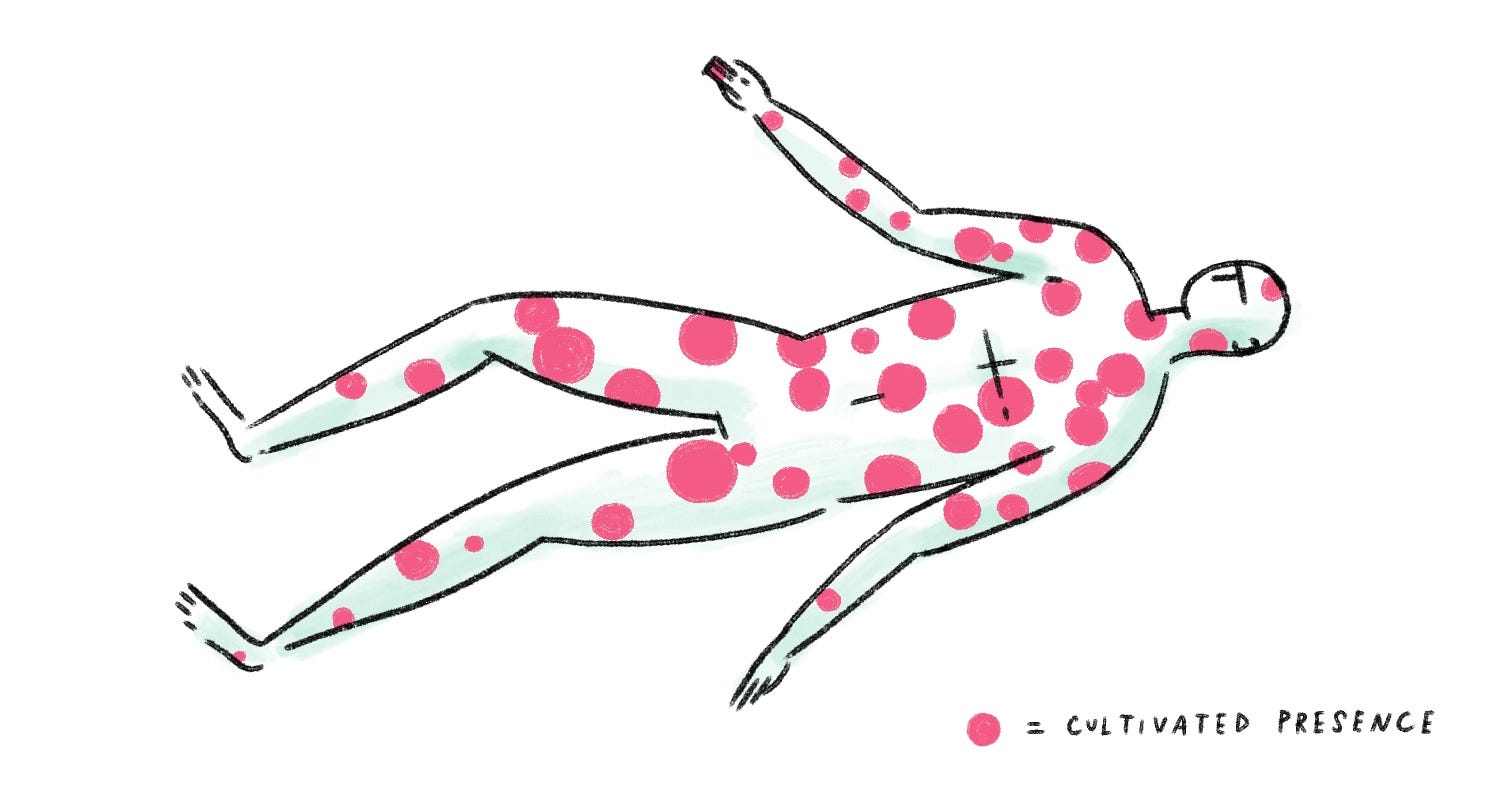
And that is the cultivation of what I call: ‘generalised presence.’

Much like some of us manifest generalised anxiety through consistently overthinking, we can create the opposite.

We can cultivate a generalised connectedness to the world around us, including the spirit that runs through all of us, by spending more time being present.

Over the years, as an avid student of self-help, I’ve learned a lot about managing thought.

One of my most significant breakthroughs was in seeing that our emotional experience is rooted in our thinking, not our circumstances.

This is crucial.

Our thoughts dictate our emotional experience, not our surroundings.

To be relaxed, we must disconnect from the unhelpful thoughts we hold in our heads.

And, oh my, are we good at creating unhelpful thoughts.

To disconnect is not to try to think less. It is to be present to what we can physically sense.

With a blossoming of this understanding, I’ve introduced presence into my life wherever I’ve been able to.

I meditate when I remember to, more often. I do this in the sitting position, but more recently I have been doing it at opportune moments through the day, notably when I walk. I have more consciously been bringing meditative walks into my days.

Sometimes I walk for two hours.

People say that what we’re all seeking is a meaning for life. … I think that what we’re seeking is an experience of being alive, so that our life experiences on the purely physical plane will have resonances with our own innermost being and reality, so that we actually feel the rapture of being alive.

~ Joseph Campbell

What is critical in all this is that beyond experiencing more calm, more of the time, I am much better able to deal with more intense sources of fear or stress. Things like socialising in groups, or interacting with provocative people no longer ignite a cascade of anxiety or anger as it once did.

I owe a lot of this to cultivating ‘reserves of presence’ like this.

I have always said the best way to ‘overcome’ fears is to face them incrementally and regularly. The experience shows us there is nothing to be afraid of.

We need to see our bodies and spirits as open vessels for the accumulation and spreading of that sense of presence.

Most importantly, we need to be present during moments that don’t necessarily test us.

Many think that to overcome fear is to be present during fearful moments. This can help, but I have always found that if you leave presence cultivation until the moments that trigger you, it’s already too late. The anxiety will be there.

Practice being present during moments when you are at ease, such as standing in line at the post office, or when walking along the street. When I walk, I notice textures; I listen to the birds; I feel the crisp oxygen at my nostrils; I genuinely stop and smell the flowers.

By doing this, I’ve become a more present person in general. I’ve built up — and continue to build up — my presence reserves.

These reserves seep into all corners of my experience.

And I’m seeing the benefits. The things that made me nervous before don’t grip me as they did.

The triggers that once set me off on an angry tirade, today feel like there is an imaginary rubbery barrier between my emotions and the supposed source of irritation.

I know I have more consciousness to cultivate by being present more often.

But I don’t see this as a chore.

It’s a reason to love being alive.

 —

If these ideas stirred something in you, I’d love to read your comment below. I read them all.

To learn more about what I do, subscribe to special extra content, and to speak with me, connect here.

Alex


from Red Lemon Club https://ift.tt/39DdfzP

Sunday, 5 January 2020

The Arrival of Consciousness - An Illustrated Guide

I am out of control.

I can’t possibly be happy when there are so many terrible things happening in the world. Life seems so meaningless and unfair.

No one makes an effort to respect me.

No one would care if I was no longer here.

I can’t stop thinking about how Mark humiliated me in front of the whole office.

It’s so annoying.

I do regret snapping at Charlie though. I’m not sure what came over me.

And now I can’t stop thinking about how there’s something wrong with me.

Other people can be so unbearable.

I feel like I can be addicted to my thoughts.

But I need to keep thinking so that I feel in control.

I need to think so that I can figure out a way to fix myself because clearly there’s something wrong with me.

I am avoidant of the things that make me anxious.

My life is moulded by my fears.

Pete says I’m too ‘in my head.’

Well, of course I am. I’m human.

And I know that I probably think too much. I am an analytical person, so thinking is a part of who I am. More than most other people.

It comes naturally to me. I’m like Sherlock Holmes working on an investigation of my own problems.

You can often find me deep in thought.

Some people call me spaced out.

Like I’m not really there.

I understand that being in the moment is probably a good thing.

Like when I watch children laughing and playing, I can see that they don’t care about things so much as I do.

And I think back to those moments when I felt like I was really there.

Like actually there.

When I was making art or surfing in the sea. I was in the ‘right now’, and for some fleeting moments, I wasn’t thinking.

But right now, I need to think a little more about how to improve myself.

Like, if I have something important like a date, I need to think about precisely what I’m going to say, so I don’t look like an idiot.

My thoughts are moulded by my fears.

I experienced this funny rush yesterday.

I ‘got it’ that when I feel bad on rainy days, it isn’t because it’s raining.

It’s because I have a thought about the rain that makes me feel bad.

I had this realisation because I was in a cafe with James, and he was telling me how he loved the rain because it created an atmosphere that always made him feel creative.

I could then see because different people experience the same thing uniquely, it can’t be the thing itself that makes us feel a certain way.

Knowing that I experience my thoughts, rather than the weather, or my surroundings is a cool idea, but I can’t really see it yet.

I can’t hold the idea. It just floats away, and I’m back in anxiety.

The world still scares me a lot.

Responsibility scares me.

People can scare me.

I meditate now because Emily said it helped her reduce her anxiety.

Usually, I get sleepy when I do it, and I find that I end up thinking about the same, except that this time my legs are crossed, and I’m more uncomfortable than usual.

I try and do ten minutes in the morning.

Except when I need to rush to work when I oversleep.

I managed to meditate a little longer than usual today.

I found that I started to enjoy it.

Like seeing that I was breathing and watching my breaths go in and out was sort of nourishing, like drinking water in the desert.

I felt like I was detached from myself for a moment.

And it was nice not to be ruminating for a change.

I still meditate when I remember to.

I do more of the things that used to make me really nervous.

I try and stay present in those moments, but my heart still pounds and I get sweaty when I’m in the spotlight.

Those setbacks are frustrating, and I vow to be even more present next time I feel fearful.

I don’t meditate so much any more because I try and bring my attention to things around me in my general life.

I have this sense that being present even when things don’t scare me makes me calmer in general.

So by being present when I’m not anxious, I will be calmer during those times when I can get nervous.

Being aware of the clicks of my shoes on the concrete.

The Autumnal scent of rotting leaves in the park.

The flapping wings of pigeons, and the honks of passing cars.

Where were you before?

Actually listening to someone rather than figuring out how to say the next impressive thing.

I still easily forget to do all this, and it usually takes waking up at 3am with a pounding heart to remind me that being more present actually does help.

Cultivating ubiquitous presence is changing my reality.

I see that staying in awareness, especially during moments when I am least stressed, is vital.

I’m loving my daily walks where I am conscious of so much.

Attention is life force.

There is beauty in every tiny thing.

It’s funny, but I am beginning to grow addicted to consciousness.

I’m even conscious (when I remember to be) when washing the dishes.

The joy I experience in presence helps me drop bad habits.

It’s like it’s effortless, and I spend more time creating.

I’m more productive because everything is ‘one thing at a time,’ rather than ‘as much as possible all at once.’

I look forward to those things from which I previously tried to escape.

I can see that my whole life has been spent in a prison of thought.

I see now that I create everything.

I am whoever I want to be. My old stories are dim, cracking outlines.

It’s no longer about me, but about stirring up aliveness in others.

I am immune to those outside triggers because I need not engage an ugly thought. It will dissipate and soon be replaced.

I love that I no longer need to do what my thoughts tell me I should do.

My spirit provides me with all the solutions and insights I need.

I let go.

I just am.

I am free.

 —

If you enjoyed this piece, you might also enjoy this:

 —

If these ideas stirred something in you, I’d love to read your comment below. I read them all.

If you would like to have a conversation with me, connect here.

Alex


from Red Lemon Club https://ift.tt/2QNLBaD

Tuesday, 31 December 2019

We Create Everything

We create everything, ‘good’ and ‘bad.’

If you’ve been following my life philosophies for a while, you will know that I speak a lot about creativity.

I talk about creativity, not only as a ‘nice way to spend your time,’ or in making art, but as a way of being.

Creating, or being creative is in direct opposition to being reactive.

Interestingly they are words composed of the same letters.

When we are reactive, we see life happening to us. It is life in victim-mode; it is a life of worry, self-protection, judgement and self-indulgence.

When we are reactive, we don’t see that we are creating what we don’t want.

The tragedy is this is the default for many when we allow the weeds of our mind to flourish.

In this way, we create it all, no matter whether we are actively creative or actively reactive.

Active creativity is a life in motion, in the body, in observation, out of mind, and in service.

And with it, sprouts intelligence, flow, and insight.

We can create unconsciously and suffer the consequences of our disconnectedness, or we can create what we want and what is in harmony with a massive and delightful vision.


We create everything.

Fear is reactivity.

Joy is creativity.

Judging the competition is reactivity.

Creating new things regardless, is creativity.

You cannot have both.

Choose.

I now do more in creative-mode because I know that I have the power to create everything.

I have less time to ruminate and react.

Spend more time in creativity. You will bring a kind of bliss into your life because you are present and you are tending to what is in front of you.

If it has been dwindling, renew your love for your own ability to create.

What remarkable things will you create?

 —

If these ideas stirred something in you, I’d love to read your comment below. I read them all.

If you would like to have a conversation with me, connect here.

Alex


from Red Lemon Club https://ift.tt/2FaSDko

Sunday, 29 December 2019

Why making money will continue to elude you

This is why making money will continue to elude you:

You believe that money will make you happy.

I know this because I have spent a lifetime making excuses for not seeking or asking for more of it.

I held back on earning more money because I thought it would make me happier.

Wait, what?

This begins to make more sense when we see that the opposite is also true:

‘Losing money will make me unhappy.’

That is the kicker here.

If we think losing money makes us unhappy, we don’t want to risk losing it by exposing ourselves to making more of it.

Make sense?

I feared to make more money because this would introduce a higher risk of losing and spending more of it. I would potentially create more instances of people saying no to my requests.

Asking for more money would increase the pain I’d experience from more lost sales or denied jobs.

And when money is at risk, we think our self-worth; our happiness; our fulfilment too — is at risk.

This is rooted in the belief that having more money will make us happier.

When people say ‘money won’t make you happy,’ what does this even mean?

When I hear this, I hear: ‘money is inextricably linked to your well-being.’

‘Money determines well-being.’

Is that true?

Many people believe this to be a truth.

It is simply not a reality.

Think about it. How can there possibly be a connection, logically?

How can how much money you gain or lose, have an impact on your self-worth; your deeper happiness?

Everything changed for me when I wriggled free of the society’s straight-jacket and its unhelpful outlook on money.

I came to my senses, seeing that:

  • Money is simply a tool.
  • It is totally neutral.
  • It is a man-made means of exchange.
  • It can be used for good or bad.

It has nothing to do with my sense of self-worth.

It is only when we THINK it does that it feels like it does.

But it does not because money is a tool, neither good or bad.

When we can genuinely absorb this, we no longer fear losing it, and we are more open to acquiring more of it.

Do this now.

Really see how you are happy deep inside yourself. See how having more or less money has no effect on this more profound happiness.

When we can see the tremendous good money for which it can be used, we have a reason to create more value, ask for more of it, and make lots more of it.

We are open to making more because hearing no is just information, not a rejection of ourselves.

It’s never personal. It’s about specific circumstances that are always changing.

We can start seeing that money, when viewed healthily, is a means to make a change and contribute, support our families, create space to relax, slow down and create.

And it starts with understanding what money really is.

You are already happy by default, beneath your thoughts.

See money, not as a source of happiness, but as a means to make a difference.

Making a difference.

Money can be used to make a difference, but it can also be seen as a reflection of a difference having been made.

It is a token of thanks you receive from making a difference.

For example, if I coach someone to reach their dream of writing a novel, and I help them to overcome blocks and resistance, I am paid for making a difference.

When I make money, I know I am doing something to make a positive difference in the lives of other people.

And that makes me want to go out and make more of it.

 —

If these ideas stirred something in you, I’d love to read your comment below. I read them all.

If you would like to have a conversation with me, connect here.

Alex


from Red Lemon Club https://ift.tt/2SLVOqT

Friday, 20 December 2019

Two steps to reduce anxiety

You’re feeling anxious.

You’re reeling from an anxious moment.

You’re frustrated with yourself that you still get anxious.

You’re scared and unsure of the future. You’re worried about worrying and fed up about being fed up.

I’ve been anxious for most of my life. I still get anxious.

Previously, I had no handle on those nerves. Now, when I get anxious, it serves as an indicator light to shifting attention so that anxiety becomes of use, as opposed to something to resist.

No longer does anxiety create a spiralling out of control and despair like it once did.

Unless I’m literally being eaten alive by a wild animal.

Then the anxiety, understandably, lingers.


Take a moment to drop your shoulders and smile.

I am here to help you.

Not because you need to be ‘fixed,’ or ‘cured.’ Not because you need to ‘overcome’ anything.

I am here to show you your humanity. I am here to help you realise that you are an amazing human, rippling with innate confidence, intelligence, creativity and potential.

How to not have anxiety then?

Variables like poor diet can contribute to — and exasperate — any anxiety. In this discussion, I focus on mind, because handling it and the way we think about anxiety can override all else.

A healthy mindset is at the core of our well-being.

How I think of the way I think determines well-being.

I know this because if my mindset is off, and I drink coffee, I will be anxious. But if my mindset is in the ‘right place,’ I can be at ease in the same environment, even if I’d had a coffee.

There are two things that I remind myself of to get a handle on any stress that arises.

Absorb the following, so it becomes part of you.

1. Understand that your needless fear comes from your thinking, not from people, your future, your surroundings, or the things you think are causing you stress.

“All you have to know is everything is created from thought, you don’t have to know anything else.”

~Sydney Banks

This is also true for any other kind of emotional response.

See that all the stories and thoughts you have about yourself are just that.

Thoughts. Noise. Judgements. Assumptions.

We live in the experience of our thinking.

Thoughts directly influence how we feel, not people, or our surroundings.

This is huge. If you’re comprehending this for the first time, your life will change forever.

If our thoughts are unpleasant, we will feel negative feelings.

If our thoughts are pleasant or neutral, and we allow our innate intelligence to rise above rumination, we will feel alive.

Take a moment to internalise that. Email me if you want more depth on this.

2. Move to creativity.

“What we are looking for is what is looking.” ― St. Francis of Assisi

We are either creating or reacting.

Real joy exists in a creative state.

When we are in our heads; when we believe the lies of our negative thoughts, and we hold on tight and ruminate, we are reacting.

Reactivity is anxiety.

Reactivity is allowing our mind to spin.

Slow down and breath for a second.

There is nothing you will gain through thinking your way through a problem.

It’s time to move to creativity.

Creativity is about where we place our attention.

We can either direct our attention to our thoughts, or outwardly — to everything other than thought.

Our attention is best used outwardly.

When we are creative, we are looking outward. We are seeing, feeling, serving, helping, making, building, and nurturing what is around us.

An innate intelligence serves us when we look towards our periphery. It reveals useful ideas and inclinations.

When we create, we forget to react. We look into the eyes of the monster we thought was scaring us and see that it was never a monster at all.

Make this way your life.

Tend to what is in front of you.

One thing at a time.

Ask, what’s next? And tend to that.

Take joy in what you can see and feel around you.

Slow down and be present with what is outside of you.

See things for what they are.

Neutral. Beautiful.

Maintain focus, not on trying not to think, but in nurturing, supporting, immersing yourself in — and giving to the world around you.

Instead of trying to be a certain way, which is self-conscious, focus on what is around you.

When you focus outwardly, your thoughts and the need to ‘be yourself’ will all fall into place by themselves.

And you will feel better instantly.

People will sense this shift in you.

Because you are yourself again.

If these ideas stirred something in you, I’d love to read your comment below. I read them all.

If you would like to have a conversation with me, connect here.

Alex


from Red Lemon Club https://ift.tt/392gHDU

Saturday, 23 November 2019

Ten lists to write to create BIG results in the next year

I love writing lists.

If you’ve been following me for a while, you will know this.

Why do I love lists?

Because they take me from what’s happening to what’s possible.

They help me collect ideas in one place that I otherwise might have missed.

Ideas excite me. I know they’re not the finished product, and I know it takes action for an idea to have any real-world worth, but having a selection of good ideas represent opportunities.

Opportunity is motivating. It is almost real. It stirs up colour, vision and possibilities in my mind’s eye.

But I’m not always motivated. In fact, I find it incredibly easy to veer off track and forget where I am and why.

This has gotten better with being super-obsessed with these lists and the planning around them. This creates much-needed clarity to keep on track with my longer-term goals.

Writing a brainstorm list of ideas around a particular question or topic has become one of the most productive things I do, and I do it pretty much every day.

Writing exhaustive lists encourages the bio-machinery at the back of my mind to spit out new ideas that weren’t easy to spot initially.

We already know what we need to know.

List-writing reveals the best of what we know in a beautifully fruitful birthing process.

These are ten lists that help me discern between good ideas, great ideas, and the best ideas.

I incorporate the best ideas into my plan for the next twelve months.

Some of these lists help you make a single choice out of many options; others to create a range of useful data points, and others to help spur awareness and understanding, which will better help you make firm decisions.

Try writing your ideas for the following, and see how they help:

Q) What would I do for the rest of my life if I knew I couldn’t fail that would still allow me to continually develop my full potential?

[This question is designed to get you thinking about what kinds of purpose, mission and goals are worth your best time.]

[Brainstorm several ideas here.]

Q) What could I make happen in the next 12-months or less that would have a hugely positive impact on my life, business, and/or the lives of others?

[Write your answers, and then, from the list of ideas, choose ONE rock-solid mission that you commit to making a reality within the next year no matter what. No matter what. You will make this a significant priority in your life now. You will remind yourself of this ONE single mission daily, like a soldier with an order from the Field Marshall.]

Q) What are all the reasons why I absolutely must complete this mission?

[Having an intense and emotional ‘why’ that fuels your actions is vital not only in staying transfixed on your goals, and staying motivated yourself but also in spreading the word to others in a way that draws their support.]

Q) What sub-goals would this ONE mission be composed of?

Q) What small steps would these sub-goals be comprised of, and in what rough order would they need to be completed?

Q) What kinds of people could help me attain each sub-goal?

[Write down all the professions, companies, job-roles, types of people you need to support your goals.

You can’t do this alone. Do what few do and enlist the help of great people. Most people fail at their goals because 1) they don’t enlist much help from others, and 2) they don’t develop connections with enough people. Go BIG here. Build a tribe of at least 150 people who will support you on this single mission and nurture that network over the next year. NOW it becomes a mission.

Some examples:

Mentors who have already found success in what I want, who I can speak to
Social media influencers
Podcasters and interviewers who can put a spotlight on my ideas
Coaches
Product reviewers
Journalists
Paying clients and prospective buyers
Sponsors and funders
Collaborators and Partners
Branding specialists.]

Q) Who exactly are the people I need to create relationships within each of the above categories?

[This is where you begin building an extensive set of lists containing real contact names and details of the people you will connect with and share lots of value with.

Yes, it’s work and requires persistence, which is why you want to ensure your mission is exciting, worthwhile, and has a substantial payoff built into it. Then it moves from ‘work’ to fun.

Use LinkedIn and your current networks, referrals and social media to develop these connections. It takes a lot of ignored calls and emails, but having a tribe of people supporting you in your mission is invaluable, and will make the difference between it being a pipe-dream and a reality. Follow me for more on how to build these social networks.]

Q) What ways can I bring value to my network in a consistent way?

[A thriving network that supports you is fueled by your own support and sharing of value. Connecting people together, sharing articles and being a useful resource will ensure many people in your network will bring value back to you too in ways that will propel you to your goals.]

Q) What are some ways I will amplify the likelihood that I will maintain progress towards my mission?

[Perhaps some distractions are holding you back.

What skills do you need to learn; books to read, courses to learn, or classes to go to?

What negative beliefs do you need to break-down and reframe that might be holding you back?

Maybe you need a coach to help guide you.

Maybe your work environment doesn’t help get stuff done.

What are some good habits you can incorporate into your day to make progress smoother and more effective?]

Q) What are the ways you are sold on yourself, your products, services and ideas?

[To make progress in this world, especially when other people are involved, and deals are to be made, I have learned that I must believe in my value in what I have to offer.

Why? Not just to persuade others.

I need to persuade myself.

Listing out the ways I am genuinely sold on myself is vital in motivating me to get my ideas and products out in the world with enthusiasm, in such a way that I support my goals.

How are you genuinely sold on yourself? Why should you be?]


from Red Lemon Club https://ift.tt/2OcIw3D

Saturday, 9 November 2019

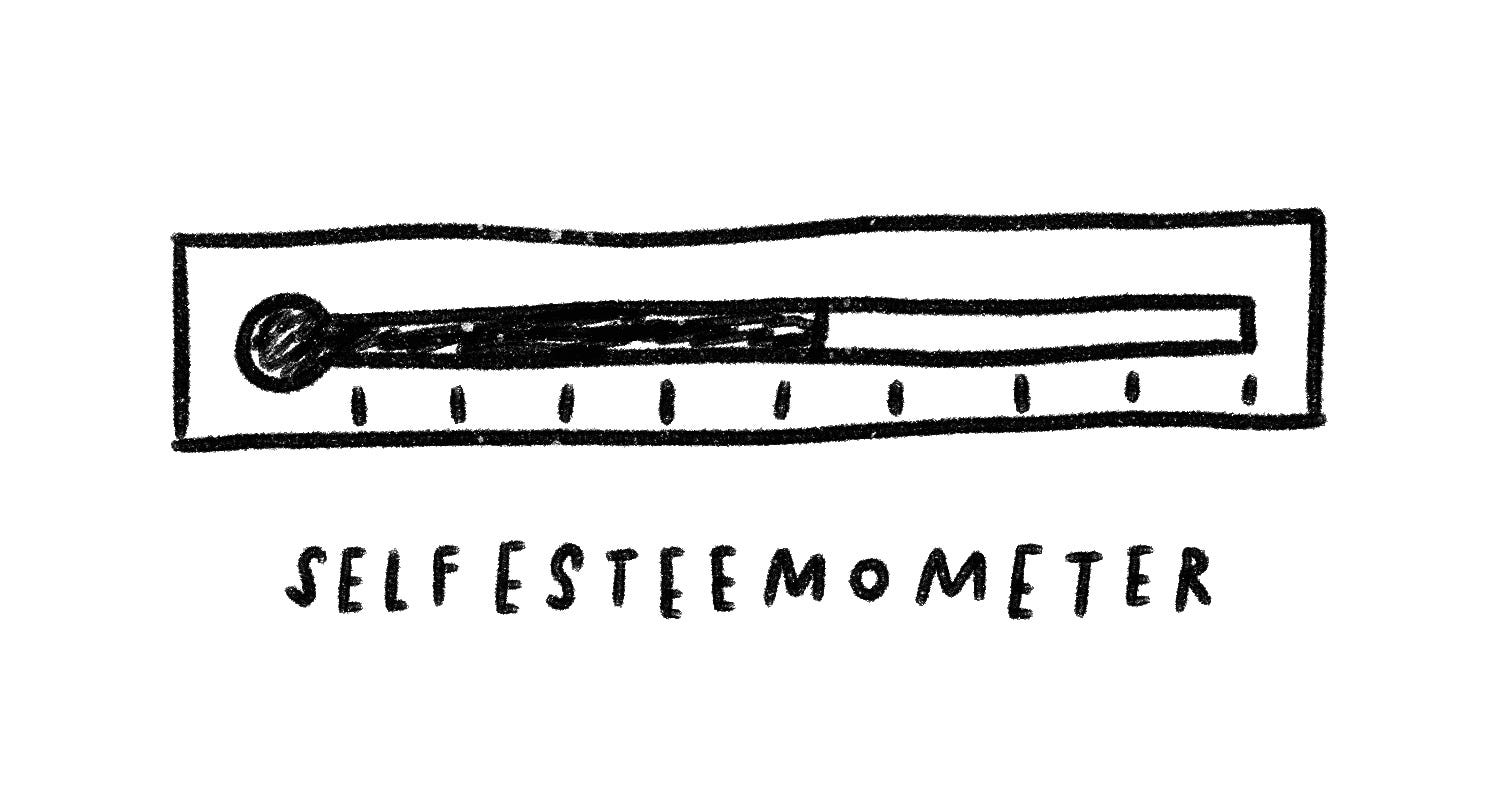
Self-esteem is an illusion

More appropriately, perhaps, it is a delusion.

If you’re like most humans, you will have questioned and doubted yourself. You might have considered that you have low self-esteem.

Self-esteem can be described as one’s confidence in their abilities. It is the image you hold of yourself with regards to your place in the world.

This can be positive or negative.

It is by no means a stable thing because as I’m sure you’ve experienced, your opinion of yourself, and the behaviours that this leads to, vary considerably depending on the context.

For example, I once considered myself to have low confidence in a group conversation setting, such as in a class. As my turn approached to introduce myself, my heart would pound maniacally, and the only thing I could think of was whether the group would catch me out — that there was something wrong with me — that I was scared. That I had low self-esteem.

But when at my desk, pen in hand, writing and doodling and sketching — ideas pouring onto paper — I felt very confident in myself.

How can either low or high self-esteem possibly define who I was?

The mere fact that our perception of ourselves can vary so dramatically, and so subtly, depending on our environment, tells us that it simply does not exist.

It is a delusion.

It is a delusion that makes us believe in one very harmful falsehood:

Our environment determines our worth.

It does not.

How can it?

What others say or think about us determine our worth.

It does not.

How can it?

I’ve spent much of my life thinking that critical words from school mates, parents and teachers decreased my self-esteem.

I always saw that other people determined my worth, and thus how good I felt in life.

That’s also how a victim thinks, and it’s a trap.

When I realised that harsh words couldn’t possibly affect my self-esteem, I returned to feeling like — and being — an owner.

Responsible and robust and in control.

 —

If there is one thing that decades of fear and over-thinking and healing and consideration have taught me, it’s this:

I am me, neither good or bad.

I am me, and I can do amazing things if I choose to.

The only thing that makes me think I lack confidence are my thoughts. That’s it. Ideas in my mind that I create.

We are only as ‘worthy’ as the thoughts we hold in our head — the lies — the stories — we entertain as truths.

Moment by moment.

You may think to yourself that you have had low self-esteem for a long time or a lifetime.

What you’re saying is that you habitually believe unpleasant thoughts about yourself.

It’s that simple.

It is the habit of engaging these thoughts that creates the illusion of personality — an illusion created by a web of repeated, unhelpful thinking.

To be free of a bad habit, replace it with a good one.

A better habit is to let go of unhelpful thoughts when they come up because you know they aren’t real.

Allow creative and encouraging insight to come up without effort, in the gaps created by the absence of painful thoughts.

It takes practice.

You are only one thought away from seeing the real truth, which is that you are you. Label-free and capable of tremendous things.

Things that do not define your worth. Things that reflect only actions repeatedly done.

Your environment does not affect your self-worth.

Circumstances have no bearing on your self-esteem.

People cannot influence your self-worth.

Because self-worth; self-esteem, does not exist.

You are you.

And the thoughts you choose to entertain.

When you can understand this; reflect deeply on it; internalise it:

You will be free.


from Red Lemon Club https://ift.tt/2NynCfh

Thursday, 17 October 2019

How to turn five dollars into a hundred, in an instant (on being 5% braver).

It’s funny how much time and energy and frustration I would have saved in my life had I been braver.

Good thing I now know that the quickest route to having an unfair advantage over the seething masses is not in doubling my output or being busier or making more things to share, though these do help.

It is to find that rarely used layer of my soul that can leap into unknowns — even if my heart is bouncing in my rib-cage.

Even a tiny percentage increase in bravery can make a lot of difference in the results I see.

Using bravery over working harder as currency is like going to the exchange and turning five-dollar bills into one hundred dollar bills. They each go further, and you can make the change instantly, and for free.

Well, not entirely free. You pay in extra handfuls of heart-beats.

I remember having a sudden hot flash after realising that I had no illustration client projects happening. No new prospects on the horizon.

Usually — after some intense pacing across my apartment — I would have turned to my big fat database of thousands of email addresses — those who had the power to determine whether I’d be paid that year or not, namely design directors, creative directors and art directors.

I’d had some prior success with these last-minute email blasts to thousands.

That is if you could define success as several hundred unsubscribes, five spam warnings, and two replies that said:

Thank you Alex. You do interesting work. I’ll definitely bear you in mind for future projects.

I thought back to that unnerving feeling that would wash over me after hitting the send to all button. Press it, and an email nuke would explode in a random spot somewhere on the Earth.

All those inboxes snapping angrily shut on my tentative army of electronic envelopes.

No more.

This wasn’t like me, anyway.

The ickiness I felt was like a flashing message that read:

Please increase bravery quotient now (you cowardly git).

Something needed to shift. There must be a better way to do this.

I was missing oomph.

And like a prod in my side, the answer floated into view.

I knew what needed to be done.

I would do like George from Seinfeld in that episode where he did the opposite of everything he usually did — and found that it worked.

Instead of not approaching that girl at the table, he’d go right up to her and tell her that he still lived with his mum.

I would do like George Costanza.

I would do the opposite of what I always did when I needed something.

I would step into uncertainty where the stakes were higher, and I could taste the edge.

With shaking knees and a pounding heart, I would go to the exchange.

I did what I would never do. I did what few other illustrators were doing.

I called a past client.

On the telephone.


With sweat clinging to my phone, after twenty minutes, I said thank you and goodbye.

The conversation went well, actually. I had forgotten to bring business into it until the last minute when I asked whether they knew of anyone looking for an illustrator.

That referral came through within two hours in the form of an inquisitive, creative director at a London agency named Steve.

Bravery had worked, and a penny dropped somewhere in the dark backrooms of my brain.

Doing the opposite of comfortable soon became more of the norm.

Though I still sometimes take the path of least resistance, it has been the bolder moves: those uncomfortable conversations — that have had the most profound impact on so much of what I do.

I thank goodness for the awkward conversations that are still to come.

—-

“A person’s success in life can usually be measured by the number of uncomfortable conversations he or she is willing to have.”

Tim Ferriss


from Red Lemon Club https://ift.tt/2MO5i02

Monday, 17 June 2019

Protected: How to Get Clients as a Freelancer Without Using Social Media

This content is password protected. To view it please enter your password below:


from Red Lemon Club http://bit.ly/2XhzdVH

Thursday, 13 September 2018

How to REALLY do what you love, and change your life doing it

Making art for a living is hard.

Hang on, you didn’t think it was supposed to be easy, did you?

‘Go and do what you love, and the money will follow!’ They say.

Follow your passion!’ They hoot.

None of these feel-good phrases gets to the truth of what is involved.

Now, don’t get me wrong, they are not wrong.

But, in their simplicity, there is a danger for some of us to set off on a creative career with misguided expectations.

When we expect something different, we more likely veer off the path. That is not a good thing for a career that requires persistence, strength of character and a healthy dose of raw determination.

Any career worth pursuing is made up of moments that we will not enjoy; moments that suck the life out of us; moments of despair.

I have wanted to quit and run away to a cabin in the hills many times. I have stewed through frustration, wondering why I didn’t just accept a real, secure job.

I have spent days immersed in a cloud of negativity, just willing things to be different.

But those are the moments for which I am most grateful.

Sounds weird, doesn’t it?

These moments are the gateways to self-realisation. They were the times I was tested.

By staying with that pain, and not being beaten by those moments, I emerged victoriously. No fibre of my being would remain the same.

Those of us who are always on the hunt for that ideal career or perfect project may find themselves moving from one exciting opportunity to the next, never quite following anything through.

I know people that are in a perpetual cycle of starting new things, being surprised and angered by initial hurdles, losing interest and hope, before aborting, feeling depressed for a while, and then moving on to something new.

With each new loss, their self-worth takes an ever-deeper knock.

Here’s a new perspective:

You don’t have to do what you love to do what you love.

You get it?

You do not have to do what you love, to do what you love.

Why?

Because doing what you love is not the single thread running through your onward journey.

It is not the only thing that determines whether you have made the ‘right’ decision.

All careers, projects and goals are tapestries. They are packages.

Those packages are made up of things you enjoy, and things that you will not enjoy.

The things that test you are the most meaningful.

That’s because challenges, when overcome, will enrich you. And when you stretch and overcome struggles, you will be rewarded, unfailingly, with the raw, natural energy that the world needs.

This is energy that will charge you creatively, but it will also motivate you to extrovert; to get your work in front of people, to inspire, and to be paid well for that offering too.

It’s THAT sense of aliveness that makes all of this worth it.

The art is really a by-product of the growth that comes out of doing what challenges you, whether it is to do the work when you don’t feel like it, or by having the courage to meet potential customers.

The most vital part of ‘doing what you love’ is not the joy, the thrill of creativity or being in flow. Of course, these are important, but they are secondary.

You must be biased to continually stretching, and continuously experiencing expansion in mind and body. 

Occasional nerves, asking for money, considered-risk-taking, and moving beyond comfort are not just options. You must see them as regular and consistent necessities for anyone who wants to make an impact.

This determination to continually stretch will elevate you to being a better, more insightful, more confident, and ultimately ingenious artist.

Picasso risked his reputation and his self-worth with every new piece he put out for the world to see. Moreover, he put out tens of thousands of pieces, when others would have slowed down, or been knocked back by criticism. His genius sprang from not only from working hard, but more importantly, from working when it was the hardest.

Your new personal strength will bleed onto the canvas, and seep into the creative work itself.

That is what people need, want, follow and for which they will pay good money. Your value stems from growth, your previous challenges and your experiences.

So do what interests you, seek challenge, and be assertive about money. All of these require that you go out and find them.

Engage with all of the above, do it with a bold force, and leave no time to overthink, stew and second-guess. 

Just move.

Then you will be doing what you love.

I talk about this in more depth in Episode 10 of ‘The Red Lemon Show’ podcast [39 mins], available on all good podcasting networks, including Anchor.fm.

“All of the information shared by Alex is just amazing. He gives it in a way that could motivate and inspire anyone.” ~Kay, iTunes podcast review


from Red Lemon Club https://ift.tt/2xd70A3