
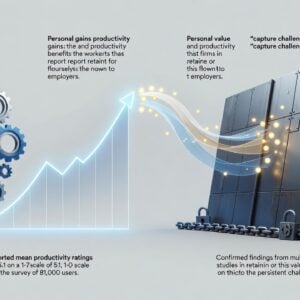
Workers using AI tools report clear productivity lifts. A large survey of Claude users puts the average self-reported gain at 5.1 on a 1-7 scale. That maps to substantially more productive. Only 3 percent saw neutral or negative effects. Yet when those same users named who captured the value, most pointed to themselves. Just 10 percent said employers or clients received more output. Anthropic Research published the findings in April 2026 from 81,000 respondents.
The pattern holds across pay levels. High-wage roles such as software development showed the strongest gains. Low-wage workers also described big jumps, often by taking on side projects or starting small ventures. Entrepreneurs stood out as the highest-gain group. Scientific and legal fields reported milder improvements. Some lawyers noted trouble with precise instructions. Early-career staff felt the benefits less often: 60 percent said they personally gained, versus 80 percent of seniors.
Scope mattered more than raw speed. Among those who described productivity effects, 48 percent cited expanded capabilities. They tackled tasks once out of reach. Forty percent pointed to faster execution of familiar work. One non-technical user became a full-stack developer. A delivery driver launched an e-commerce site. A landscaper built a music app. These are not incremental tweaks. They represent new output that did not exist before.
Many respondents kept the time saved. Freed hours went toward personal projects, relationships, or side income. A smaller share saw employers demand more volume for the same pay. The survey captured open responses from personal-account users who volunteered. That group may lean toward seeing gains as their own. Enterprise deployments could differ.
Concern about displacement rose with exposure. Anthropic’s measure of observed exposure tracks how much of a job’s tasks Claude actually handles. Higher exposure correlated with greater worry. For every 10-percentage-point increase in exposure, perceived job threat climbed 1.3 points. People in the top exposure quartile voiced the concern three times as often as the bottom quartile. Early-career workers showed elevated anxiety. Prior Anthropic data had already flagged slower hiring for recent graduates in exposed fields.
The link between speedup and fear formed a U-shape. Those who felt slowed down worried about creative fields being devalued. Beyond that baseline, fear increased steadily with reported acceleration. The people gaining the most speed expressed the highest displacement risk. One software engineer put it plainly: concern runs 24/7 in white-collar roles.
Other studies echo the individual-versus-firm gap. Gallup’s 2026 State of the Global Workplace report found 65 percent of U.S. workers in AI-using organizations saw positive personal productivity effects. Only 12 percent strongly agreed AI had transformed organizational work. An NBER survey of nearly 6,000 executives across the U.S., U.K., Germany, and Australia showed 89 percent reported no impact on labor productivity over three years. Firms still forecast future gains. Gallup and the NBER paper both highlight the disconnect.
Harvard Business Review research from February 2026 reached similar conclusions through ethnography at one U.S. tech firm. AI saved time on tasks, yet workers filled the space with additional work. Breaks shrank. Output volume rose without corresponding process changes. The result felt like intensification rather than relief. Harvard Business Review documented the pattern across interviews and observations.
Atlanta Fed analysis of nearly 750 CFOs in March 2026 found executives perceive larger productivity effects than measurable indicators such as revenue per employee support. Expectations run ahead of realized results. Atlanta Fed noted delayed output realizations as one explanation.
Workday’s January 2026 global study of 3,200 employees at large firms showed time savings often consumed by rework. Fixing AI-generated errors or verifying outputs erased part of the initial gain. Organizations that redesign roles and reinvest saved time see stronger capture. Workday identified role redesign as a differentiator.
PwC’s AI Jobs Barometer and CEO surveys point to concentration. Twenty percent of companies capture 74 percent of AI-driven value. The rest share the remainder. Top performers pursue growth and business-model reinvention, not only cost cuts. Headcount and wages grew faster at high-exposure firms in their data. PwC data from 2026 reinforces that adoption alone does not guarantee broad gains.
Recent X posts and discussions track the same tension. Workers describe personal time savings that do not translate to firm-level metrics. Executives report frustration when dashboards show no lift despite tool rollout. One thread noted 65 percent of employees claim gains while 89 percent of executives see no company-wide impact. The numbers align with survey patterns.
Resultsense’s June 2026 analysis of the Anthropic survey framed the issue for UK leaders. The productivity dividend exists. Capture mechanisms do not. Without deliberate redesign, recovered capacity leaks to individuals or evaporates into expanded scope without new revenue. Early-career erosion and self-employment exits compound over time. Resultsense urged explicit decisions on value allocation and role evolution.
Firms that treat AI as scope expansion rather than pure acceleration face different requirements. Existing job descriptions and metrics predate the capability jump. Junior staff now produce work once reserved for specialists. Processes built for narrower roles cannot absorb the surplus without adjustment. Measurement at the task level against pre-AI baselines makes the gap visible. Without it, nothing breaks and nothing prompts action.
Retention risks follow the same distribution. The heaviest users show the highest anxiety. Transparent communication about how roles evolve and how upside is shared becomes a competitive factor. Companies that ignore the pattern risk losing the very employees generating the largest individual gains.
Macro forecasts still project meaningful aggregate effects. Anthropic’s separate analysis of 100,000 real conversations estimated current models could raise U.S. labor productivity growth by 1.8 percent annually over a decade if adoption reaches scale. That figure assumes task-level efficiencies compound without organizational friction. Anthropic Research cautioned the projection excludes further model improvements and adoption rates.
The gap between individual reports and firm outcomes persists across datasets. Personal accounts, executive surveys, ethnographic studies, and labor-market linkages all point in one direction. AI changes what one person can accomplish. Turning that change into sustained business performance requires choices about measurement, process, and incentives that technology does not make automatically.
from WebProNews https://ift.tt/VknUtb2


No comments:
Post a Comment