
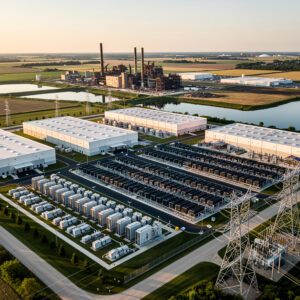
In a unanimous vote that signals redemption for one of the most notorious industrial flops in recent U.S. history, the Mount Pleasant, Wisconsin, village board on January 26 approved Microsoft’s plans for 15 new data centers on the sprawling former Foxconn site. The approval covers nearly 9 million square feet of development, with a taxable value surpassing $13 billion, poised to transform the 3,000-acre expanse once promised as a manufacturing mecca into a cornerstone of the artificial intelligence infrastructure boom.
The site, southeast of Milwaukee near Interstate 94, has languished since Foxconn’s 2017 pledge of a $10 billion factory heralded by then-President Donald Trump. That vision evaporated, leaving the village with over $250 million in debt from land acquisitions and infrastructure, and Foxconn employing just 1,000 statewide by 2023. Microsoft began acquiring parcels in 2023 and 2024, building on two existing data centers under construction and now expanding northwest across two lots on Durand Avenue and International Drive. CNBC reported the board’s swift endorsement after the village planning commission’s prior unanimous nod on January 21.
Foxconn’s Shadow Fades Amid AI Surge
Village President David DeGroot defended the project’s longevity during public comments, pushing back against a critic who called jobs temporary. “I’m addressing this to all of the union folks that are here. When I heard that these jobs are temporary from somebody, if I was you, I would take umbrage to that, because it’s my understanding that you are going to be out there on those sites for the next 10 years, doing your jobs, plying your trade, and I don’t see anything temporary in 10 years,” DeGroot said, as six supporters outnumbered three opponents. Community Development Director Samuel Schultz assured no extra water beyond the 8.4 million gallons annually allocated from Racine, fitting within existing entitlements.
Microsoft’s footprint here builds on over $7.3 billion committed to date, including a $3.3 billion first-phase AI data center announced with President Joe Biden in 2024 and a $4 billion second site revealed in September 2025 by Wisconsin native Brad Smith, Microsoft’s president. Each new building dwarfs a Walmart Supercenter at over 560,000 square feet—15 equate to 40 such stores—per village documents reviewed by the Milwaukee Journal Sentinel. Construction could span years, with final engineering plans and permits next.
Power and Water Demands Test Local Limits
The expansion requires three new substations, amplifying concerns over energy and water in a region near Lake Michigan. Microsoft’s existing campus peaks at 702,000 gallons daily or 8.4 million yearly, with first-phase estimates at 234,000 daily, drawn from Racine Water Utility under strict Department of Natural Resources rules for return to watersheds. Smith pledged in a “community-first” AI initiative: “We will minimize our water use, and we will replenish more of your water than we will use.” The company supports rate structures shielding residents from power cost hikes, partnering on solar offsets and grid modernization with MISO, as noted by Reuters.
Clean Wisconsin has sued Racine for records, citing opacity amid broader alarms that Mount Pleasant and a Vantage project nearby could demand 3.9 gigawatts—exceeding all Wisconsin homes’ usage. Yet Mount Pleasant Trustee Ram Bhatia highlighted pre-existing Foxconn infrastructure mitigating issues: “We have built the infrastructure… most of the concern that our community had were addressed at that time.” Resident Alfonso Gardner praised Smith’s roots: “They’re the third largest company… Brad has a good heart. He was born and raised here.” WISN covered the warm reception, contrasting Caledonia’s opposition that scrapped Microsoft’s northern plans.
Economic Lifeline from AI Ambitions
Tax revenue could reach tens of millions annually, with Microsoft guaranteeing $1.4 billion assessed value by 2028 in key tax districts, per Racine County Economic Development Corp. Proceeds fund $250 million debts, creek restorations, STEM via Gateway Technical College, and more. Foxconn, retaining Area I operations, released land in Areas II and III, investing over $1 billion total. Prior phases promise 800-2,300 union construction jobs lasting a decade, though operations lean automated at 500 permanent roles.
Smith credits the site’s readiness: “Foxconn wasn’t able to deliver against the vision. But… it created a foundation. And that is an indispensable part of what brought Microsoft to Wisconsin.” This aligns with hyperscalers’ global race, Microsoft’s $80 billion fiscal 2026 capex fueling Azure and OpenAI ties amid power crunches elsewhere. Mount Pleasant’s Plan Commission fast-tracked reviews, with FOX6 Milwaukee dubbing it a budding hub.
Broader Ripples in Tech Infrastructure Wars
Approvals coincide with Microsoft’s earnings eve and Maia 200 chip unveil, underscoring AI urgency despite occasional pauses—like 2025 halts in Wisconsin and beyond for demand calibration. The Racine County Eye sees Microsoft as the largest taxpayer, with union work sustaining locals. Yet environmental watchdogs decry noise, grid strain, and Great Lakes diversions echoing Foxconn’s 7 million daily gallon bid. Village mandates architectural tweaks, lighting, parking, and full utility compliance.
As Microsoft submits permits, the site evolves from “Wisconn Valley” bust to AI powerhouse, blending redemption economics with tech’s voracious needs. Officials like DeGroot eye closure of Foxconn-era districts early, repaying bonds and spurring clusters. RCEDC frames it as fulfilling 2017’s tech zone dream through billions in private capital.
from WebProNews https://ift.tt/FCQ0SKD


No comments:
Post a Comment