
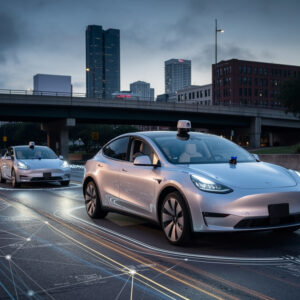
In the bustling tech hub of Austin, Texas, Tesla Inc. has quietly escalated its autonomous vehicle ambitions, deploying Model Y vehicles that navigate city streets without a human behind the wheel—or even inside the car. This development, confirmed by sightings and statements from CEO Elon Musk, marks a pivotal moment in the company’s long-promised shift toward fully driverless transportation. As of mid-December 2025, videos and eyewitness accounts show these empty robotaxis cruising public roads, a step that brings Tesla closer to commercializing its Robotaxi service amid intense scrutiny from regulators, competitors, and safety advocates.
The rollout builds on months of supervised testing that began earlier in the year. Tesla initially launched its Robotaxi program in Austin with safety monitors onboard, allowing select users to hail rides via the company’s app. But recent updates indicate a rapid progression: Musk announced on social media that unsupervised operations would commence within weeks, a timeline that appears to have been met. According to reports, the vehicles are now operating autonomously, relying solely on Tesla’s Full Self-Driving (FSD) software, which processes data from cameras, sensors, and neural networks to make real-time decisions.
This isn’t just a technical feat; it’s a strategic gambit in a competitive field dominated by players like Waymo, owned by Alphabet Inc. Tesla’s approach differs by leveraging its existing fleet of consumer vehicles rather than purpose-built pods, potentially enabling faster scaling. Yet, as the cars roam empty, questions loom about reliability, regulatory hurdles, and public trust in a technology that Musk has hyped for nearly a decade.
Accelerating Toward Autonomy
Industry observers note that Tesla’s move aligns with Musk’s pattern of aggressive timelines. In a recent post on X, formerly Twitter, Musk claimed the unsupervised phase was “pretty much solved,” with validation underway. This echoes his earlier predictions, such as a December 2025 statement forecasting driverless robotaxis in Austin by year’s end. Sources like TechCrunch report that the removal of safety monitors follows six months of testing, positioning Tesla to challenge Waymo’s established services in cities like San Francisco and Phoenix.
The technical backbone of this initiative is Tesla’s FSD version, which has undergone iterative improvements. Data from millions of miles driven by Tesla owners feeds into machine-learning models, refining the system’s ability to handle complex urban scenarios. In Austin, the robotaxis have been spotted navigating traffic, obeying signals, and avoiding obstacles without intervention, as detailed in videos shared on platforms like X. However, skeptics point to past incidents where FSD required human overrides, raising concerns about edge cases in a dynamic environment like Austin’s mix of highways, downtown congestion, and pedestrian-heavy areas.
For industry insiders, the key metric is disengagement rates—the frequency of human interventions per mile. Early X posts from users and analysts, including those tracking Tesla’s progress, suggest that while supervised rides in Austin averaged thousands of miles between interventions, the fully driverless phase introduces new risks. Tesla hasn’t publicly released detailed safety data for these unsupervised tests, but Musk’s updates imply confidence in the software’s maturity.
Regulatory and Safety Scrutiny
As Tesla pushes boundaries, federal and state regulators are watching closely. The National Highway Traffic Safety Administration (NHTSA) has investigated Tesla’s autonomous systems in the past, particularly after crashes involving FSD. In Austin, where Texas laws are relatively permissive for autonomous testing, Tesla operates under a framework that doesn’t require special permits for unoccupied vehicles, unlike California’s stricter rules. This regulatory environment has allowed Tesla to accelerate deployment, but it also amplifies calls for transparency.
Critics, including safety advocates posting on X, highlight potential flaws. One prominent thread summarized early robotaxi rides in Austin, noting issues like driving in the wrong lane and phantom braking—sudden stops without cause. These anecdotes, while not exhaustive, underscore the challenges of scaling autonomy in real-world conditions. Electrek reported Musk’s claim that the technology is nearing perfection, yet historical delays in Tesla’s autonomy promises temper optimism.
Moreover, the absence of safety drivers shifts liability squarely onto Tesla. If an incident occurs, questions about insurance, fault attribution, and emergency protocols become paramount. Industry experts compare this to Waymo’s phased approach, which maintained human oversight longer before going fully driverless. Tesla’s strategy, by contrast, bets on data-driven validation to outpace rivals, but it invites heightened oversight from bodies like the NHTSA, which has yet to comment specifically on the Austin tests.
Competitive Pressures and Market Implications
Tesla’s Austin experiment isn’t isolated; it’s part of a broader push to dominate the ride-hailing sector, projected to reach trillions in value as autonomy matures. Musk envisions a network where Tesla owners lend their cars to a shared fleet, generating revenue through app-based rides. In Austin, the service area has expanded significantly since launch, covering more ground than initial geofenced zones, as noted in updates from Drive Tesla.
Public sentiment, gleaned from X discussions, is mixed. Enthusiasts celebrate milestones like the first empty Model Y sightings, viewing them as proof of Tesla’s lead in AI-driven mobility. Detractors, including financial analysts, argue it’s more hype than substance, with one X post labeling the rollout a “stock pump” amid Tesla’s fluctuating share prices. Indeed, Tesla’s market capitalization has swung on autonomy news, with investors betting on Robotaxi as a growth engine beyond electric vehicle sales.
Economically, success in Austin could ripple outward. Local businesses might benefit from efficient transport, but taxi drivers and ride-share operators face disruption. Tesla’s model, emphasizing over-the-air updates, allows rapid iteration—contrast this with traditional automakers’ slower hardware cycles. As InsideEVs observes, the hard part begins now: proving scalability without compromising safety.
Technological Underpinnings and Challenges
At the core of Tesla’s robotaxi is its vision-only system, eschewing lidar for cost-effective cameras. This choice, controversial among engineers, relies on advanced neural nets trained on vast datasets. In Austin tests, the vehicles demonstrate capabilities like precise lane changes and intersection handling, but X users report inconsistencies in service availability, with fleet density diluting as the area expands.
Scaling presents logistical hurdles. Tesla aims for unsupervised operations across large swaths of the city by year’s end, per Musk’s timelines, but maintaining reliability in varied weather or construction zones remains unproven. Forbes described early user experiences as promising yet skeptical, noting the thrill of a driverless ride tempered by occasional hesitations.
Furthermore, ethical considerations arise: How does the system prioritize decisions in potential collisions? Tesla’s opaque development process fuels debates, with calls for third-party audits. Insiders speculate that upcoming FSD updates, mentioned in X posts, could enhance performance by enlarging model sizes, potentially making the system “several times better” as Musk claims.
Public Adoption and Future Horizons
User adoption in Austin has been gradual. Since opening to the public, the service has logged hundreds of thousands of miles, but availability issues persist, as critiqued in X analyses. Riders appreciate the novelty—summoning a car via app, entering without a driver—but concerns about emergency stops or vandalism linger. Tesla addresses this with in-app monitoring and remote oversight, though details are sparse.
Looking ahead, Austin serves as a blueprint for expansion. Musk’s vision includes nationwide fleets, but regulatory patchwork complicates this. States like California demand extensive reporting, potentially delaying rollouts. Teslarati confirmed the empty vehicle tests, signaling readiness for passenger rides soon.
Globally, Tesla’s progress influences competitors. Chinese firms like Baidu advance similar tech, while U.S. rivals invest billions. For Austin residents, the sight of empty Teslas heralds a transformative era, blending innovation with uncertainty.
Innovation Amid Uncertainty
The economic stakes are immense. Analysts project that a successful Robotaxi network could add billions to Tesla’s revenue, disrupting Uber and Lyft. Yet, X sentiment reveals investor caution, with some questioning if the Austin demo is mere marketing ahead of true scaling.
Technically, Tesla’s data advantage—billions of miles from its fleet—sets it apart. But challenges like sensor limitations in low visibility persist, as debated in industry forums. Musk’s paranoia about safety, reiterated in earnings calls, suggests internal rigor, yet external validation is key.
As Tesla navigates this path, Austin’s streets become a live lab, testing not just software but societal readiness for machines in motion.
Path to Commercial Viability
Transitioning from tests to paid services requires proving profitability. Tesla’s cost structure, without human drivers, promises margins superior to traditional taxis. In Austin, fleet growth has been modest, with X posts noting stagnation despite area expansion, attributed to validation waits.
Partnerships could accelerate adoption—imagine integrations with local transit. However, legal precedents from past autonomy incidents loom, potentially shaping case law.
Ultimately, Tesla’s Austin endeavor encapsulates the high-wire act of autonomous innovation: bold promises meeting rigorous reality, with the world watching every turn.
from WebProNews https://ift.tt/JQKMSdX


No comments:
Post a Comment