
Navee’s Skyward Surge: Revolutionizing Mobility from Streets to Seas at CES 2026
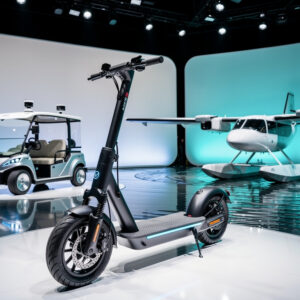
At the bustling halls of CES 2026 in Las Vegas, Chinese micromobility firm Navee made waves with an eclectic array of transportation innovations that blurred the lines between urban commuting, leisure, and aviation. The company’s showcase, unveiled amid the glow of neon lights and tech enthusiasts, featured a high-speed electric scooter, an autonomous golf cart, and—most intriguingly—a seaplane. This ambitious lineup signals Navee’s push beyond traditional e-scooters into diverse mobility realms, aiming to capture markets from city streets to open waters. Industry observers noted how Navee’s offerings reflect a broader trend in personal transport, where electrification and smart features are expanding into unexpected territories.
The star of the show was the UT5 Ultra X e-scooter, a dual-motor beast touted for its blistering performance. With twin 2,400W motors, Navee claims it can hit a top speed of 43 mph and cover up to 87 miles on a single charge, though real-world tests often halve such manufacturer estimates due to variables like rider weight and terrain. Equipped with front and rear hydraulic suspension and disc brakes, the scooter accelerates from 0 to 12 mph in under two seconds, making it a thrill-seeker’s dream. As reported by Engadget, this model stands out for its sleek design and advanced safety features, positioning it as a premium option in a crowded e-scooter market.
Complementing the UT5 Ultra X are siblings like the NT5 Ultra X, designed for rougher paths with 1,200W motors per wheel and a 40 mph top speed. These scooters incorporate app-based controls, Apple Find My integration, and IPX6 water resistance, enhancing user convenience and durability. Navee’s focus on performance isn’t just about speed; it’s about integrating smart tech to make rides safer and more intuitive. For instance, auto-sensing headlights and triple brake systems address common pain points in urban mobility, where quick stops and visibility are crucial.
Unveiling the Unexpected: Golf Carts and Beyond
Shifting gears from two-wheeled speed demons, Navee introduced an AI-powered golf cart that follows users autonomously around the course. This isn’t your grandfather’s golf buggy; it’s equipped with intelligent navigation that tracks the golfer’s movements, eliminating the need for manual pushing or driving. According to details shared in a preview by Android Headlines, the cart draws inspiration from supercar aesthetics, blending luxury with functionality. It’s part of Navee’s strategy to infiltrate leisure sectors, where electric vehicles can offer eco-friendly alternatives to gas-powered counterparts.
The golf cart’s AI capabilities include obstacle avoidance and precise path-following, powered by onboard sensors and machine learning algorithms. This innovation could transform golfing experiences, making them more accessible for those with mobility challenges or simply seeking convenience. Industry insiders speculate that such products might extend to other recreational areas, like resorts or large campuses, where automated transport reduces physical strain and enhances enjoyment.
But Navee’s CES presentation didn’t stop at land-based vehicles. The company teased a seaplane, a bold foray into aerial and aquatic mobility. Described as an electric vehicle capable of skimming over water surfaces, it evokes visions of futuristic transport blending flight and boating. While details remain sparse, the concept aligns with emerging trends in electric vertical takeoff and landing (eVTOL) crafts, though this one emphasizes water-based operations. Posts on X from tech enthusiasts highlighted excitement around similar innovations, with users buzzing about how such vehicles could revolutionize coastal commuting.
From Press Releases to Real-World Impact
Navee’s pre-CES announcements built significant hype. A press release from PR Newswire outlined the company’s debut at the event, promising solutions for various riding scenarios. This marks Navee’s evolution from a niche e-scooter maker—evident in their 2024 CES appearance where they focused on urban models—to a multifaceted mobility provider. The shift underscores a calculated expansion, leveraging China’s manufacturing prowess in electric vehicles.
Comparisons to past innovations abound. For example, X posts recalled XPeng’s flying car concepts from previous years, drawing parallels to Navee’s seaplane ambitions. One viral thread discussed the XPeng AeroHT, a dual-mode vehicle with road and air capabilities, noting over 3,000 pre-orders and planned 2026 production. Such references on social platforms indicate growing consumer interest in hybrid transport modes, where Navee’s entry could carve out a niche in water-adjacent markets.
Technical specifications of the seaplane remain under wraps, but industry speculation points to battery-powered propulsion for short-range flights over water, potentially reducing emissions in ferry-dependent regions. This aligns with global pushes for sustainable transport, as seen in initiatives like REGENT’s seaglider, which CNN covered back in 2021 as a ground-effect vehicle reaching 180 mph. Navee’s version, if realized, could compete in this space, offering all-electric alternatives for island hopping or coastal tours.
Market Dynamics and Competitive Pressures
Navee’s CES 2026 lineup arrives amid fierce competition in the electric mobility sector. Rivals like Segway and Xiaomi have long dominated e-scooters, but Navee’s high-performance models, such as the UT5 Max with its 31 mph top speed, aim to differentiate through superior specs and integration. A hands-on review from Tom’s Guide described test-riding the UT5 Ultra X as exhilarating, praising its disc brakes, dual suspension, and traction control—features that elevate it to “Rolls-Royce” status among scooters.
On the golf cart front, Navee’s AI-driven model challenges established players like Club Car, which offer electric variants but lack the autonomous following tech. Social media chatter on X emphasized the premium design, with one post from Navee’s official account teasing intelligent precision for golf courses. This could appeal to high-end resorts seeking tech-forward amenities, potentially boosting Navee’s revenue streams beyond consumer sales.
The seaplane, however, represents the riskiest bet. Aviation regulations, especially for electric and hybrid crafts, pose significant hurdles. Drawing from X discussions about REGENT’s sea trials—featuring a 65-foot wingspan and 15,000-pound test vehicle—Navee must navigate similar engineering challenges. Successful prototypes like these suggest feasibility, but scaling to commercial viability requires substantial investment and regulatory approval.
Strategic Expansion and Future Visions
Navee’s broader portfolio at CES included teases of electric wagons and dirt bikes, signaling a lifestyle-oriented approach. An X post from the company highlighted this expansion, positioning mobility as part of everyday adventures rather than mere commuting. This diversification could mitigate risks in saturated markets, allowing Navee to tap into recreational and adventure segments.
Financially, the company’s moves are backed by investments in smart tech. Their website, Navee Tech, showcases series like the ST3 for high-performance rides and GT3 for city use, emphasizing shock absorption and smooth handling. Integrating these with new products creates a cohesive ecosystem, where app connectivity unifies user experiences across devices.
Critics, however, question the seaplane’s practicality. Unlike e-scooters, which face urban adoption barriers like helmet laws and speed limits, aerial vehicles demand infrastructure for takeoffs and landings. Yet, as NotebookCheck.net detailed in their coverage, Navee’s scooter unveils demonstrate engineering chops that could extend to more complex projects.
Innovation’s Ripple Effects on Industry Trends
The buzz around Navee’s CES presence extended to live coverage, with Tom’s Guide’s CES live blog capturing real-time reactions. Enthusiasts on X shared images and videos, amplifying the hype. One post from Engadget echoed the surprise element, questioning the seaplane’s inclusion in a micromobility lineup.
This eclectic mix might inspire competitors to think beyond conventional boundaries. For instance, the auto-following golf cart could influence warehouse logistics or elderly care mobility aids. Similarly, the seaplane concept revives interest in wing-in-ground-effect vehicles, as seen in historical posts about Boeing’s Wave Glider for ocean data collection.
Looking ahead, Navee’s trajectory suggests a focus on integrated ecosystems. By 2026, with mass production ramps like those for XPeng’s flying cars, the company could lead in multi-modal transport. Challenges remain, including supply chain issues for batteries and global trade tensions affecting Chinese firms.
Sustainability and Consumer Adoption Challenges
Environmental considerations underpin Navee’s electric push. The UT5 series’ long-range batteries promote reduced fossil fuel dependence, aligning with global net-zero goals. However, recycling and sourcing ethical materials for lithium-ion cells pose ongoing concerns, as debated in tech forums.
Consumer adoption hinges on affordability and infrastructure. High-speed scooters like the UT5 Ultra X, potentially priced in the premium range, may limit accessibility. X users expressed enthusiasm but cautioned on legal speeds, with many jurisdictions capping e-scooters at 15-20 mph.
For the seaplane, adoption could flourish in archipelagic regions, offering faster alternatives to boats. Drawing from Laotian Times‘ coverage of Navee’s debut, the emphasis on diverse scenarios hints at tailored regional strategies.
Pioneering Paths in Personal Transport
Navee’s CES 2026 revelations encapsulate a moment of bold experimentation in mobility. From the adrenaline-pumping UT5 Ultra X to the leisurely golf cart and visionary seaplane, the lineup challenges norms and invites speculation on future commutes.
Industry experts see this as a pivot toward experiential transport, where vehicles enhance lifestyles rather than just facilitate movement. As one X post noted, innovations like autonomous shuttles from Keolis in past CES events paved the way for today’s smart carts.
Ultimately, Navee’s success will depend on execution—turning prototypes into reliable products. With strong CES momentum, the company is poised to influence how we navigate our world, one electric innovation at a time.
from WebProNews https://ift.tt/Su4xKOJ


No comments:
Post a Comment